
Key Points
• DIR/Floortime uses play, everyday objects, and emotional connection to support communication and social growth
• Following a child’s interests builds trust, regulation, and back-and-forth interaction
• Relationship-based play helps children develop language, emotional awareness, and confidence at their own pace
When a child struggles with communication, emotional regulation, or social engagement, even simple moments can feel overwhelming for families. A parent may notice their child avoids eye contact, repeats the same play action over and over, or becomes frustrated when someone tries to join their play. These challenges are common for children on the autism spectrum and for children with developmental delays.
Many traditional approaches focus on teaching specific skills quickly. While structure can be helpful, it may feel stressful for children who are not emotionally ready. DIR/Floortime therapy offers a different path, one rooted in play, emotional safety, and connection.
Instead of asking a child to perform on demand, DIR/Floortime meets them where they are. Through playful interactions with familiar objects like toy cars, blocks, dolls, or puzzles, children begin to communicate, engage, and grow in ways that feel natural and meaningful.
According to the American Academy of Pediatrics, play-based, relationship-focused interactions are essential for brain development, language growth, and emotional regulation in early childhood. DIR/Floortime builds on this foundation by turning everyday play into powerful learning opportunities.
Let’s explore how DIR/Floortime works and why play is such a critical tool for building communication and emotional growth.
Understanding DIR/Floortime Therapy
DIR stands for Developmental, Individual-differences, Relationship-based. This model recognizes that children learn best through emotional experiences and relationships, not through repetition alone.
The Three Core Components of DIR
Developmental
Children move through emotional and developmental stages at different speeds. Some children may still be learning how to stay calm during play, while others are ready for problem-solving and pretend play. DIR/Floortime supports each child at their current developmental level rather than rushing milestones.
Individual Differences
Every child processes the world differently. Some children are sensitive to sounds like a vacuum cleaner or blender. Others avoid certain textures, such as sticky playdough or soft fabrics. Understanding these sensory and motor differences allows caregivers and therapists to choose the right objects, activities, and pace.
Relationship-Based
Learning happens through connection. When a child feels emotionally safe and understood, they are more likely to engage, communicate, and explore. DIR/Floortime prioritizes warm, responsive relationships as the foundation for growth.
How Play Builds Communication Skills
Play is a child’s first language. Before children use words, they communicate through actions, facial expressions, gestures, and shared experiences.
During DIR/Floortime, play is not random. It is intentional, responsive, and built around the child’s interests.
For example, a child may:
• Line up toy animals repeatedly
• Spin the wheels of a toy car
• Stack and knock down blocks
• Open and close doors on a toy house
Rather than stopping these behaviors, DIR/Floortime uses them as entry points for communication.
How Play Supports Communication
Play-based interactions help children:
• Develop shared attention
• Practice turn-taking
• Express emotions safely
• Build symbolic and verbal language
Research in Child Development highlights that when adults respond to a child’s actions, sounds, and interests during play, children show stronger language growth, increased social engagement, and improved emotional regulation over time (Hirsh-Pasek et al., 2015).
Practical Play-Based Communication Strategies
DIR/Floortime encourages adults to join play rather than direct it.
Key Strategies
• Follow the child’s lead instead of introducing new toys immediately • Sit at the child’s level on the floor
• Use the same objects the child is already interested in
• Respond to actions with facial expressions, gestures, or simple words
Practical Example
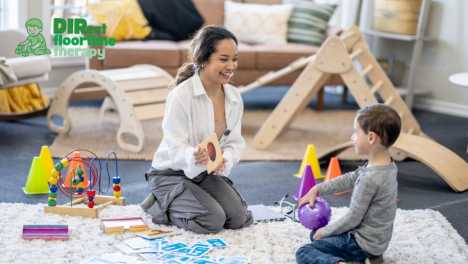
If a child spins the wheels of a toy car repeatedly, a caregiver might:
• Sit nearby with a second car
• Spin the wheels in the same way
• Pause and wait for the child to notice
• Add a simple sound like “vroom”
Over time, this interaction may grow into shared attention, eye contact, turn-taking, or verbal labeling-all without pressure.
Emotional Growth Through Relationship-Based Interaction
Emotional development and communication are deeply connected. A child who feels calm and understood is more likely to interact, learn, and express themselves.
DIR/Floortime supports emotional growth by:
• Validating feelings
• Responding to frustration with empathy
• Helping children recover from emotional stress
Common Emotional Behaviors Addressed
• Meltdowns during transitions
• Crying or dropping to the floor when frustrated
• Avoiding interaction
• Becoming rigid during play
By staying emotionally present and responsive, caregivers help children feel safe enough to engage.
Developmental Area How DIR/Floortime Supports Growth
Communication Encourages gestures, sounds, words, and shared meaning
Emotional Regulation Builds calming strategies through
connection
Social Engagement Supports eye contact, turn-taking, and shared play
Problem-Solving Promotes flexible thinking through play Confidence Reinforces effort and emotional success
Supporting Progress at Your Child’s Pace
Progress in DIR/Floortime is gradual and individualized. Children may take weeks or months to move from parallel play to interactive play, and that is okay.
Principles for Supporting Growth
• Celebrate small steps
• Avoid comparing your child to peers
• Focus on connection rather than outcomes
• Allow repetition and exploration
Hypothetical Scenario
A child who initially avoids interaction may start by tolerating an adult sitting nearby during play. Over time, the child may allow shared play, then initiate interaction, and eventually use gestures or words to communicate.
Each step builds on emotional trust.
Integrating DIR/Floortime into Daily Life
DIR principles extend beyond therapy sessions. Everyday routines offer powerful opportunities for connection.
Daily Moments for Engagement
• Mealtimes using utensils or favorite foods
• Bath time with cups and floating toys
• Getting dressed with choices of clothing
• Outdoor play with balls, swings, or bubbles
By slowing down and following the child’s lead, caregivers can create meaningful interactions throughout the day.
Measuring Progress in DIR/Floortime
Progress is measured by the quality of interaction, not how quickly a child learns a skill. Signs of Progress May Include:
• Longer periods of engagement
• Increased eye contact
• More shared enjoyment
• Emerging communication attempts
Area to Obseve Example Indicator
Engagement Child initiates play
Area to ObseveExample Indicator
Communication Uses gestures or sounds
Recovers from
Regulation
frustration more easily
Social Interest Seeks interaction
Frequently Asked Questions
1. Is DIR/Floortime appropriate for nonverbal children?
Yes. DIR/Floortime supports communication at all levels, including gestures, sounds, and symbolic play.
2. How long are DIR/Floortime sessions?
Sessions typically last 45–60 minutes, depending on the child’s needs and tolerance.
3. Can parents use DIR strategies at home?
Absolutely. Parent involvement is a core part of DIR/Floortime.
4. Does DIR/Floortime replace other therapies?
DIR/Floortime can complement other interventions by supporting emotional and relational development.
5. When should I expect results?
Progress is individualized. Consistency, patience, and emotional connection are key Helping Your Child Grow Through Connection
DIR/Floortime therapy offers a compassionate, play-based approach to communication and emotional growth. By focusing on relationships, sensory awareness, and emotional safety, children build skills that last. At DIRect Floortime, we partner with families to support meaningful development through connection, curiosity, and trust. Families in New Jersey and beyond can see how play-based, relationship-focused strategies help children grow with confidence. If you’re exploring supportive options for your child, we’re here to guide you every step of the way.