
Creating meaningful developmental progress at home does not require rigid therapy blocks, complex materials, or perfectly executed schedules. In fact, one of the core strengths of DIR/Floortime is that it fits naturally into everyday life.
For families especially busy households balancing school, work, and multiple responsibilities, the idea of adding “one more thing” can feel overwhelming. But DIR/Floortime is not about doing more. It’s about doing everyday moments differently with emotional presence, curiosity, and connection.
This guide offers a practical, flexible daily at-home DIR/Floortime routine families can adapt to their own rhythm and needs.
Key Points
- A DIR/Floortime routine focuses on connection and regulation—not rigid schedules.
- Everyday routines offer powerful opportunities for communication and engagement.
- Consistency comes from emotional presence not perfection.
Understanding What a DIR Routine Really Means
Before diving into specific times of day, it’s important to redefine what “routine” means in the context of DIR/Floortime.
A DIR routine is not:
- A strict timetable
- A checklist of therapy tasks
- A performance to get “right”
Instead, it is:
- A mindset of emotional attunement
- A commitment to following your child’s lead
- A practice of co-regulation
- A way of embedding connection into everyday interactions
When families understand this, pressure decreases. The goal is not flawless execution it’s building shared emotional experiences consistently over time.
Morning: Start With Regulation and Connection
Mornings often set the emotional tone for the entire day. For children who experience sensory sensitivities, anxiety, or regulation challenges, rushed mornings can quickly lead to stress.
A DIR-informed morning begins with one simple principle: regulation before expectation.
1. Begin With Warm Connection
Before giving instructions or making demands, try:
- A calm greeting with soft eye contact
- A warm, predictable tone of voice
- Gentle touch (if your child is comfortable with it)
- A short shared song or playful phrase
Even 2–3 minutes of attuned connection can make a significant difference.
2. Use Movement to Support Regulation
Some children wake up slow and sluggish; others wake up overstimulated. Support their individual differences by incorporating:
- Gentle stretching
- Jumping or bouncing (if they seek movement)
- Deep-pressure hugs (if regulating for them)
- Singing while getting dressed
The goal is not speed it’s helping your child feel emotionally available before demands increase.
3. Allow Extra Transition Time
Transitions are often hardest in the morning. Instead of rushing, narrate what’s happening:
- “First we brush teeth, then we put on shoes.”
- “You’re not ready to leave yet. I see that.”
Acknowledging emotions helps children feel understood. When children feel understood, cooperation often follows more naturally.
Playtime: Follow the Child’s Lead
One of the core pillars of DIR/Floortime is child-led play. At home, this doesn’t need to last hours. Even 10–15 minutes of intentional engagement can create powerful developmental opportunities.
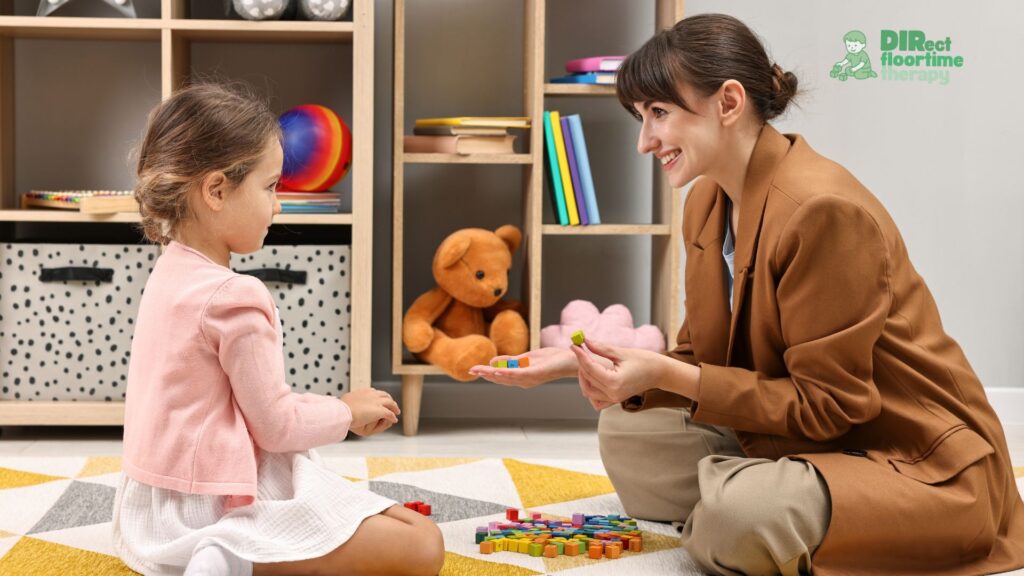
1. Sit at Your Child’s Level
Physically lowering yourself to your child’s eye level communicates availability and partnership. It reduces power struggles and increases connection.
2. Observe Before Joining
Before speaking or directing:
- Notice what captures their attention
- Observe how they play
- Watch their emotional cues
Are they lining up cars? Spinning? Pretending? Repeating dialogue?
Instead of correcting or expanding immediately, first join them in their world.
3. Join Without Taking Over
If your child is stacking blocks, stack with them.
If they are pretending to cook, accept their imaginary food.
If they repeat a phrase, repeat it back with variation and playfulness.
Child-led play builds:
- Shared attention
- Emotional engagement
- Back-and-forth communication
- Problem-solving skills
It also strengthens trust. Your child learns: “My interests matter. My parent enjoys being with me.”
That emotional safety fuels developmental growth.
Daily Routines as DIR Opportunities
One of the most powerful aspects of DIR/Floortime is that therapy thrives in real life.
Everyday activities are not interruptions to therapy, they are the therapy.
Mealtime
Mealtime offers natural opportunities for:
- Turn-taking
- Requesting
- Eye contact
- Sensory exploration
- Emotional sharing
Pause before giving what your child wants. Wait for eye contact, a gesture, a sound, or a word. Celebrate even small communication attempts.
You might say:
- “You’re looking at the juice. Do you want more?”
- “I see you’re frustrated. That’s hard.”
Emotionally relevant communication is often more meaningful than structured exercises.
Bathing
Bath time can be regulating and playful.
- Follow your child’s water play ideas
- Introduce playful surprises
- Narrate sensations (“Warm water on your arms!”)
- Encourage back-and-forth splashing or pouring
Shared joy during routine activities builds emotional resilience.
Getting Dressed
Instead of rushing compliance:
- Offer playful choices
- Turn clothing into characters
- Pause and wait for participation
These small shifts transform stressful moments into relational opportunities.
Outdoor Walks
Nature offers rich sensory and emotional experiences.
- Follow your child’s pace
- Comment on what they notice
- Share moments of wonder
Even pointing at a bird together becomes shared attention—a key developmental milestone.
Transitions: Support Before Expecting
Many children struggle most during transitions—moving from preferred to non-preferred activities.
A DIR-informed approach focuses on support before expectation.
1. Prepare Gently
Give advance notice:
- “In five minutes, we’ll clean up.”
- “After this song, it’s time to leave.”
Predictability lowers anxiety.
2. Use Playfulness
Transitions do not have to feel abrupt. Try:
- Silly voices
- Movement games (“Hop to the bathroom!”)
- Transition songs
Playfulness activates engagement instead of resistance.
3. Acknowledge Feelings
Instead of dismissing frustration:
- “You’re upset. You wanted to keep playing.”
- “It’s hard to stop something fun.”
When children feel understood, flexibility grows.
Over time, consistent emotional validation builds stronger regulation skills.
Afternoon Check-Ins: Reconnect and Reset
Afternoons can bring fatigue, sensory overload, or emotional spillover from school.
Rather than immediately diving into homework or tasks, try a short emotional check-in:
- Sit together quietly
- Offer a snack and calm presence
- Engage in brief child-led play
Even 10 minutes of reconnection can prevent escalation later.
Ask gently:
- “How was your day?”
- “Do you need quiet time or play time?”
These questions support emotional awareness and autonomy.
Evening: Co-Regulation and Reflection
As the day winds down, sensory input should gradually decrease. Evening is an ideal time for co-regulation and emotional integration.
1. Slow the Pace
Dim lights. Reduce noise. Turn off stimulating screens earlier.
Create predictability through consistent bedtime rituals.
2. Engage in Calming Shared Activities
Examples include:
- Reading together
- Gentle rocking
- Soft music
- Quiet storytelling
During these moments, connection matters more than content.
3. Reflect Briefly
For children who can engage in reflection:
- “What was your favorite part of today?”
- “What felt hard?”
Even short reflections help children integrate emotional experiences.
They also strengthen parent-child communication patterns.
The Role of Consistency
Consistency in DIR/Floortime does not mean rigid timing.
It means:
- Consistent emotional availability
- Consistent validation
- Consistent efforts to join your child’s world
- Consistent practice of co-regulation
There will be imperfect days. Busy days. Frustrating days.
What matters is returning to connection.
Over time, small daily interactions compound into meaningful developmental progress.
Benefits Beyond Developmental Skills
An at-home DIR routine supports more than communication and regulation.
Families often report:
- Reduced power struggles
- Greater emotional awareness
- Improved sibling relationships
- Increased parental confidence
- Lower household stress
Parents shift from asking, “How do I fix this behavior?” to asking, “What does my child need right now?”
That shift transforms family dynamics.
For New Jersey Families Seeking Structure Without Pressure
Many families especially those balancing school systems, therapy appointments, and community activities, feel pressure to create perfect schedules.
DIR/Floortime offers something different:
- Flexibility
- Adaptability
- Emotional attunement
Your daily routine does not need to mirror anyone else’s. It should reflect your child’s individual differences and your family’s natural rhythm.
What works for one household may not work for another and that’s okay.
Final Thought: One Connected Moment at a Time
A DIR/Floortime routine is not something to master overnight.
It is something to grow into one connected moment at a time.
When parents slow down, follow their child’s lead, and prioritize emotional connection throughout the day, development unfolds naturally.
You don’t need hours of therapy blocks.
You need presence.
You need curiosity.
You need connection.
And in those everyday moments during breakfast, playtime, transitions, and bedtime you are already creating the foundation for lifelong growth.