Key Points
- Summer introduces a unique cluster of sensory challenges for autistic children, including unexpected water temperatures, sunscreen textures, crowd noise, and the loss of the predictable school-day routine.
- Tactile, auditory, olfactory, and proprioceptive sensitivities do not take a summer vacation. For many NJ children, warm-weather activities can be significantly more dysregulating than a typical school day.
- DIR/Floortime strategies support summer regulation by prioritizing the child’s sensory profile, using graduated exposure, and building new experiences through play rather than pressure.
- With the right preparation and accommodation, summer can become one of the richest developmental seasons for autistic children and their families.
Summer in New Jersey arrives with a rush of sensory input that can catch even the most prepared NJ family off guard. The pool opens. The splash pad turns on. Beach trips to the Shore are planned. And for parents of autistic children, what should be a season of joy can quickly become a season of dread.
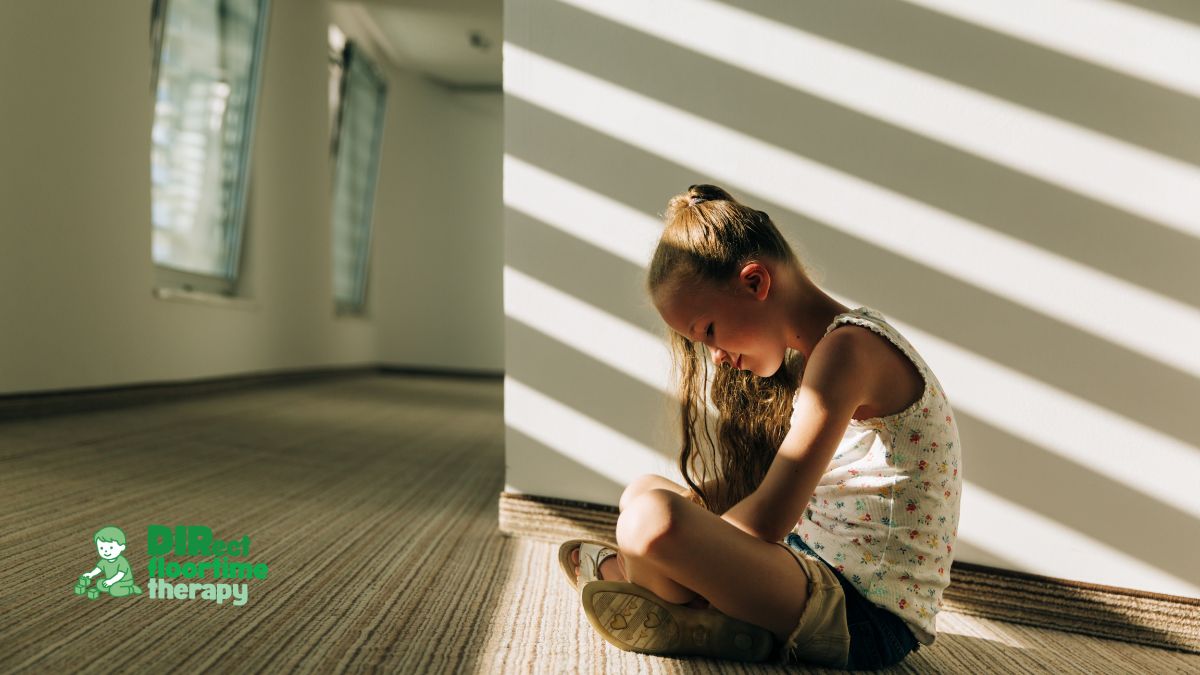
In Westfield, a father described his eight-year-old daughter’s response to their first beach trip of the year: she refused to remove her shoes within sight of the sand, pulled her shirt over her nose to block the smell of sunscreen, and covered her ears the moment a nearby group of children began shouting. “She wasn’t being difficult,” he said. “She was overwhelmed before we even reached the water.”
His daughter’s experience is not unusual. Research by Marco et al. (2011) in Pediatric Research found that between 69 and 93 percent of autistic children experience some form of sensory processing difference. In summer, the environment conspires to hit nearly every sensory channel at once: tactile input from sand, water, and sunscreen; auditory input from crowds and splashing; olfactory input from chlorine and food; proprioceptive disruption from uneven terrain and unexpected movement. For a child whose nervous system is already working overtime to process daily life, summer can feel less like a holiday and more like a sustained emergency.
But it does not have to. With the right understanding of your child’s sensory profile and a DIR/Floortime approach to building new experiences gradually and playfully, summer can become one of the most developmentally rich seasons your family shares.
Understanding the Summer Sensory Storm
Before we can adapt summer activities, we need to understand exactly which sensory channels are being challenged and why.
The Tactile Layer: Sunscreen, Sand, and Wet Clothing
Tactile processing differences are among the most common sensory experiences in autism. Research by Cascio et al. (2008) in the journal Neuropsychologia confirmed that autistic individuals show significantly different responses to light touch and texture compared to neurotypical peers. For many children, the feel of sunscreen being applied, especially if it is cold from the tube, thick in texture, or applied with unexpected pressure, can trigger a full defensive response before the family has even left the driveway.
Sand presents a different but equally significant challenge. The unpredictability of its texture, the way it sticks to skin and enters shoes, and its tendency to create a full-body tactile experience that is impossible to escape, makes it one of the most commonly avoided surfaces for tactile-sensitive children. Wet clothing, which clings to the body and changes in texture and weight as it dries, adds another layer of discomfort that most neurotypical people barely notice.
The Auditory Layer: Crowds, Splashing, and Outdoor Amplification
Outdoor summer environments are acoustically unpredictable in ways that indoor spaces rarely are. At a community pool in Cherry Hill or a beach in Cape May, sound bounces off water and hard surfaces, crowds generate a constant background roar, and individual sounds, a child screaming in delight, a lifeguard whistle, a passing speedboat, arrive without warning. A study by Stiegler and Davis (2010) in the American Journal of Speech-Language Pathology highlighted that unpredictable auditory environments are among the most challenging sensory contexts for autistic children, precisely because the brain cannot habituate to stimuli that keep changing.
The Olfactory Layer: Chlorine, Sunscreen, and Food
Summer gatherings concentrate smells in a way that few other environments do. Chlorine from pools, the heavy fragrance of sunscreen, grilling food, sweat, and the particular smell of hot pavement create an olfactory landscape that can be genuinely nauseating for children with hyper-osmia. Research by Tavassoli and Baron-Cohen (2012) in the Journal of Autism and Developmental Disorders confirmed that olfactory sensitivity is a frequently underestimated component of the autistic sensory profile, and that strong smells can disrupt behavior and regulation even in children who do not verbally report discomfort.
The Routine Layer: Summer and the Loss of Predictability
Beyond the sensory environment itself, summer brings a structural challenge that is equally significant: the end of the school-year routine. Research by Donaldson et al. (2016) in the journal Research in Autism Spectrum Disorders found that autistic children’s anxiety levels increase significantly during school transitions and unstructured holiday periods. The school day, for all its sensory challenges, provides predictability, a known sequence of events, familiar people, and clear expectations. Summer removes all of that scaffolding at once.
The DIR/Floortime Approach to Summer
In the DIR/Floortime model developed by Dr. Stanley Greenspan and Dr. Serena Wieder, we approach new or challenging environments the same way we approach all developmental work: by starting where the child is, not where we want them to be. Summer activities are not exceptions to this principle. They are opportunities to apply it.
Graduated Exposure: Starting Small and Building Up
The most powerful tool for building a child’s tolerance for summer activities is graduated exposure, the process of introducing a challenging stimulus in small, manageable doses while maintaining the child’s regulatory window. Research by Koegel et al. (2012) in the Journal of Autism and Developmental Disorders confirmed that graduated, child-led exposure to challenging environments produces significantly better outcomes than full immersion, and that maintaining the child’s emotional regulation throughout the process is the key variable in success.
Applied to summer in NJ, this might look like:
- Week one at the pool: Visit the pool when it is quiet. Sit at the edge with feet in the water. Leave before anyone else arrives. The goal is a positive sensory memory of the space, not swimming.
- Week two: Enter the shallow end with a parent. Stay for ten minutes. Focus entirely on what the child enjoys, whether that is the sensation of water on their hands, the visual pattern of ripples, or splashing in place.
- Week three and beyond: Gradually increase time, noise level, and peer presence based on the child’s regulatory responses, never based on a predetermined timeline.
Sunscreen: The Battle You Can Win
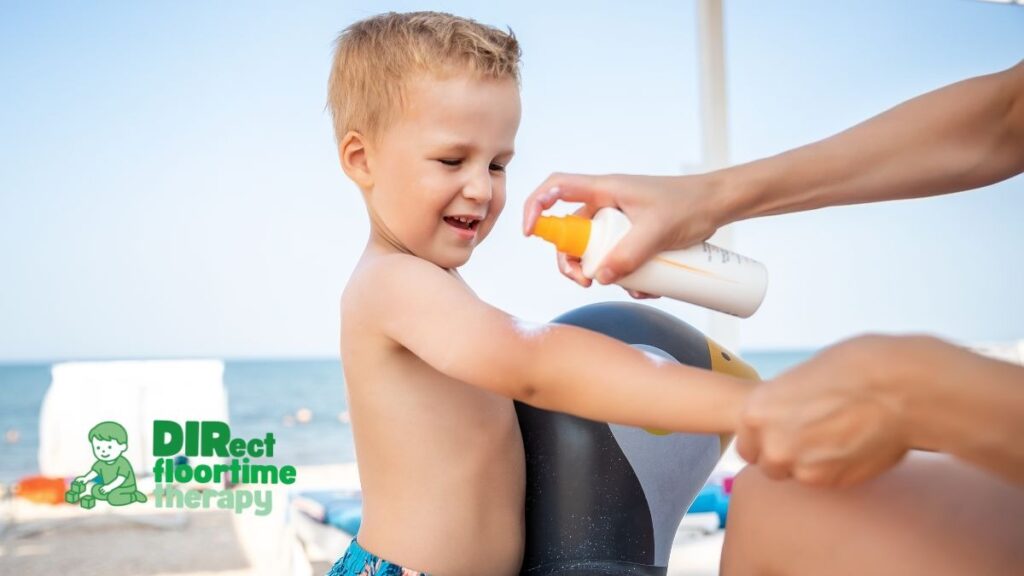
Sunscreen application is one of the most consistently reported summer flashpoints for NJ families, and it is also one of the most solvable with the right approach.
- Temperature matters. Warm the sunscreen in your hands before applying it. Cold lotion on warm skin is a significant tactile shock.
- Pressure over light touch. Many tactile-sensitive children tolerate firm, predictable pressure far better than light, unpredictable strokes. Apply sunscreen with confident, even pressure rather than a light, spreading motion.
- Let the child apply it to themselves first. Giving the child control over the application, starting with their own arms before moving to harder-to-reach areas, increases predictability and reduces the defensive response.
- Try sunscreen sticks or spray. Different formulations have different textures. A solid stick may be far more tolerable than a lotion. Spray applied to clothing rather than skin is another option for highly sensitive children.
- Build a sunscreen routine. Do the same routine, in the same order, at the same time each day. Predictability is regulation. Within two weeks, many children show significantly reduced resistance.
Water Play: Following the Child’s Lead
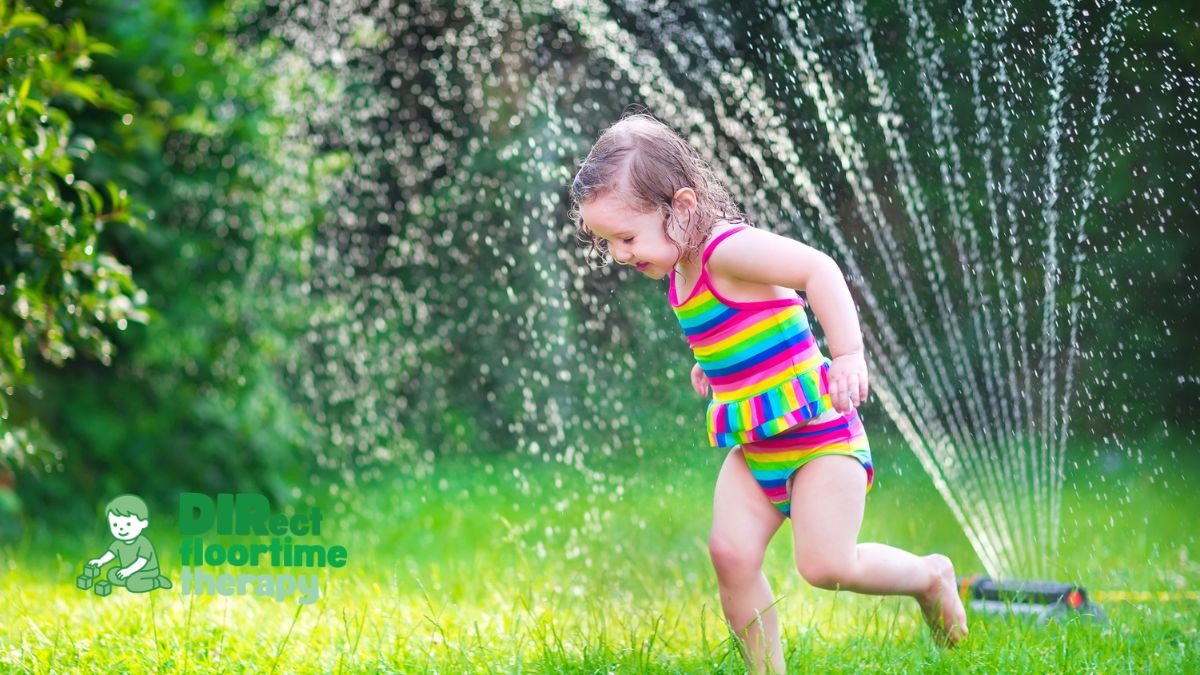
Not every autistic child dislikes water. Many are deeply drawn to it. The key is respecting the child’s specific profile rather than assuming.
- For water-avoidant children: Start with dry water play, kinetic sand, dried rice, or fine gravel, before introducing moisture. A shallow tray with a small amount of water gives the child control over how much contact they make.
- For water-seeking children: Channel the sensory seeking into structured water play that also builds communication. A water table that requires a parent’s help to fill, or a squirt gun that only works when both people participate, creates natural opportunities for joint attention and shared joy.
- Transition warnings. Moving from wet to dry is one of the most dysregulating transitions of a summer day. Give a clear, consistent warning before any water play ends: “Two more minutes, then we will dry off.” Use a visual timer if your child benefits from one.
Building a Sensory-Smart Summer Routine for NJ Families
Structure is not the enemy of summer fun. For autistic children, it is the foundation that makes fun possible.
- Create a visual summer schedule. A simple picture schedule showing the sequence of the day, from breakfast to outdoor time to lunch to quiet time, gives your child the predictability that the school calendar usually provides.
- Designate a “recharge” space. Whether you are at home in Montclair or visiting a family member in Voorhees, identify a quiet, cool, low-stimulation space where your child can go when their sensory cup is getting full. This is not a punishment space. It is a regulatory resource.
- Pack a sensory bag for every outing. Include noise-canceling headphones, a preferred fidget, a change of dry clothing, a sensory-safe sunscreen, and a familiar snack. Familiar items in an unfamiliar environment provide an anchor.
- Time outdoor activities strategically. Early morning and late afternoon are typically less crowded, cooler, and quieter than midday. If crowd noise is a significant trigger, timing is one of the most powerful accommodations you have.
- Maintain the morning routine. Even on unscheduled summer days, keeping the wake time, breakfast, and morning routine consistent significantly reduces the ambient anxiety that comes from structural unpredictability.
FAQs
My child loves water but hates getting out of the pool. How do I handle transitions?
Water-exit meltdowns are one of the most common summer challenges we hear about. The key is consistency and advance warning. Use a visual timer for the last five minutes, give a verbal countdown at two minutes, and follow the exit with an immediate sensory reward, a favorite towel, a preferred snack, or a brief quiet time in the car. Over time, the predictability of the post-pool routine makes the transition itself less distressing.
Are there sensory-friendly pools or beaches in New Jersey?
Yes. Many NJ community pools offer early morning lap-swim hours that are significantly quieter than peak times. Several Shore communities have designated quiet beach areas with reduced vendor noise and foot traffic. The Autism Society of New Jersey also maintains a directory of sensory-friendly summer programs and events across the state.
My child refuses to wear a swimsuit. What should I do?
This is primarily a tactile issue. Try swimwear made from softer, less structured fabrics. Many families find that rash guards, which provide more coverage and a more consistent pressure sensation than a traditional swimsuit, are better tolerated. Letting the child wear a comfortable T-shirt and shorts over their swimsuit during the walk to the water can also help, as it delays full exposure to the swimsuit sensation until the child is already engaged in the activity they enjoy.
How do I explain my child’s sensory needs to other parents at the pool?
Keep it simple and confident. “He processes sensory input differently, so we do things at his pace” is a complete and accurate explanation that most parents in NJ will receive graciously. You do not owe anyone a detailed medical explanation. A brief, matter-of-fact statement normalizes your child’s experience without inviting debate.
A Summer That Belongs to Your Child
Summer is not one-size-fits-all, even for neurotypical families. For autistic children and their parents in New Jersey, the most successful summer is not the one that looks most like everyone else’s. It is the one that fits your child’s nervous system, builds on their genuine interests, and creates memories rooted in safety, joy, and connection.
DIR/Floortime reminds us that every developmental milestone, including the ability to tolerate sunscreen, wade into a pool, or eat lunch at a crowded picnic table, grows out of a foundation of relationship and trust. Research by Pajareya and Nopmaneejumruslers (2011) in Autism: The International Journal of Research and Practice consistently shows that when children feel emotionally safe and relationally connected, their capacity to engage with challenging environments expands. Build the relationship first. Summer will follow.
Contact Direct Floortime today to learn how our parent coaching program can help your family build a summer that is sensory-safe, joyful, and full of genuine connection.