
Key Points
- The research on screen time and autism is more nuanced than most parenting advice suggests. Screens are not uniformly harmful, and eliminating them entirely is neither realistic nor always developmentally appropriate.
- The type, context, and co-engagement of screen time matters far more than the number of minutes. Passive, solo, fast-paced content is significantly more disruptive to development than interactive, co-viewed, or educationally structured content.
- For many autistic children, screens serve a genuine regulatory and motivational function. The DIR/Floortime approach does not demonize this function. It uses it as a bridge to broader engagement and communication.
- Limit-setting around screens does not require punishment or battles. It requires predictability, co-regulation, and a relationship strong enough to hold a limit with warmth.
It is a scene that plays out in kitchens across Bergen County, Mercer County, and virtually every other corner of New Jersey: the iPad is handed over to stop the meltdown. The meltdown stops. Relief floods the room. And then comes the guilt.
Most NJ parents of autistic children carry a complicated relationship with screens. They know the iPad works. It regulates, occupies, and soothes in ways that nothing else quite matches. And they have heard, from pediatricians, from relatives, from social media, that it is damaging their child’s development. So they feel guilty using it and overwhelmed trying to limit it, and the cycle continues without resolution.
This article exists to replace that guilt cycle with evidence. Because the research on screen time and autism is significantly more nuanced than the headline-level advice most parents receive, and understanding it changes the entire frame.
What the Research Actually Shows
The General Screen Time Guidelines Were Not Designed for Autistic Children
The American Academy of Pediatrics guidelines recommending limited screen time for children were developed primarily based on research in neurotypical populations. A commentary by Orsmond and Kuo (2011) in the Journal of Autism and Developmental Disorders noted explicitly that the evidence base for screen time recommendations in autistic children is substantially different from the general pediatric literature, and that blanket application of neurotypical guidelines to autistic children is not clinically appropriate. Autistic children interact with screens differently, use them for different purposes, and are affected by them differently. The guidelines need to be applied with that context in mind.
Screens as Regulation and Motivation
For many autistic children, screens provide something that the social and sensory world often does not: predictability, consistency, and a controllable level of stimulation. Research by Mazurek and Wenstrup (2013) in the Journal of Autism and Developmental Disorders found that autistic children spent significantly more time with screens than neurotypical peers, but critically, this relationship was mediated by social motivation differences rather than addictive patterns. In other words, many autistic children prefer screens not because they are addicted to them but because screens offer a form of engagement that is less socially unpredictable and less sensorially overwhelming than human interaction. This is an important clinical distinction.
Understanding this reframes the question from ‘how do I get my child away from the screen?’ to ‘what need is the screen meeting, and how can I meet that need through relationship as well?’
When Screens Are Genuinely Harmful
The research does identify specific screen-related patterns that are associated with poorer developmental outcomes in autistic children. A systematic review by Beyens et al. (2018) in JAMA Pediatrics found that fast-paced content, particularly content with rapid scene changes and high audiovisual stimulation, was associated with reduced attention, increased hyperactivity, and sleep disruption in young children. For autistic children, whose sensory and attentional systems are already working under significant load, this type of content is disproportionately disruptive.
The research also consistently identifies solo, passive screen use as more developmentally limiting than co-viewed or interactive content. A child watching fast-paced videos alone for three hours is having a fundamentally different developmental experience from a child spending thirty minutes watching a preferred show with a parent who is commenting, asking questions, and using the content as a springboard for shared communication.
When Screens Can Support Development
Several studies have found genuinely positive applications of screen-based technology for autistic children. Research by Hourcade et al. (2012) in Computers and Education found that touchscreen tablets significantly increased social interaction and communication behaviors in autistic preschoolers when used in structured, supported contexts. A review by Grynszpan et al. (2014) in the Journal of Autism and Developmental Disorders found that computer-based interventions targeting social skills, communication, and emotion recognition produced measurable improvements in autistic children across multiple studies. The screen is not the problem. The way it is used is the variable that matters.

The DIR/Floortime Lens on Screen Time
In the DIR/Floortime model developed by Dr. Stanley Greenspan and Dr. Serena Wieder, the question is never simply ‘is this activity good or bad?’ The question is always: ‘Is this activity building circles of communication, expanding the child’s emotional and social world, and supporting their individual developmental profile?’
Applied to screen time, this framework produces a different set of questions from those most NJ parents are asking:
- Is the child using the screen alone, or is there an opportunity for shared engagement?
- Is the screen content predictable and calming, or fast-paced and overstimulating?
- Can the child’s screen interest be used as a bridge to communication, joint attention, or shared play?
- Is screen time displacing relationship-based interaction, or supplementing a day that is already rich in human connection?
Using the Screen as a Bridge, Not a Barrier
One of the most powerful Floortime strategies for screen-engaged autistic children is to enter their screen world rather than fighting it. This approach transforms the screen from a replacement for relationship into a context for relationship.
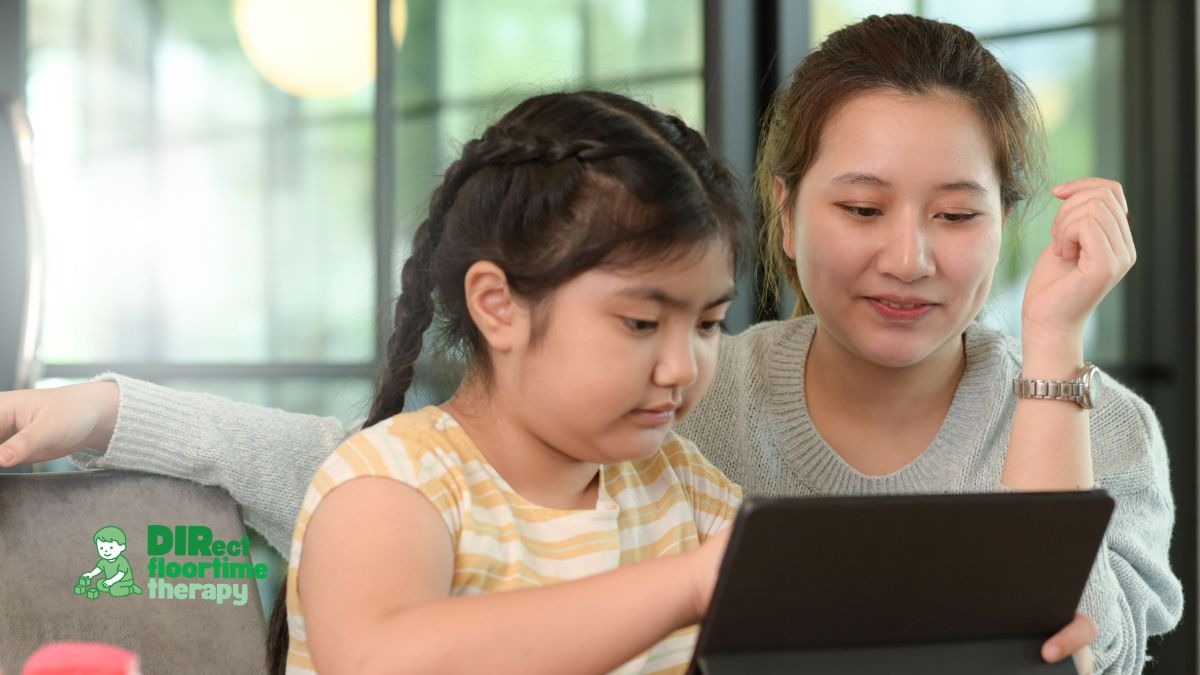
- Sit beside, not behind. When your child is watching a preferred show or playing a game, sit beside them. Comment on what is happening. ‘Oh, that car is going really fast!’ You are not interrupting. You are joining. This is the first step toward a circle of communication that began in the screen world.
- Follow the child’s lead into their content. If your child is absorbed in a particular character, show, or game, learn about it. Become a participant in their interest. Ask questions. Express genuine curiosity. ‘What does that character do? Can you show me?’ This is Floortime applied to the digital world.
- Use screen content as a launching pad. A child who is deeply engaged with a show about trains can be invited to build a train track together after the show. A child fascinated by a cooking game can be invited to stir the batter for dinner. The screen interest becomes the bridge to embodied, shared activity.
- Create communication temptations around screen access. Rather than simply handing over the device, create small moments of communication around screen use. Hold the device near your face so the child looks toward you to request it. Wait for a word, a sign, or a gesture before turning it on. These are not punishing delays. They are communication opportunities embedded in a highly motivating context.
Setting Screen Time Limits the DIR/Floortime Way
Limits around screen time are appropriate and important. But the way those limits are set and enforced determines whether they build regulation or create battles.
Predictability Is the Foundation of Limit Acceptance
The most common reason screen time limits fail in NJ households is not that children cannot accept limits. It is that the limits are inconsistently applied. When a child cannot predict when screen time will end, every moment of screen use is shadowed by anxiety about losing it, which paradoxically increases the child’s grip on the device. Research on predictability and anxiety regulation in autism by Pellicano and Burr (2012) in Trends in Cognitive Sciences confirmed that reducing unpredictability in the environment is one of the most powerful anxiety-reduction tools available for autistic children. Consistent, predictable screen time rules, the same start time, the same duration, the same ending ritual, reduce the anxiety that drives the grip.
The Ending Ritual Matters as Much as the Limit
How screen time ends is as important as when it ends. An abrupt removal of the device from a child who is mid-engagement is a sensory and emotional disruption that virtually guarantees a negative response. A predictable, graduated, sensory-respectful ending ritual significantly reduces the intensity of transitions.
- Use a visual timer for the last ten minutes. The Time Timer or a sand timer gives the child a concrete, visual representation of the approaching end. This replaces the shock of sudden removal with a gradual, visible count-down.
- Give a two-minute verbal warning. ‘Two more minutes, then we are going to turn off the iPad and build the Lego set.’ Pair the ending with the announcement of what comes next.
- Create a consistent device parking spot. A specific, designated location where the device lives when not in use, a charging dock, a specific shelf, reduces the negotiation over where it goes and makes the transition feel complete rather than provisional.
- Follow the screen with a sensory bridge activity. Immediately after screen time ends, offer a brief proprioceptive or sensory activity, a quick jump on the trampoline, a short walk, a squeeze with a weighted blanket, that helps the nervous system transition out of the high-stimulation screen state.
When a Child Cannot Stop at All
For some NJ families, the challenge is not reducing screen time gradually. It is that any attempt to limit screens produces an immediate, extreme response. This pattern, sometimes described as ‘problematic media use,’ is more common in autistic children than in neurotypical peers. Research by Mazurek and Engelhardt (2013) in the Journal of Autism and Developmental Disorders found that problematic video game use in autistic children was associated with greater inattention, poorer friendship quality, and higher levels of autistic traits, but also that these relationships were mediated by the social and regulatory functions the games were serving. If screens are functioning as your child’s primary coping mechanism, the solution is not to remove the coping mechanism. It is to gradually build alternative coping resources while simultaneously making screen use more structured and co-engaged.
Practical Screen Time Guidelines for NJ Families
- Prioritize content quality over time limits. Slow-paced, age-appropriate, educational, or narrative content is significantly less disruptive than fast-paced, highly stimulating content. Start by improving the quality of screen use before focusing on the quantity.
- Co-view whenever possible. Even ten minutes of sitting beside your child during screen time, commenting and connecting, transforms a passive, solo activity into a social-communicative experience.
- Protect the hour before bed. Screen use in the hour before bedtime is one of the most well-supported sleep disruptors in the research literature. A study by Mazurek and Petroski (2015) in Sleep Medicine found that screen use before bed was associated with significantly poorer sleep quality in autistic children, and that poor sleep in turn worsened behavioral and sensory regulation the following day. The pre-sleep hour is worth protecting firmly.
- Keep mealtimes screen-free. Shared mealtimes are one of the most natural contexts for the back-and-forth communication that DIR/Floortime targets. Protecting them from screens preserves one of the richest daily opportunities for relationship-based development.
- Use screens purposefully for AAC. If your child uses an AAC app or communication device, screen time that supports communication is categorically different from entertainment screen time. Do not lump them together in a blanket limit.
FAQs
My child only talks about their favorite show. Is that a problem?
A preferred screen topic that becomes a child’s primary communication subject is actually a significant opportunity. The child is motivated to talk about something. That motivation is the fuel for language development. Follow their lead into that topic. Ask questions. Build on it. Extend it into play. The content of what a child wants to talk about matters far less than the fact that they want to talk.
Should I be worried if my child prefers screens to people?
This preference is worth understanding rather than simply worrying about. Screens offer predictability, controllability, and a lower sensory demand than most human interactions. If your child consistently prefers screens to people, it is worth exploring what specific aspects of human interaction feel overwhelming, and working with a DIR/Floortime therapist to gradually build the safety and appeal of human connection. The goal is not to make your child choose people over screens. It is to make relationship feel as rewarding as the screen world.
How much screen time is appropriate for an autistic child?
There is no universal answer. The American Academy of Pediatrics recommends no more than one hour per day of high-quality programming for children aged two to five, and consistent limits for older children, but explicitly notes that these guidelines require individualization for children with developmental differences. Work with your child’s occupational therapist and DIR/Floortime provider to identify a screen time framework that fits your child’s specific regulatory and developmental profile.
My child uses an iPad for AAC. Does that count as screen time?
No. Functional communication device use is not entertainment screen time and should not be counted against any screen time limit. Restricting AAC device access as part of a screen time limit would be equivalent to restricting a child’s ability to speak. AAC use should be unlimited and unrestricted.
What if my child is using YouTube videos to learn things? Is that okay?
Self-directed learning through video content is a genuine strength that many autistic children demonstrate. If your child is watching content that they are actively processing, building knowledge from, or using as a springboard for conversation and questions, this is qualitatively different from passive entertainment consumption. Monitor the content for age-appropriateness and be present enough to engage with what they are learning.
The Screen Is Not the Enemy
The families we work with across New Jersey who have the most success with screen time are not the ones who eliminated screens. They are the ones who learned to use screens as a bridge rather than a barrier, who entered their child’s digital world with curiosity rather than competition, and who built enough predictable structure around screen use that their child no longer needed to fight for it.
DIR/Floortime does not ask you to take away your child’s greatest source of comfort and joy without offering something in its place. It asks you to join your child in that world, to use their passion as a doorway, and to gradually expand the circle of what brings them the same sense of engagement, predictability, and delight. Research by Pajareya and Nopmaneejumruslers (2011) in Autism: The International Journal of Research and Practice confirms that when children feel genuinely met and understood in their interests, their openness to human interaction expands. The screen becomes less necessary when the relationship becomes more rewarding.
Contact Direct Floortime today to learn how our parent coaching program can help your family develop a screen time approach that works with your child’s developmental profile rather than against it.