
Key Points
- Speech and pragmatic language are distinct cognitive and neurological capacities. Speech refers to the physical production of words and sentences. Pragmatic language, also called social language, refers to the ability to use language appropriately in social contexts, including knowing when to speak, how to take turns, how to adjust language for different audiences, and how to interpret nonliteral meaning.
- Many autistic children develop strong or even advanced speech while experiencing significant pragmatic language difficulties. The presence of fluent speech does not predict pragmatic competence, and assuming it does is one of the most common reasons autistic children are denied support they need.
- A 2024 study in Frontiers in Psychology, drawing on two decades of research into pragmatic language in autism, confirmed that pragmatic impairment is one of the most consistent and most clinically significant features of autism spectrum disorder, present across verbal ability levels.
- DIR/Floortime specifically targets the social-communicative foundations, including joint attention, emotional reciprocity, and shared problem-solving, that underpin pragmatic language development. It addresses the why of communication, not just the how.
In a third-grade classroom in Cherry Hill, New Jersey, a nine-year-old surprises every substitute teacher who enters the room. He uses words like ‘catastrophic’ and ‘trajectory’ correctly in sentences. He can recite the names of every United States president in chronological order. His reading level is two years above grade.
And every single recess, he stands alone at the edge of the playground, watching the other children play, not because he does not want to join them but because he genuinely does not know how to enter the group. He does not know when to speak and when to listen. He does not know that when his classmates groan about a homework assignment, they are not asking for a factual explanation of the assignment. He does not know that ‘Want to play?’ is an invitation that requires a quick, warm response rather than a detailed explanation of which games he prefers and which he finds pointless.
This child is not failing to communicate. He is communicating within the limits of his current pragmatic language capacity. Speech and pragmatic language are not the same skill, and in autism, they can diverge dramatically. A 2024 bibliometric review published in Frontiers in Psychology by Liu et al., examining two decades of research into pragmatic language in autism, confirmed that difficulties in the social use of language are among the most clinically consistent features of autism spectrum disorder, present across the verbal ability spectrum, from minimally verbal children to children and adults who speak fluently and at length.
What Pragmatic Language Is and Why It Matters
The Three Dimensions of Pragmatic Language
Pragmatics is the branch of linguistics that studies how context shapes the use and interpretation of language. In clinical practice, pragmatic language ability refers to three broad dimensions:
- Using language. Using language for a range of communicative purposes, including greeting, informing, demanding, promising, and requesting. Many autistic children develop some of these uses fluently while others remain underdeveloped.
- Changing language. Adapting language to the social context, including the listener’s needs, the setting, and the relationship. This includes adjusting vocabulary and tone for different audiences, providing background information to an uninformed listener, and repairing a communication breakdown when it occurs.
- Following rules of conversation. Observing the conversational rules that regulate social exchange, including taking turns, staying on topic, interpreting nonliteral language such as jokes and sarcasm, understanding facial expressions and body language, and reading the social cues that signal when to speak, when to stop, and when the other person is not following.
A 2025 study published in Autism by researchers including Martin, Lee, Bicknell, Goodkind, Maltman, and Losh conducted a longitudinal investigation of pragmatic language across contexts in autism and related neurodevelopmental conditions. The study, published in Frontiers in Neurology in 2023, found that pragmatic language difficulties in autism were persistent across time and were not well predicted by general language ability or vocabulary scores, confirming that speech fluency is not a reliable indicator of pragmatic competence.
Why Autistic Children Can Have Strong Speech and Weak Pragmatics
The neurological systems that support speech production, including the phonological and syntactic systems that allow a child to produce grammatically correct sentences with accurate pronunciation, are partially distinct from the systems that support pragmatic language use. The social understanding, theory of mind, joint attention, and emotional attunement that underpin pragmatic language draw on different neural networks from those involved in speech production. One system can be strong while the other is significantly different, which is exactly what many autistic children demonstrate.
This is why a child who speaks in paragraphs can simultaneously be unable to tell that a friend’s one-word reply means the conversation should stop, or why a child who can write beautifully structured essays cannot navigate the unstructured back-and-forth of a lunch table conversation. The paragraph and the conversation require different neurological resources.
What Pragmatic Language Difficulties Look Like in NJ Daily Life
At School
- Talking at rather than with. The child delivers long monologues about a topic of personal interest without noticing that the listener has become disengaged. The information is accurate and detailed, but the child does not track the social dimension of the exchange.
- Missing the teacher’s implied messages. When a teacher says, ‘I wonder if everyone has finished that problem?’ the intended message is ‘Hurry up and finish.’ Many autistic children process the literal content of this sentence and do not recognise the implied directive.
- Struggling with group work. Group work requires continuous pragmatic negotiation: taking turns speaking, building on others’ ideas, recognising when someone is disagreeing politely, and managing the social dynamics of shared decision-making. These demands are significant for autistic children with pragmatic language differences.
- Difficulty with humour and sarcasm. Jokes, sarcasm, and figurative language rely on the listener recognising that the speaker does not mean what they literally said. Processing nonliteral language requires theory of mind, the understanding that another person has a different mental state from one’s own, which is one of the dimensions of social cognition that many autistic children develop differently.
At Home
- Long information dumps instead of conversational exchanges. The child provides extensive factual information about their interests without noticing that the parent’s responses indicate limited engagement.
- Difficulty asking for help in socially appropriate ways. A child who needs help may stand silently beside a parent, or abruptly demand assistance, rather than using the social preamble that typically precedes a request.
- Difficulty with repair. When a conversational breakdown occurs, the child may not know how to repair it. They may repeat the same utterance louder rather than rephrasing, or they may withdraw from the exchange entirely.

The DIR/Floortime Approach to Pragmatic Language
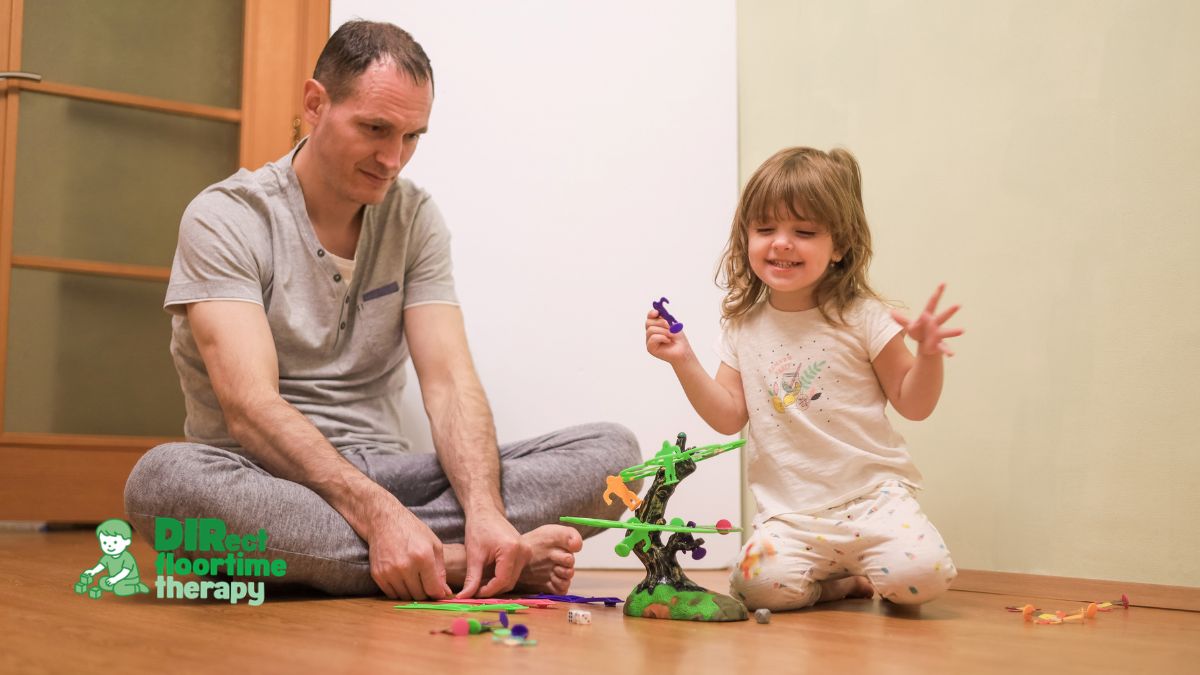
In the Developmental, Individual-difference, Relationship-based (DIR)/Floortime model, pragmatic language is not taught as a discrete skill set. It emerges as a byproduct of the genuine communicative connection that Floortime builds between a child and their communication partners. This distinction matters enormously, because pragmatic language cannot be drilled into existence in the way that vocabulary or grammar rules can.
Pragmatic competence is rooted in social understanding, and social understanding develops through repeated, emotionally meaningful social experiences within a safe relationship. The Floortime session, in which a parent follows the child’s lead, builds communicative circles, responds to the child’s emotional state, and gradually introduces the complexity of shared problem-solving, is building the neurological substrate from which pragmatic competence grows.
Targeting the Foundations
- Joint attention. Every moment of genuine shared attention is a moment in which the child is practising the fundamental pragmatic skill of coordinating their attentional focus with another person’s. This is the most basic pragmatic act, and it is the one Floortime builds first.
- Emotional reciprocity. Reading another person’s emotional state and responding appropriately is a core pragmatic capacity. Floortime builds this through the parent’s attuned, responsive engagement, giving the child repeated experience of having their emotional signals read and responded to, which gradually supports their own ability to read others.
- Turn-taking in play before turn-taking in conversation. The back-and-forth of turn-taking in play is the structural precursor to the back-and-forth of conversational turn-taking. A child who can reliably take turns in a simple rolling-a-ball-back-and-forth game has developed the regulatory and attentional capacity that conversational turn-taking will build on.
- Shared problem-solving. The fourth developmental milestone in the DIR framework is the capacity for complex, two-way, problem-solving communication. Working together to solve a practical problem, fitting pieces together, deciding which block goes where, negotiating who goes first, is direct practice in the collaborative pragmatic skills that social conversation requires.
What to Request in the IEP for Pragmatic Language Goals
- Request goals that are explicitly pragmatic, not just speech goals. A goal targeting sentence length or vocabulary is a speech goal. A goal targeting the child’s ability to initiate a social exchange with a peer, maintain a topic across three conversational turns, or repair a communication breakdown is a pragmatic language goal. Ensure your child’s Individualized Education Program (IEP) contains goals from both categories.
- Request social language groups. Many New Jersey schools offer social language groups facilitated by a speech-language therapist (SLT). These groups provide structured, supported practice in pragmatic language skills with peers, which is the most naturalistic context in which these skills can be developed.
- Ensure lunchtime and recess are addressed. For many autistic children, the unstructured social times at school are where pragmatic language demands are highest, and support is lowest. Specific accommodations for lunch and recess, including peer support, structured social activities, or a designated social language facilitator, can make a significant difference in practice.
FAQs
My child speaks perfectly. Why does their school say they have a communication disorder?
Because speech and communication are not the same thing. A child who produces grammatically perfect sentences but cannot use those sentences to navigate social conversation, interpret nonliteral language, or adjust their communication to their audience has a pragmatic language difference that is clinically significant regardless of their speech fluency. The school’s assessment is likely accurate, even if it feels confusing given your child’s verbal ability.
Can pragmatic language be improved with therapy?
The 2024 bibliometric review in Frontiers in Psychology confirmed that social communication interventions can reduce pragmatic impairments in autistic children. Effective approaches include naturalistic, play-based interventions, social stories, augmentative and alternative communication (AAC) tools, and parent-mediated approaches. DIR/Floortime’s relational, play-based framework is well aligned with the intervention approaches the research identifies as effective.
My child’s speech-language therapist says they have no communication difficulties because they speak well. What should I do?
Request a specific pragmatic language assessment. General speech-language assessments frequently do not capture pragmatic language differences in verbally fluent children because the testing context is structured and one-on-one, which removes many of the pragmatic demands that cause difficulty. A pragmatic language assessment should include observation of the child in naturalistic social settings, parent and teacher report measures, and specifically designed pragmatic language tasks. Contact the Statewide Parent Advocacy Network of New Jersey (SPAN NJ) at spanadvocacy.org if you need support advocating for a more comprehensive assessment.
Words Are Only the Beginning
The child at the edge of the Cherry Hill playground has everything he needs to eventually find his way into that group. He has intelligence, curiosity, and a genuine desire for connection. What he needs is support in developing the specific social-communicative capacity that will allow him to translate that desire into action: the pragmatic language skills that tell him when to speak, what to say, how to read the room, and when to simply stand close and let the connection happen gradually.
At Direct Floortime, we build those foundations through relationship, play, and the kind of attuned, patient support that allows pragmatic competence to emerge naturally rather than being forced into existence through drills. Every shared laugh, every completed conversational circle, every moment of genuine mutual understanding is a step toward the social language that school, friendship, and life require.
Contact Direct Floortime today to learn how our parent coaching program can help your child build the social communication foundations that fluent speech alone cannot provide.