

Keypoint
- Transitions are one of the most consistent daily triggers for meltdowns in autistic children, but with the right approach, they do not have to be.
- The difficulty with transitions is neurological, not a choice. The autistic brain needs more time and more deliberate support to shift from one state to another.
- Warning, connection, and predictability form the three core pillars of any transition strategy that produces real, lasting results.
- DIR/Floortime offers parents a relationship-centred framework for transforming the hardest transition moments into opportunities for co-regulation and connection.
- Consistent, small adjustments practised at home create neurological change over time, gradually expanding your child’s capacity to handle transitions at school, in the community, and across all settings.
- Understanding what your child’s nervous system needs during a transition is more effective than any compliance-based strategy, and it builds the relationship that makes everything else possible.
Introduction: The Moment Before the Meltdown
Most autism parents know this moment well. Everything is calm. Your child is engaged, content, doing something they love. And then you say it. “Time to turn off the TV.” “We have to leave the park now.” “Come on, dinner is ready.” And within seconds, the entire atmosphere of the house changes.
What follows can range from protest and tears to a full meltdown: the kind that leaves everyone exhausted, confused, and wondering what just happened. The activity seemed small. The request seemed reasonable. You gave a warning. You used a calm voice. And still, here you are, on the other side of something that felt completely out of proportion.
If this is your family’s experience, you are not alone. Transition difficulties are among the most commonly reported challenges for families of autistic children across New Jersey and nationwide. They show up at home, at school, in the community, and they tend to cluster around the ordinary pivot points of a day: waking up, getting ready, leaving for school, arriving home, starting homework, moving toward dinner, getting ready for bed.
But here is what most families are not told early enough: transition difficulty is not a behaviour problem. It is a neurological one. And once you understand what is actually happening in your child’s brain and body during a transition, the path forward becomes much clearer.
This post will walk you through the neuroscience behind transition difficulty, the three core principles that make a real difference, specific strategies for the transitions that cause the most difficulty in daily life, and how the DIR/Floortime model builds genuine long-term capacity rather than just managing the moment.
Part One: Why Transitions Are So Hard for Autistic Children
To understand why transitions produce such intense reactions, it helps to understand what a transition actually asks of the nervous system. From the outside, stopping one activity and starting another looks simple. From the inside of an autistic nervous system, it is anything but.
What the Brain Has to Do During a Transition
A transition is not a single event. It is a sequence of neurological demands that happen in rapid succession, each one requiring cognitive and emotional resources. When you ask your child to stop what they are doing and move to the next thing, their brain must:
- Disengage from the current activity, which may be providing essential sensory regulation, emotional comfort, or a state of deep focus
- Tolerate the in-between moment, the gap between the old activity and the new one, when neither source of regulation is fully available
- Shift the nervous system from its current sensory and emotional baseline to a new one that fits the upcoming activity
- Hold the expectation of what comes next in working memory while managing the discomfort of the shift itself
- Regulate the frustration, anxiety, or grief that accompanies leaving something meaningful or familiar
- Re-engage with a new environment, set of demands, or set of sensory inputs, sometimes before full regulation has been re-established
For a neurotypical child, much of this process happens automatically, quickly, and below the threshold of conscious awareness. For an autistic child, each step may require deliberate effort, additional time, and significantly more support. The nervous system reaches its capacity limit not because the child is being difficult, but because the cognitive and emotional cost of the transition has exceeded what the nervous system can manage at that moment.
What looks like a disproportionate reaction is, in fact, a proportionate response to a genuinely overwhelming neurological demand.
What looks like a disproportionate reaction is, in fact, a proportionate response to a genuinely overwhelming neurological demand. While some children express this distress outwardly through tears or explosive behavior, others withdraw completely—and understanding the difference between an autistic meltdown or shutdown is critical to knowing how best to support their recovery.
The Role of Sensory Regulation in Transitions
One dimension of transition difficulty that is frequently underestimated is the sensory regulation function of preferred activities. When an autistic child is deeply engaged in something they love, whether that is a screen, a Lego build, a particular game, or any other high-interest activity, that engagement is often doing important regulatory work. It is not just entertainment. It is the nervous system finding and holding a state of calm.
When that activity is abruptly removed, the child does not just lose the activity. They lose the regulatory anchor the activity was providing. The nervous system, now without its stabilising input, has to find a new equilibrium from scratch, under the added stress of the transition itself. This is why transitions away from preferred activities are so consistently the hardest ones.
Understanding this reframes the challenge completely. The goal is not to get your child to care less about their preferred activities. The goal is to find ways to support the nervous system through the loss of that regulatory anchor, and to build enough internal regulation capacity over time that the loss becomes more manageable.
Predictability, Certainty, and the Autistic Brain
Research into autistic cognition consistently shows that autistic brains are wired to reduce uncertainty through pattern, routine, and prediction (Bervoets et al., 2021). When the world is predictable, the nervous system can allocate its resources efficiently When the world is unpredictable, the nervous system has to manage that uncertainty as a background threat, which significantly reduces the resources available for everything else, including transitions.
This is why transitions that arrive without warning are so much more likely to produce meltdowns than transitions that are anticipated. A warned transition can be prepared for. An unwarned transition arrives as a threat, hitting a nervous system that has no margin left.
It is also why some children seem to handle transitions much better on some days than others. The determining factor is rarely the transition itself. It is the state of the nervous system going into it: how much sensory load has accumulated during the day, how much sleep the child got, how demanding school was, whether there were any unexpected events, and how many small transitions have already been navigated before this one.
Part Two: The Three Pillars of Effective Transition Support
Across decades of developmental research and the clinical experience of DIR/Floortime practitioners working with families from Jersey City to Cherry Hill, three core principles emerge as the foundation of transition support that actually works. These are not quick fixes. They are practices that, applied consistently, build genuine capacity over time.
Pillar One: Warning
The single most impactful change most families can make immediately is building a genuine, graduated transition warning into every difficult transition (Brewer et al., 2014). A genuine warning is not a single announcement thirty seconds before the transition. It is a countdown sequence that gives the nervous system enough time to begin adjusting before the change arrives.
The goal of a transition warning is not to inform your child that something is ending. It is to give the nervous system a runway. The longer and more consistent the runway, the lower the activation level when the transition actually arrives.
A practical countdown sequence
A graduated countdown for a major daily transition might look like this:
- Fifteen-minute warning: “In fifteen minutes we are going to start getting ready for bath time. You have plenty of time to finish what you are doing.”
- Ten-minute warning: “Ten more minutes. We will start when the timer goes off.”
- Five-minute warning: “Five more minutes. You can finish what you are doing.”
- Two-minute warning: “Almost time. Two more minutes and then we will go together.”
- One-minute warning: “One more minute. You are doing great.”
- Transition: “Okay, it is time. Let’s go together.”
Several details in that sequence matter. The language is calm and matter-of-fact, never urgent or threatening. The child is acknowledged as doing well, which keeps the nervous system regulated. The parent is moving with the child, not sending them alone. And the countdown is consistent, happening the same way every time, so the sequence itself becomes familiar and therefore less threatening.
For children who benefit from visual supports, a physical timer they can see, or a visual countdown strip, gives the nervous system an external reference that does not require holding the time estimate in working memory. Many families across Montclair, Maplewood, and the surrounding towns find that a visible timer alone reduces transition resistance significantly.
Warnings that backfire and why
It is worth noting that warnings delivered with urgency, frustration, or as a veiled threat, such as “I am warning you, we are leaving in five minutes,” carry a very different nervous system message than calm, informational warnings. If the warning itself feels threatening, it adds activation rather than reducing it. The tone and emotional content of the warning matters as much as the timing.
Pillar Two: Connection
The second pillar of effective transition support is the one most often skipped when families are busy or rushed, and it is the one that makes the biggest difference. Before announcing that an activity is ending, join your child in their current world for a brief moment.
This does not need to be long. Thirty seconds to two minutes is enough. Sit beside them. Look at what they are looking at. Make a genuine, warm comment about what they are doing. Show them that you see and value their engagement before you ask them to leave it.
When a child’s nervous system registers that the parent is present, attuned, and not simply managing them toward the next task, the threat level of the transition drops. The child is not alone in the uncomfortable in-between moment. The parent is there, and the parent is safe.
This is what DIR/Floortime calls co-regulation: using your own regulated nervous system as a resource your child’s nervous system can synchronise with. When you are genuinely calm and present, your child’s nervous system has something to anchor to. When you are rushed, anxious, or frustrated, even if you are trying to hide it, your child’s nervous system picks that up and adds it to the existing activation.
Practising connection before transition is not a soft, optional add-on to the real strategy. It is the mechanism that makes the warning land as support rather than threat. It changes the context of everything that follows.
“Connection is not a reward for good behaviour during transitions. It is the condition that makes transitions possible. Enter their world first, and the door out of it opens more easily.”
Pillar Three: Predictability
The third pillar is the one that works on the largest timescale but produces the most durable results. When the structure of daily life is predictable, each individual transition carries less neurological threat because the child has already navigated that sequence many times before.
Building predictability does not require a rigid, inflexible schedule that leaves no room for spontaneity. It means identifying the transitions that cause the most difficulty and building a consistent structure around those specific moments, so they become familiar rather than threatening.
Where predictability makes the biggest difference
The transitions that benefit most from a predictable structure are the ones that recur daily and carry the highest sensory or emotional load. In most families these are:
- The morning sequence from waking to leaving for school
- The after-school arrival and wind-down before homework or other demands
- The transition into and through the homework period
- The move from active evening time toward dinner
- The bedtime sequence from active play to sleep
For each of these, a consistent sequence, followed in the same order every day, with the same cues and the same anchor points, becomes a nervous system script. The child knows what comes next without having to hold it in working memory or manage the anxiety of not knowing. Over weeks and months, the sequence becomes automatic, and the nervous system can navigate it with far less activation.
Visual schedules and why they work
For many autistic children, a visual schedule posted at eye level provides a concrete external reference that reduces the cognitive cost of managing the day’s sequence. Rather than having to remember what comes next, ask a caregiver, or tolerate the anxiety of uncertainty, the child can check the schedule and know.
Effective visual schedules are simple, consistent, and at the child’s level of understanding. For younger children or those with limited reading, picture-based schedules work well. For older children, a written list may be more appropriate. The key is that the schedule is genuinely followed, not decorative. A schedule that says one thing and the day does another quickly loses its regulatory value.

Part Three: Strategies for the Transitions That Cause the Most Difficulty
With the three pillars in place as a foundation, here are targeted strategies for the specific transition situations that NJ families most frequently raise in DIR/Floortime consultations.
Leaving Screens and High-Interest Activities
Leaving a screen, a game, a Lego build, or any absorbing high-interest activity is the most commonly reported transition challenge. As discussed above, the difficulty is compounded by the regulatory function the activity is serving, not just the child’s preference for it.
STRATEGIES FOR LEAVING PREFERRED ACTIVITIES
- Start the warning countdown earlier than feels necessary. For high-interest activities, fifteen to twenty minutes may not be too much.
- Offer a transition object or bridge activity: “When we turn off the game we can bring your favourite toy to the table.”
- Use a physical timer the child can see, not just your voice. A visual countdown removes the dependency on the child trusting your time estimate.
- Honour the activity verbally before ending it: “That looks amazing. You can come back to it after dinner. Let’s take a photo of it so you remember exactly where you were.”
- Where possible, preserve the activity rather than ending it: pause instead of close, save progress, take a photo of the Lego build in progress.
- Avoid framing the transition as punishment or consequence. “Because I said so” or “you have had enough” escalates rather than supports.
- Give your child a small moment of agency: “Do you want to pause it yourself, or should I?”
Leaving Public Spaces and Social Settings
Public departures carry a particular weight because they combine leaving a preferred activity with the social and sensory complexity of a public environment. They also tend to happen at the end of a day, when the child’s regulatory reserves are already significantly depleted from the accumulated demands of school, social interaction, and environmental sensory load.
Many families in Hoboken, Parsippany, and across the state find that public meltdowns during departure are the most distressing because they happen in front of other people, adding a layer of parental stress that the child picks up on, making the situation harder for everyone.
STRATEGIES FOR LEAVING PUBLIC SETTINGS
- Arrive with a communicated and specific end time: “We are staying until 4 o’clock. When the clock on my phone says 4, we will go.”
- Start the countdown before you are ready to leave, not at the moment you want to go.
- Let your child make one last chosen action before leaving: “You can go on the slide one more time and then we are going.”
- Have a positive anchor waiting in the transition: a favourite snack in the car, a specific song for the drive home, something the child is genuinely looking forward to.
- Regulate yourself first. If you are anxious about leaving, your child will register that anxiety before you have said a word.
- Avoid apologising for the transition or over-explaining why you have to leave. A calm, matter-of-fact tone communicates safety more effectively than justification.
- If a meltdown begins in public, prioritise regulation over departure. Getting to a quieter space and waiting is more effective than trying to complete the transition through the meltdown.
Morning Transitions
Morning routines carry a unique challenge because they stack multiple sequential transitions, each carrying its own demand, under the pressure of an external deadline, often before the child’s nervous system has had enough time to regulate after waking. Waking itself is a transition. Bathroom is a transition. Getting dressed is a transition. Eating breakfast is a transition. Leaving the house is a transition. By the time the child gets to school, they have already navigated four to six demanding shifts, each one costing nervous system resources.
STRATEGIES FOR MORNING TRANSITIONS
- Build in significantly more time than you think you need. Time pressure is itself a nervous system stressor that raises the activation level of every subsequent transition.
- Use a visual morning schedule posted where your child can see and follow it independently.
- Prepare as much as possible the night before: clothes laid out, bag packed, lunch made. Reducing morning decisions reduces morning demand.
- Choose your battles deliberately. If getting dressed is the hardest step, simplify every step around it.
- Include at least one genuinely enjoyable element in the morning routine so the sequence is not experienced as purely demand-based
- Regulate yourself before you try to support your child. A calm adult is the most effective morning regulation tool available.
- If mornings are consistently difficult, speak with your child’s DIR/Floortime therapist about a morning routine plan tailored to your child’s specific sensory and regulatory profile.
Homework and After-School Transitions
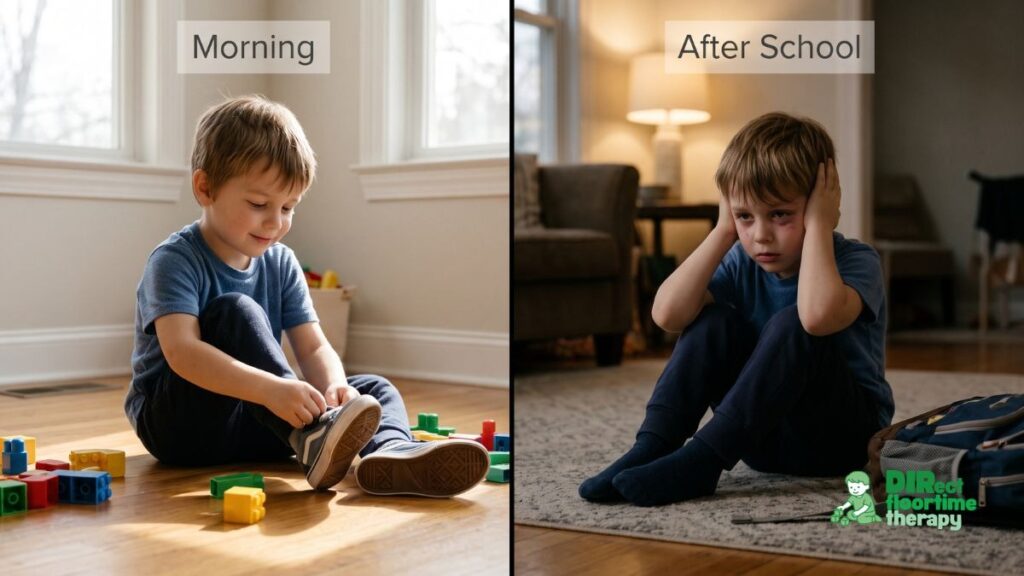
Many children, autistic or not, find the after-school transition among the most difficult of the day. For autistic children, school requires sustained effort across every developmental domain—social, sensory, cognitive, and emotional—often with little opportunity for genuine regulation. Children who navigate unmanaged sensory overload at school spend hours in a state of high neurological alert, meaning their regulatory reserves are often empty before they even walk through the front door.
Expecting an immediate transition into homework demands at this point is asking the nervous system to produce more when it has very little left. Many families find that building a genuine decompression period into the after-school routine, before any academic demands begin, transforms the homework transition entirely.
STRATEGIES FOR AFTER-SCHOOL AND HOMEWORK TRANSITIONS
- Build in a dedicated decompression window after school before any academic demands. Thirty to sixty minutes of unstructured, low-demand, child-led activity can restore enough regulation for homework to be manageable.
- Have a predictable after-school snack ready. Hunger is a significant nervous system stressor that amplifies everything else.
- Do not begin homework conversations immediately. Allow physical and emotional arrival time first.
- Keep the homework environment consistent: same place, same time, same set-up. Predictability reduces the activation cost of beginning.
- Break homework into small, clearly defined segments with brief movement breaks between them.
- Communicate with the school if homework consistently produces dysregulation. The IEP team can address homework load, format, and structure.
Bedtime Transitions
The transition to sleep is neurologically one of the most demanding of the day. It requires moving from activity, alertness, and sensory engagement to stillness, decreased stimulation, and the complete release of conscious control. For many autistic children, this transition is experienced as genuinely threatening at a nervous system level. Sleep involves giving up the predictability and control of wakefulness for the uncertainty and vulnerability of unconsciousness.
Bedtime resistance and bedtime meltdowns are among the most common concerns raised by families at DirectFloortime consultations, and they are among the most responsive to a consistent, sensory-informed routine.
STRATEGIES FOR BEDTIME TRANSITIONS
- Begin the wind-down sequence at least forty-five to sixty minutes before the intended sleep time. A gradual decrease in stimulation gives the nervous system time to shift rather than being required to drop suddenly.
- Reduce sensory input progressively through the wind-down: lower lights, reduce screen brightness, lower volume, decrease activity level and movement.
- Create a consistent sensory bedtime ritual that the child experiences as regulating rather than demanding: a warm bath, specific pyjamas, a weighted blanket if helpful, a particular scent, the same music or white noise.
- Use a visual bedtime sequence so the child can see exactly how many steps remain and what comes next at every point.
- Allow enough time for genuine connection in the bedtime routine: reading together, talking about something good from the day, a moment of warmth and closeness that signals safety before sleep.
- Avoid screens in the final hour before bed. The blue light and cognitive stimulation of screens actively work against the neurological shift toward sleep.
- If sleep difficulties are significant and persistent, raise this with your paediatrician and with the DIR/Floortime team. Sleep deprivation compounds every other regulatory challenge.

Part Four: What DIR/Floortime Adds to Transition Support
The strategies above are practical, evidence-informed, and effective. Families who apply them consistently see real change. But DIR/Floortime adds a dimension that goes beyond strategy: it addresses the underlying developmental capacity that makes transitions genuinely easier over time, not just more manageable in the moment.
In a DIR/Floortime framework, the goal is never simply compliance with transitions. It is the development of the neurological and relational capacities that make the child more resilient, more flexible, and more able to navigate the natural demands of daily life with genuine confidence.
Building Shared Attention and Engagement
The first developmental milestone in the DIR model is shared attention and engagement: the capacity to be in a warm, engaged, regulated relationship with another person. This is built through hundreds and thousands of small moments of genuine connection, not through instruction or compliance training.
When a child and caregiver develop strong shared attention, the caregiver’s presence during a difficult transition becomes genuinely regulating rather than adding to the threat. The child’s nervous system recognises the parent as a source of safety, which lowers the activation level of the transition itself. The transition becomes something to navigate together, rather than something to endure alone.
Expanding the Window of Tolerance
Through consistent co-regulation, the child’s nervous system gradually develops a wider window of tolerance: the range of activation within which the child can think, connect, and function without dysregulation. A child who once melted down at every screen transition begins to navigate the same transition with frustration rather than dysregulation, and eventually with relative ease.
This is a slow process that happens across months and years, not weeks. But it is real, it is neurologically grounded, and it is permanent. The capacity built through hundreds of co-regulated transitions becomes part of the child’s own regulatory repertoire, available to them in any setting, with any caregiver.
Supporting Two-Way Communication and Emotional Problem-Solving
At higher developmental levels of the DIR model, children develop the capacity to engage in two-way communication about their emotional experiences, and eventually to think through emotional challenges and find solutions. A child who has reached these levels can begin to participate in planning transitions, predict their own reactions, and develop strategies collaboratively with their parents.
“I know leaving the park is hard for me. Can we do the timer and then have my special snack in the car?” A child who can say that, or something like it, has the self-knowledge and the communication capacity to be an active participant in managing their own transitions. This level of agency is transformative. But it requires the earlier developmental foundations to be fully in place first.
Extending the Work to School
Many families across New Jersey find that transition difficulties are significantly more pronounced at school than at home. This makes neurological sense. The school environment carries a substantially higher sensory and social load, and the child has far fewer opportunities for the kind of connection-based co-regulation that makes transitions manageable.
A well-designed IEP should include specific transition support strategies informed by the child’s sensory and regulatory profile. If your child’s IEP does not currently address transitions specifically, you can request that the team review and update it. Areas to address include:
- Graduated transition warnings built into the classroom schedule, not left to individual teachers
- A designated transition support person or buddy during identified high-difficulty transitions
- Visual schedules accessible to the child at eye level throughout the school day
- Scheduled sensory breaks between high-demand activities to rebuild regulatory capacity
- A quiet decompression space the child can access after particularly difficult transitions
- Clear communication between school and home about transition challenges and what strategies are working
The DIR/Floortime team at DirectFloortime works directly with families to prepare for IEP meetings, understand their rights under IDEA, and advocate for the specific supports their child needs. If your child’s school is not currently meeting their transition support needs, we can help you navigate that process.
Frequently Asked Questions from NJ Families
My child handles some transitions fine but melts down on others. Why is it so inconsistent?
The difficulty of any given transition depends on multiple interacting factors: how regulated the child’s nervous system is going into it, how much they value the activity being left, how familiar the upcoming activity is, what sensory and social load the environment is carrying, and how many other transitions have already been navigated that day. The same transition that is manageable on a calm Tuesday morning may be impossible on a Friday afternoon after a hard week at school. The transition itself has not changed. The child’s available regulatory capacity has.
Tracking patterns across days and weeks often reveals that the most difficult transitions cluster around particular times of day, particular settings, or particular combinations of demand. That information is extremely useful for planning support.
We have been using warnings consistently for weeks and they do not seem to be helping.
Warnings work most effectively when they are consistent in timing, genuinely calm in tone, and paired with connection before the transition. If warnings are delivered with urgency or frustration, the emotional content overrides the informational content and the nervous system registers threat rather than preparation time.
It is also worth checking whether the warning is genuinely long enough for your child. Some children need a much longer runway than ten minutes, particularly for transitions away from very high-preference activities. Extending the warning window to twenty or thirty minutes, while pairing it with a brief moment of joining, sometimes produces rapid change where shorter warnings have not.
Should we try to avoid difficult transitions entirely to protect our child’s nervous system?
In the short term, reducing unnecessary difficult transitions is a valid and sensible strategy. There is no value in adding stress when it is not required. But in the longer term, the goal is to build genuine capacity so that transitions become more manageable, not to eliminate them from daily life. The world requires transitions, and a child who has never been supported through them has not developed the resilience to navigate them.
The DIR/Floortime approach is specifically designed to build genuine developmental capacity, not to create a protected environment that insulates the child from challenge. The difference is in how challenges are approached: with support, connection, and co-regulation rather than demand and compliance.
My child’s school says they do not have the resources to provide individual transition support.
Under the Individuals with Disabilities Education Act (IDEA), a child with an IEP is legally entitled to the supports and services necessary to access their education. Transition support is a well-established and recognised accommodation. The school’s resource constraints do not override that legal entitlement.
If your child’s school is not providing adequate transition support, you have the right to request an IEP review meeting to address this specifically. You can request an occupational therapy evaluation to assess sensory and regulatory needs, and you can ask the team to document specific transition support strategies in the IEP. Parent advocacy is frequently what turns these situations around, and the DirectFloortime team can support you in preparing for these conversations.
How do we handle a public meltdown when a transition goes wrong?
When a meltdown begins in a public setting, the single most important shift is from transition completion to nervous system support. Your job in that moment is not to finish the departure on schedule. It is to keep your child and yourself safe, and to support the nervous system in returning to regulation.
Move to a quieter space if possible. Reduce sensory input around your child. Get physically close and low. Use a quiet, calm voice. Reduce or eliminate verbal demands. And wait. Regulation takes the time it takes, and trying to rush it extends it. The transition can happen when regulation returns. Nothing in the environment is more important than your child feeling safe with you.
The secondary challenge of public meltdowns is managing your own nervous system response to other people’s reactions. Judgement from bystanders, even imagined judgement, adds activation that your child picks up on. Reminding yourself that you understand what is happening, even if others do not, helps you stay regulated enough to support your child through it.
Conclusion: Transitions Are a Skill, Not a Character Flaw
The single most important reframe for families navigating this challenge is this one: transition difficulty is not a behaviour problem, and it is not a reflection of your child’s character, your parenting, or your family’s situation. It is a developmental skill gap, rooted in how the autistic nervous system processes change. And like all developmental skills, it can be built, with the right support, the right environment, and the right relationship.
Every graduated warning you give is nervous system data that builds expectation over time. Every moment of genuine connection before a transition reduces the threat level. Every consistent routine makes the next iteration easier. Every meltdown you support your child through without withdrawing love or connection builds the trust that makes regulation possible. None of this produces overnight results. All of it produces real ones.
Your child is doing their absolute best with a nervous system that has a genuinely different set of needs. The more clearly you understand those needs, the more effectively you can meet them, and the more your child experiences you as the safest possible person to navigate the hard moments with.
At DirectFloortime, we work with families throughout New Jersey, from the communities of Bergen and Essex County through Morris County and Somerset County, and across Middlesex, Monmouth, and down through Camden and Burlington County, to build exactly this kind of understanding and to put it into practice at home, at school, and in the community. We offer individual family consultations, parent coaching, and direct child therapy grounded in the DIR/Floortime model.
If transitions are a consistent source of stress and difficulty in your family, we would welcome the conversation. Visit DirectFloortime.com or call us at (973) 433-5541 to schedule a consultation and find out how DIR/Floortime can change the way transitions feel in your home.