A Practical Guide to Planning, Preparing, and Navigating Holiday Travel With Your Child
Why Holiday Travel With an Autistic Child Takes Extra Planning
The holidays mean different things for different families. For many NJ parents raising an autistic child, they also mean navigating airports, long car rides, unfamiliar beds, disrupted routines, and relatives who may not fully understand what your child needs. That combination can feel daunting before you have even packed a bag.
But holiday travel with an autistic child is not simply something to survive. With the right preparation, the right tools, and a plan that centers your child’s sensory and emotional needs, it can be a genuinely good experience, not perfect, but manageable and sometimes even memorable in the best way.
This guide to holiday travel with an autistic child walks you through everything: how to prepare your child before you leave, what to pack, how to handle airports and road trips specifically, how to stay regulated once you arrive, and what to do when things do not go as planned. We cover both flying and driving, because the strategies overlap significantly but the specifics differ.
Key Takeaways
- Preparation before you leave is the single most effective tool for successful holiday travel.
- Children with autism do better when changes are previewed, not just explained.
- A sensory comfort bag is not optional equipment. It is essential.
- Airports and long car rides each require specific, different strategies.
- Staying regulated away from home depends on protecting sleep, food, and predictability as much as possible.
- Things will not always go perfectly. A plan for hard moments matters as much as a plan for smooth ones.
- DirectFloortime supports NJ families with the tools and strategies to handle holiday stress year-round.
Why Holiday Travel Is Hard for Autistic Children
Understanding why travel is difficult makes it easier to plan around the actual challenges rather than reacting to them one by one.
Holiday travel compresses several of the most dysregulating experiences into a short window of time. Sensory overload from crowded airports, highway traffic, unfamiliar smells, and loud environments. Routine disruption from changed mealtimes, bedtimes, and daily structures. Unpredictability from delays, detours, and plans that shift. Social demands from relatives, holiday gatherings, and unfamiliar adults. Sleep disruption from new beds, time zone differences, or simply the excitement of the season.
In our experience working with NJ families, routine disruption and sensory overload are the two biggest contributors to anxiety and dysregulation during travel and holidays. Neither of these is a character flaw or a parenting failure. They are neurological responses to genuinely overwhelming conditions. Organizations such as the Autism Society of America also offer general resources for families.
The goal of preparing for holiday travel with an autistic child is not to eliminate every challenge. It is to reduce the number of unknowns your child’s nervous system has to process at once, so that the ones that remain are more manageable. The same sensory overload that affects a child at school (see our guide to sensory overload at school) can show up in airports, cars, and relatives’ homes.
Preparing Your Child Before You Leave
The most important work you can do happens before you get in the car or arrive at the airport. Children with autism generally do better when changes are previewed, not just announced. Telling your child the morning of departure that you are going on an airplane is very different from spending two weeks introducing the idea in small, manageable steps. Good preparation is the foundation of holiday travel with an autistic child.
Use a visual schedule. A simple sequence of images showing what will happen, in order, helps your child understand the journey as a series of predictable steps rather than one large unknown. Wake up, pack bags, drive to airport, go through security, wait at gate, board plane, arrive. Each step becomes familiar before it happens. For more guidance on easing shifts between activities, see how to help an autistic child with transitions.
Read books or watch videos about airports or road trips. There are several children’s books specifically about flying and traveling. YouTube also has parent-made walkthroughs of airport security processes. Familiarity with the visual environment before arrival significantly reduces anxiety.
Visit the departure point if possible. If you are flying from Newark Liberty International Airport, a brief visit to the terminal a week or two before the trip, without the pressure of actually flying, can help your child begin to associate the environment with safety rather than the unknown.
Practice waiting. Airport and car travel both involve significant waiting. Practice low-stimulation waiting activities at home in the weeks leading up to the trip: a quiet corner with headphones, a preferred activity, and a timer. This builds the capacity to wait without escalation, which aligns with why autistic children struggle with waiting and how DIR Floortime builds tolerance without punishment.
Talk through the destination. Show photos of where you are going. The house or hotel room, the relatives you will see, the food you are likely to eat. The more familiar the destination feels before arrival, the less the nervous system has to absorb on the day. Stories and photos like these make holiday travel with an autistic child feel less like a leap into the unknown.
What to Pack: The Sensory Comfort Bag
A sensory comfort bag is a dedicated, portable kit of items that help your child stay regulated during travel. It travels with your child at all times, in a carry-on or in the back seat, never in checked luggage. Packing well is one of the simplest ways to make holiday travel with an autistic child more predictable.
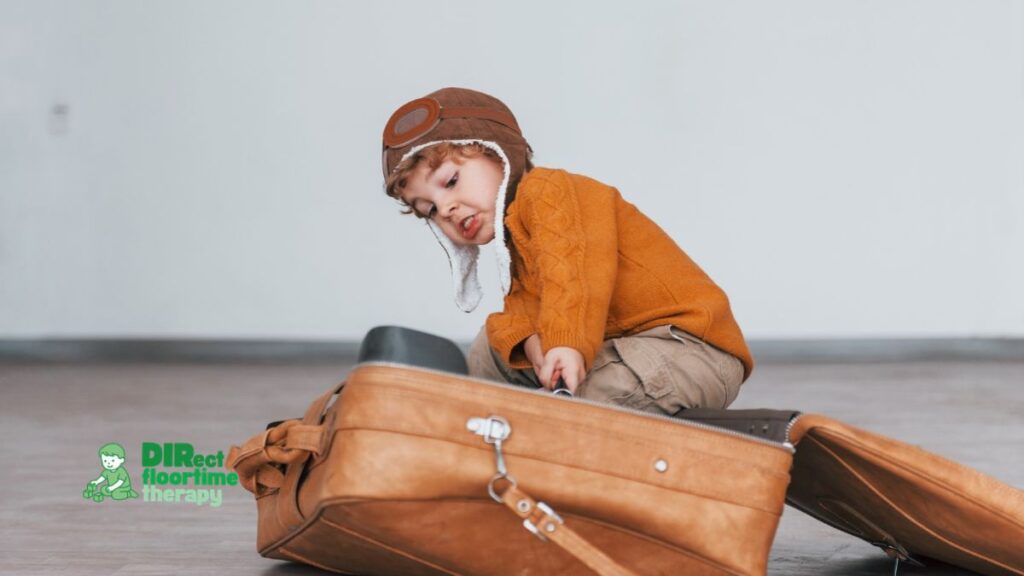
Sensory Comfort Bag Essentials
- Noise-cancelling headphones or ear defenders (a non-negotiable for most children)
- A preferred comfort item: a stuffed animal, a small blanket, a familiar toy
- Fidget tools: a smooth stone, a silicone sensory ring, a small tangle toy
- Safe, preferred snacks (food that is familiar, accepted, and does not require refrigeration)
- A tablet or device loaded with downloaded shows, games, or music (do not rely on Wi-Fi)
- Chewing tools if your child uses oral sensory input for regulation
- A small weighted lap pad if your child responds well to deep pressure
- Sunglasses for children sensitive to bright or fluorescent lighting
- A visual schedule for the day printed or saved on a device
- A change of clothes in a zip-lock bag for sensory or comfort emergencies
- Any medication needed during travel, in original packaging
The bag itself should be familiar. Use it at home before the trip so your child knows what it contains and associates it with comfort rather than novelty.
Flying With an Autistic Child: Airport-Specific Strategies
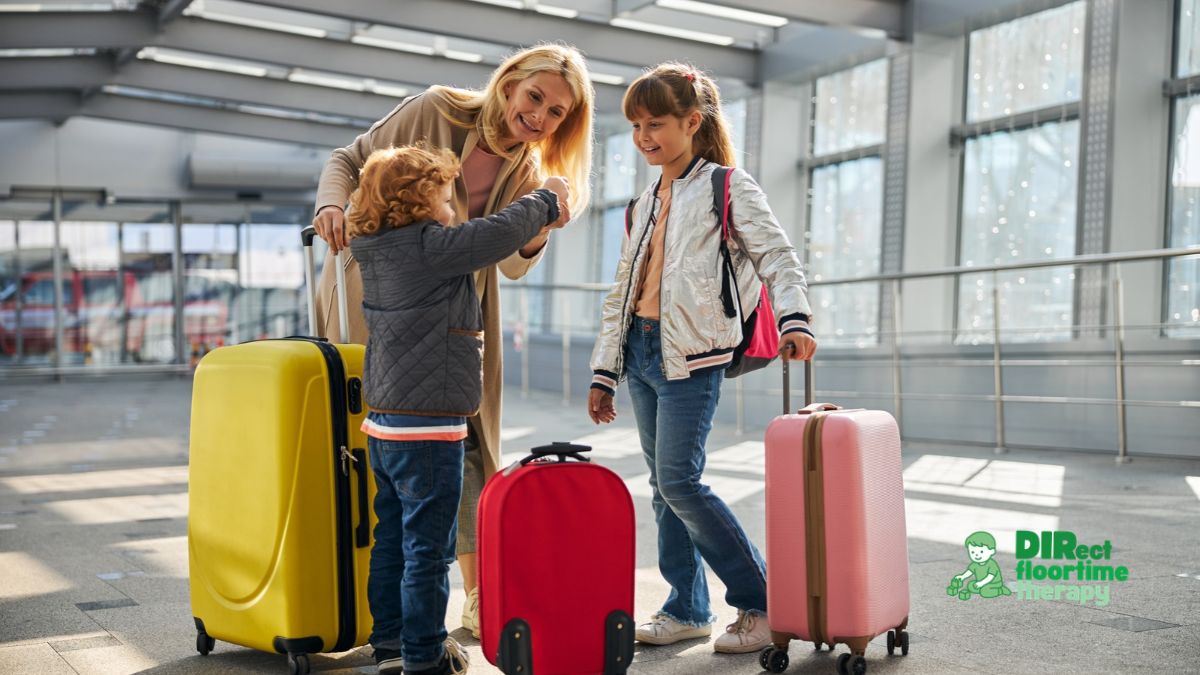
Airports are among the most sensory-dense environments most people ever encounter. The combination of crowds, announcements, fluorescent lighting, long walks, security procedures, and unpredictable delays makes them genuinely difficult for children with heightened sensory processing. For many families, the airport is the hardest part of holiday travel with an autistic child.
Here are the strategies that make the most practical difference:
If your child has significant sensory or behavioral support needs, it is a good idea to contact the airline in advance. Under the Air Carrier Access Act, airlines may not discriminate on the basis of disability, and the U.S. Department of Transportation explains your rights as a traveler. Some airlines offer pre-boarding, priority seating, or staff assistance, so it is always worth asking. You can also call the TSA Cares helpline at (855) 787-2227 at least 72 hours before you fly to ask what to expect at the security checkpoint.
Road Trips With an Autistic Child: Car-Specific Strategies
Long car rides bring a different set of challenges: confinement in a small space, the monotony of extended travel, and limited opportunities to move and decompress. The good news is that road trips offer more flexibility than flights: you can stop when you need to, adjust the environment more easily, and control more variables. Many families choose driving for holiday travel with an autistic child because it offers more control.
Planning Stops and Pacing
Plan your stops before you leave. Identify rest stops, parks, or quiet areas along your route where your child can get out, move their body, and decompress. Build these stops into your schedule rather than treating them as delays. A 20-minute movement break every two hours is not wasted time. It is what makes the next two hours possible. Predictable stops are one of the biggest wins for holiday travel with an autistic child by car.
Environment, Timers, and Seating
Control the car environment. Bring a small window shade for glare, keep the temperature comfortable, and load a playlist of familiar, preferred music or audio. Some children do better with silence; others need familiar sound. Know your child.
Use a countdown system. Many children with autism struggle with open-ended waiting. A simple countdown, whether a timer on a device or a visual schedule showing each leg of the journey, helps the car ride feel finite and manageable rather than endless.
Keep familiar items accessible. The sensory comfort bag should be within your child’s reach in the back seat, not in the trunk. Having their tools available without asking prevents frustration during the ride. Familiar items go a long way in holiday travel with an autistic child.
Travel during your child’s optimal time. If your child is calmer in the mornings, leave early. If they nap reliably in the early afternoon, time a long highway stretch for then. Work with your child’s natural rhythm where the schedule allows.
Have a co-regulation plan for the back seat. If possible, have another adult sit with your child during the ride, particularly for longer journeys. Someone who can offer calm presence, manage the sensory bag, and provide connection makes a significant difference in how regulated your child stays.
Staying Regulated Once You Arrive
Getting there is one part of the challenge. Staying regulated in an unfamiliar environment for several days is another. Many families find that the first day or two after arrival is the hardest, as the nervous system adjusts to new sensory inputs, smells, sounds, and spatial layouts. Holiday travel with an autistic child does not end when you reach your destination.
Set up a calm space immediately. As soon as you arrive, identify one area in the house or hotel room that will be your child’s designated calm space. It does not need to be elaborate: a corner with a familiar blanket, their comfort items, and low lighting. Show your child where it is on arrival. Knowing it exists often reduces the frequency with which they need it.
Protect sleep as much as possible. Sleep disruption magnifies every sensory and emotional challenge. Bring your child’s bedtime items from home: their pillow, their white noise machine if they use one, their nightlight. Keep the bedtime routine as close to normal as the circumstances allow. For more, read why autistic children struggle to fall asleep.
Maintain food familiarity. Holiday meals are often full of unfamiliar foods, strong smells, and social pressure to eat. Bring safe foods from home and make sure your child has access to something they will accept at every meal. Do not rely on the holiday table to meet your child’s nutritional needs on difficult days. See sensory food aversion and picky eating in autistic children for more.
Manage the social calendar. Multiple gatherings in rapid succession is too much for most children with autism. Where you can, build in rest days between social events. Give your child a visual schedule of what is coming so they can anticipate rather than be surprised.
Brief your hosts in advance. A short, honest conversation with relatives before you arrive, about your child’s sensory needs, communication style, and what helps them stay calm, prevents a great deal of misunderstanding in the moment. You do not need to give a clinical explanation. A few practical points are enough: please do not demand eye contact, please do not surprise them with hugs, please keep this area available as a quiet space. Hosts who understand your plans make holiday travel with an autistic child far easier.
When Things Do Not Go as Planned
Even the best-prepared trip will have hard moments. Flights get delayed. Relatives say the wrong thing. Your child reaches their limit earlier than expected. The holiday meal is louder and more chaotic than you anticipated. Hard moments are a normal part of holiday travel with an autistic child.
Having a plan for hard moments is as important as having a plan for smooth ones. Here are a few principles that help: Every family’s holiday travel with an autistic child looks different, so build the plan around your child.
Lower the bar for success. A successful holiday trip is not one where everything went smoothly. It is one where your child felt safe and you stayed connected. If your child made it through dinner, that is enough. If they needed to leave early, that is okay. Adjust your definition of success to match your child’s actual capacity, not an idealized version of it.
Have an exit strategy. Know in advance how you will leave a gathering early if you need to, without it becoming a crisis. Brief your hosts. Have your car parked where you can get to it easily. Agree with your partner or travel companion on a signal that means it is time to go.
Stay regulated yourself. Your child’s nervous system is calibrated to yours. When you are calm, it is easier for them to find calm. When you are anxious or embarrassed, they feel it. The single most useful thing you can do in a hard moment is regulate yourself first, even briefly, before responding to your child.
Do not apologize for your child. You do not owe anyone an apology for your child’s neurological reality. A brief, factual explanation if one seems useful, but no apology. Your child is not misbehaving. They are communicating that they have reached their limit. That deserves compassion, not embarrassment.
Coming Home: The Re-Entry Period
Many families find that the days immediately after returning home are unexpectedly difficult. Your child’s nervous system has been working hard throughout the trip, managing sensory input, social demands, and routine disruption. When you return home, the relief can trigger a release of everything that was held together during travel. Recovery is part of holiday travel with an autistic child too.
This is not regression. It is recovery. And the best support for it is the same as the support that helped before the trip: predictability, familiar routines, reduced demands, and generous amounts of connection.
Plan for a quieter first day back. Where possible, avoid scheduling therapy, school events, or social commitments for the day after you return. Give your child time to decompress in their own space, with their own things, before the routine fully resumes.
If you notice that recovery takes longer than you expected, or that your child’s regulation has shifted in ways that concern you after a period of travel, that is worth discussing with a therapist who understands their developmental profile. Travel stress can sometimes surface things that benefit from additional support.
Frequently Asked Questions About Holiday Travel With an Autistic Child
Is it safe to fly with an autistic child who has significant sensory sensitivities?
Yes, and many NJ families do it successfully every holiday season, but the difference between a manageable flight and an overwhelming one almost always comes down to preparation. The key is reducing unknowns before you even arrive at the airport. A child who has seen a visual walkthrough of the security process, practiced waiting with their comfort items, and knows what the boarding announcement sounds like has a nervous system that is not encountering these things for the first time. Visual schedules, noise-cancelling headphones, a loaded device with downloaded content, familiar snacks, and a pre-boarding arrangement with the airline are not luxury extras. They are the preparation that makes flying possible. Most families who feel anxious about the first trip find that subsequent trips go considerably more smoothly as the routine becomes familiar.
How do I explain airport security to my child before we go?
Use a simple, sequential visual walkthrough presented the same way every time. Many parents find short YouTube videos showing the full security process genuinely useful, particularly those recorded from a child’s perspective. Walk through the sequence step by step at home in the days before the trip: shoes come off, bag goes on the belt, you walk through the scanner, you wait on the other side, you collect everything and put your shoes back on. Some families practice with a pretend belt made from a table. The goal is for the sequence to feel familiar before it happens for real. If your child responds to social stories, write one specific to your departure airport. The more the nervous system has previewed an experience, the less it registers as a threat when that experience arrives.
What do I do if my child has a meltdown at the airport or in the car?
Your first priority in both situations is reducing sensory input, not resolving the situation. In an airport, that means moving away from the gate area toward a quieter corridor, a family restroom, or any space with fewer people and less noise. In a car, pull over safely when you can and turn off the radio. Put headphones on your child if they use them. Reduce demands completely. Do not try to reason, explain, or negotiate during a meltdown—for background on why multi-step demands overwhelm regulation, read why an autistic child struggles with instructions. During a meltdown, a child’s ability to process language and reason is often greatly reduced, so words and explanations rarely help in the moment. For general background, see the National Institute of Mental Health overview of autism spectrum disorder. What helps is calm presence, familiar sensory input, and time. Wait for the nervous system to come down before returning to the travel plan. It also helps enormously to identify a quiet spot in advance before you travel, so you are not problem-solving in the middle of a crisis. See also Meltdown or Shutdown? for how to tell what your child is experiencing.
How long does it usually take for my child to adjust after returning home from a holiday trip?
This varies considerably by child, by the length and intensity of the trip, and by how well-regulated your child stayed during travel. Many families find that their child needs a few days of reduced demands and familiar routine before returning to baseline, and some need a week or more, particularly after a long trip involving significant time zone differences, multiple social environments, or disrupted sleep. Needing recovery time after travel is common and not a sign that the trip caused lasting harm or that something has regressed. What helps most is keeping the first days back as predictable and low-demand as possible. Familiar foods, familiar sleep environment, familiar daily structure. Avoid scheduling therapy, school events, or social commitments for the first day back if you can.
Can DirectFloortime help us build a travel preparation plan specific to our child?
Absolutely, and this is one of the most practical ways our NJ families use their sessions in the weeks leading up to a holiday trip. A therapist who knows your child’s sensory profile, regulation patterns, communication style, and specific triggers can help you build a preparation plan that actually fits your child rather than a generic checklist from the internet. We can help you identify which parts of travel are most likely to be hard for your particular child, what tools and strategies will be most effective given their profile, and how to coach the other adults in your travel party so everyone is responding consistently. Reach out to our team to schedule a consultation before your trip. We serve families across New Jersey and are here to help you prepare. Contact our team to talk through your travel plans.
Planning to Travel This Holiday Season? We Are Here to Help You Prepare.
DirectFloortime supports NJ families with the tools, strategies, and therapeutic guidance to navigate holiday travel with an autistic child with more confidence and less stress. Whether you are preparing for a trip or recovering from one, we are here. Learn more about our in-home DIR Floortime therapy and center-based therapy.
Contact us today:
Phone: (973) 433-5541
Email: info@directfloortime.com
Website: DirectFloortime.com