
Key Points
- Autism is not always visible through dramatic behaviors. The most clinically significant early signs are often absences, things a child is not doing rather than things they are doing.
- The American Academy of Pediatrics recommends formal autism screening at 18 and 24 months, but many NJ parents notice differences much earlier.
- Early intervention, ideally before age three, produces significantly better long-term outcomes in communication, social engagement, and adaptive behavior.
- DIR/Floortime offers a relationship-based framework for supporting early development from the moment a concern is identified, without waiting for a formal diagnosis.
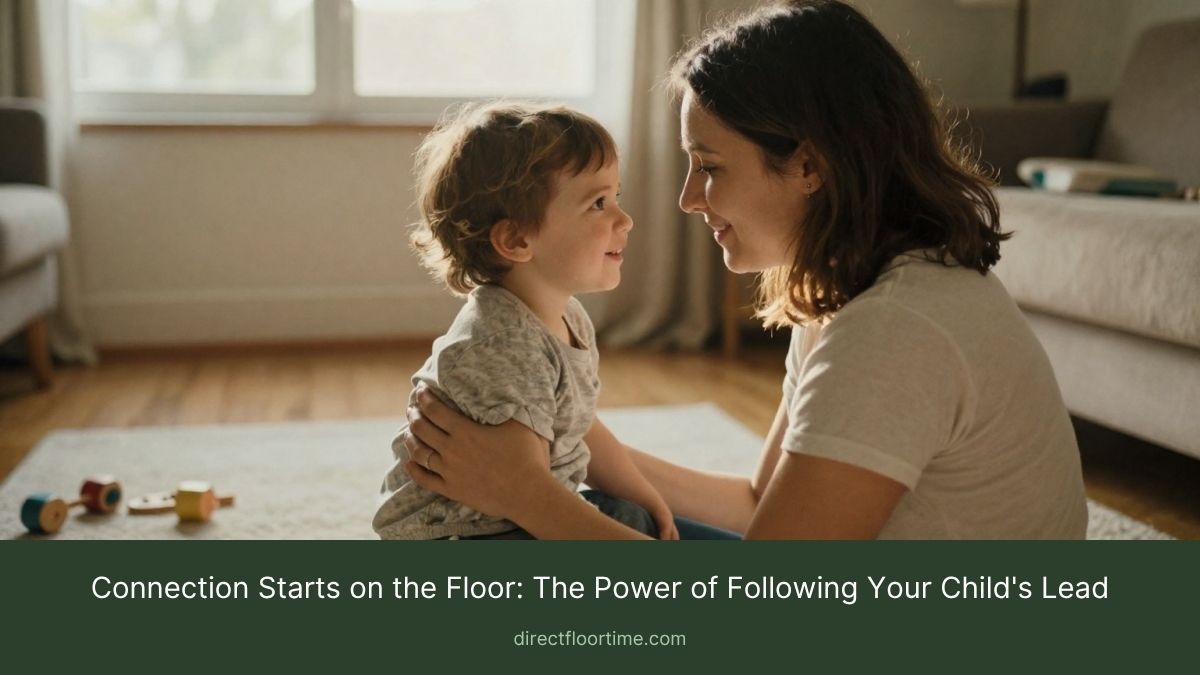
It starts as a feeling. Not a diagnosis, not a clinical report, just a quiet, persistent sense that something is a little different. Maybe your eighteen-month-old in Teaneck, New Jersey, doesn’t turn when you call their name. Maybe they line up their toy cars instead of rolling them across the floor. Maybe they haven’t waved goodbye yet, and every other child at the playgroup seems to wave constantly.
You mention it to your pediatrician. They say, “Every child develops differently. Let’s see how things look at the next visit.” And so you wait. And the feeling grows.
If this sounds familiar, you are not overreacting. Research published in the Journal Pediatrics by Zwaigenbaum et al. (2015) confirms that parental concern about development is one of the strongest early predictors of an autism diagnosis. In other words, the instinct you are feeling has clinical weight. It deserves to be taken seriously.
This article breaks down what the early signs of autism actually look like, why they are so often dismissed or explained away, and what NJ families can do right now, before, during, and after a diagnosis.

What “Early Signs” Actually Means
When most people picture autism, they picture a child who is nonverbal, who avoids all social contact, or who displays obvious repetitive behaviors. But the clinical picture of autism in infancy and toddlerhood is far more nuanced, and far easier to miss.
The earliest signs of autism are often social and communicative absences rather than obvious behavioral surpluses. According to the Centers for Disease Control and Prevention (CDC), developmental red flags can appear as early as six months, and parents are frequently the first to notice them.
The “Missing Milestones” That Matter Most
Rather than a single dramatic sign, autism in early childhood typically shows up as a cluster of missing or delayed social-communication milestones. These include:
- No social smiling by 6 months. A baby who rarely or never smiles back at a parent’s smile is missing a foundational social-emotional exchange.
- No babbling by 12 months. Babbling is the precursor to language. Silence at this stage is a meaningful clinical signal.
- No pointing, waving, or reaching by 12 months. These gestures are the earliest forms of intentional communication. Their absence was identified by Baron-Cohen et al. (1992) in the British Journal of Psychiatry as one of the most reliable early indicators of autism.
- No single words by 16 months. While some variation is normal, the absence of any functional words by this age warrants evaluation.
- Loss of previously acquired language or social skills at any age. Developmental regression, where a child loses words or social behaviors they previously had, is always a reason to seek immediate evaluation.
- Lack of joint attention by 12 to 18 months. Joint attention, the ability to share a focus with another person by looking where they look or following a point, is the bridge between a child’s inner world and the social world around them.
It is important to note that no single milestone in isolation constitutes a diagnosis. However, research by Landa (2008) in the Journal of Child Psychology and Psychiatry confirms that clusters of these early signs, especially when combined with parental concern, should prompt immediate referral for a comprehensive developmental evaluation.
Why Are These Signs So Often Missed?
One of the most painful experiences NJ families describe is the feeling of being dismissed. A parent raises a concern, and they are told to wait and see. There are several reasons this happens, and none of them are a reflection of your instincts being wrong.
The “Boys Develop Later” Myth
Autism is diagnosed approximately four times more often in boys than girls, and this statistic has unfortunately been misused to reassure parents of boys that delays are simply a matter of gender. This is not supported by the evidence. While there are biological differences in how autism presents across genders, developmental milestones are not significantly different between typically developing boys and girls in the first two years of life.
The “Einstein Was a Late Talker” Reassurance
Parents of late-talking children are frequently offered anecdotal reassurances about famous people who spoke late. While it is true that some children who speak late do catch up without intervention, research by Rescorla (2011) in the Journal of Speech, Language, and Hearing Research found that late talkers who do not receive early support continue to show language and learning differences into school age at significantly higher rates than peers who received early intervention. Waiting is a risk.
The Pediatric Appointment Problem
A typical well-child visit in New Jersey lasts between fifteen and twenty minutes. Research by Glascoe (2000) in Ambulatory Pediatrics found that pediatricians miss a significant proportion of developmental delays during routine visits when they rely on observation alone rather than standardized screening tools. The American Academy of Pediatrics now recommends using the M-CHAT-R/F screening tool at 18 and 24 months, but its implementation remains inconsistent across NJ practices.
The DIR/Floortime Lens: What to Look for and How to Respond
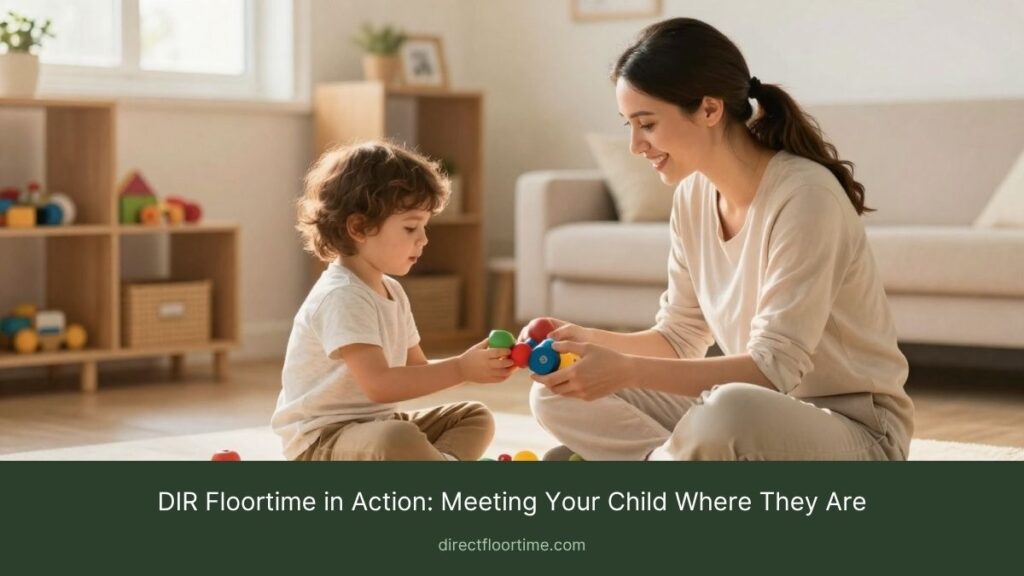
At Direct Floortime, we use the Developmental, Individual-difference, Relationship-based (DIR) framework developed by Dr. Stanley Greenspan and Dr. Serena Wieder to understand early development. Rather than waiting for a formal diagnosis before starting support, DIR/Floortime gives parents a way to meet their child where they are right now and begin building the foundations of connection.
The Six Developmental Milestones DIR Looks For
Greenspan’s DIR model identifies six Functional Emotional Developmental Capacities (FEDCs) that form the foundation of healthy development. In early screening, we look at whether a child is moving through these stages:
- Milestone 1: Self-regulation and shared attention. Can the child stay calm and focused long enough to engage with the world around them?
- Milestone 2: Engagement and relating. Does the child show pleasure, warmth, or interest when interacting with a familiar caregiver?
- Milestone 3: Two-way intentional communication. Does the child respond to gestures, expressions, or vocalizations? Do they initiate any form of back-and-forth exchange?
- Milestone 4: Complex problem-solving communication. Can the child use a series of back-and-forth interactions to achieve a goal, such as taking a parent’s hand and leading them to a desired object?
- Milestone 5: Using symbols and ideas. Is the child beginning to use words, pictures, or pretend play to represent the world?
- Milestone 6: Building bridges between ideas. Can the child connect ideas logically, such as understanding cause and effect in simple play?
A child who is showing gaps in the first two or three milestones, regardless of their age or diagnosis status, is a child who can benefit from a DIR/Floortime approach right now. Research by Pajareya and Nopmaneejumruslers (2011) in Autism: The International Journal of Research and Practice found that DIR/Floortime intervention significantly improved functional emotional and overall developmental scores in young children with ASD, and that earlier engagement produced stronger outcomes.
What NJ Parents Should Do Right Now
If you are reading this article because something feels different about your child’s development, here is a clear, practical path forward.
Step 1: Trust Your Instinct and Document What You See
Keep a simple log on your phone. Note the dates your child does and does not do certain things. Record short videos of your child’s play, communication attempts, and responses to their name. This documentation is invaluable when you speak to a developmental specialist.
Step 2: Request a Developmental Screening Today
Do not wait for the next scheduled well-child visit. Call your pediatrician and specifically request the M-CHAT-R/F autism screening. If your child is under three, you can also contact the New Jersey Early Intervention System directly. Early Intervention in New Jersey is a free, federally mandated program for children from birth to age three who show developmental delays.
Step 3: Seek a Comprehensive Developmental Evaluation
A developmental pediatrician, child psychologist, or neuropsychologist can conduct a full evaluation using gold-standard diagnostic tools such as the ADOS-2 (Autism Diagnostic Observation Schedule). Do not rely on a pediatric well-child visit alone for a definitive picture of your child’s development.
Step 4: Begin Relationship-Based Support Immediately
You do not need to wait for a diagnosis to begin helping your child. At Direct Floortime, we begin working with families from the moment a concern is identified. Parent coaching in the DIR/Floortime approach gives you practical, playful strategies for building connection, expanding communication, and supporting your child’s development in your own home, every single day.
FAQs
My child is two and not talking. Should I be worried?
Yes, this warrants immediate evaluation rather than watchful waiting. The absence of functional words by 24 months is a recognized developmental red flag. Contact your pediatrician and the NJ Early Intervention System this week.
Could it just be a speech delay rather than autism?
Possibly. Not every child with a speech delay has autism, and not every autistic child has a significant speech delay. A comprehensive evaluation will look at the full picture: speech, social communication, play skills, sensory processing, and behavior. What matters most is getting a clear picture of your child’s developmental profile, whatever the label.
My pediatrician said to wait and see. What should I do?
You are within your rights to request a referral to a developmental specialist at any point. If your pediatrician is not responding to your concern, you can also self-refer to the NJ Early Intervention System if your child is under three, or contact a developmental pediatrician directly. Parental concern is a valid and clinically recognized referral reason.
Is it too late if my child is already four or five?
No. While the research on early intervention consistently points to birth-to-three as an especially impactful window, studies by Kasari et al. (2014) in the Journal of Child Psychology and Psychiatry demonstrate that children of all ages show meaningful developmental gains with the right relationship-based intervention. It is never too late to begin.
What is the first step with Direct Floortime?
Contact us for an initial consultation. We will talk through your concerns, review your child’s developmental history, and recommend a path forward, whether that is parent coaching, direct therapy, or a combination of both.
The Most Important Thing You Can Do Today
The single most powerful thing a New Jersey parent can do if they are concerned about their child’s development is to act now. Not next month. Not after the next well-child visit. Now.
Early signs of autism are not a verdict. They are a signal, one that your child’s nervous system is sending to say: “I need support, and I need connection.” The DIR/Floortime model answers that signal not with drills or compliance training, but with relationship, play, and deep respect for who your child is.
Whether your child receives an autism diagnosis or not, the strategies we teach at Direct Floortime will strengthen your relationship, expand your child’s communication, and build the social-emotional foundations that every child needs to thrive.
Contact Direct Floortime today to speak with a member of our team and take the first step toward understanding your child’s development.