

When you are a parent, your intuition is a powerful thing. You know the exact cadence of your child’s laughter, the way they look at you when they want comfort, and how they explore their world.
But sometimes, a quiet feeling begins to settle in. You might notice that your 18-month-old isn’t turning around when you call their name, or that they prefer spinning the wheels of a toy car rather than rolling it across the floor. Perhaps your two-year-old has suddenly stopped using words they used to say every day, or they experience intense, inconsolable meltdowns over transitions that seem minor to others.
If you are noticing developmental differences in your toddler, your mind is likely flooded with questions. Is this just a phase? Am I overreacting? What do I do next?
First, take a deep breath. You are not overreacting; you are paying attention. Noticing these differences isn’t about looking for labels—it is about understanding how your child experiences the world so you can give them the connection and support they need to thrive.
Navigating the healthcare and educational systems in New Jersey can feel overwhelming, especially when you are trying to find answers quickly. This guide provides a compassionate, expert-backed roadmap to securing an autism evaluation in NJ, identifying early signs, and beginning supportive interventions right away.
Part 1: Trusting Your Instincts—Common Signs of Autism in Toddlers
Autism Spectrum Disorder (ASD) is a neurodevelopmental difference that shapes how a child processes sensory information, communicates, and relates to others. Because it is a spectrum, it looks vastly different from one child to the next.
According to guidelines from the American Academy of Pediatrics (AAP) and tracking data from the Centers for Disease Control and Prevention (CDC), early signs of autism often manifest clearly within the first two years of life. Instead of looking for a single specific behavior, it is more helpful to look at patterns of communication, social connection, and sensory processing.
Social and Communication Milestones to Track
- Response to Name: By 12 months, most toddlers consistently turn their head or look at you when their name is called. A child on the spectrum may frequently appear not to hear you, even if their hearing is perfectly fine.
- Joint Attention: This is the shared experience of looking at an object or event together. Examples include a child pointing to a bird in the sky to say “look at that!” or looking in the direction where you point. The CDC highlights a lack of pointing or following your gestures by 14 months as a common early indicator.
- Eye Contact and Gestures: You might notice a reduction in direct eye contact during meaningful moments, or a lack of communicative gestures like waving goodbye, nodding, or reaching out to be picked up.
- Speech Delays or Regression: Your child may experience delays in babbling or spoken language. Crucially, AAP developmental clinical studies show that about 25% to 30% of autistic children hit early speech milestones but then experience a developmental regression between 12 and 24 months, losing words or social smiles they previously had.
Behavioral and Sensory Processing Patterns
- Repetitive Movements: Repetitive physical actions, formally known as stimming (self-stimulatory behavior), can include hand-flapping, rocking, spinning in circles, or pacing. This is often a beautiful, natural mechanism the child uses to regulate their nervous system when excited, overwhelmed, or anxious.
- Intense Interests and Object Play: A toddler might focus deeply on specific parts of toys (like spinning the propeller of a plane repeatedly) rather than playing with the toy as a whole, or they may line up blocks, shoes, or cars in long, precise rows, becoming highly distressed if the order is disrupted.
- Sensory Sensitivities: High neurological sensitivity or under-responsiveness to environmental inputs. A child might scream at the sound of a vacuum cleaner or a hair dryer, refuse certain food textures completely, or exhibit an extreme aversion to clothing tags or the sticky feeling of sunscreen.
- Need for Predictability: Strong resistance to changes in daily routines or paths, often leading to intense dysregulation or meltdowns when a transition occurs without warning.
An Important Note from the DIRFloortime Perspective:
Traditional approaches often view these signs purely as “deficits” or “behaviors to be extinguished.” At Direct Floortime NJ, we look at them through a relational, developmental lens. A repetitive action or a sensory meltdown isn’t bad behavior—it is a window into your child’s internal state. It tells us how their unique nervous system is processing the world and where they need a supportive partner to help them co-regulate.
Part 2: The Two Essential Parallel Paths in New Jersey
When you decide to seek answers, one of the most confusing parts of the process is learning that medical diagnoses and educational services are handled by entirely different entities.
Many parents mistakenly believe they must wait for an official medical diagnosis before they can get help for their child. In New Jersey, this is a myth that can cost you precious time. You can—and should—pursue both paths simultaneously.
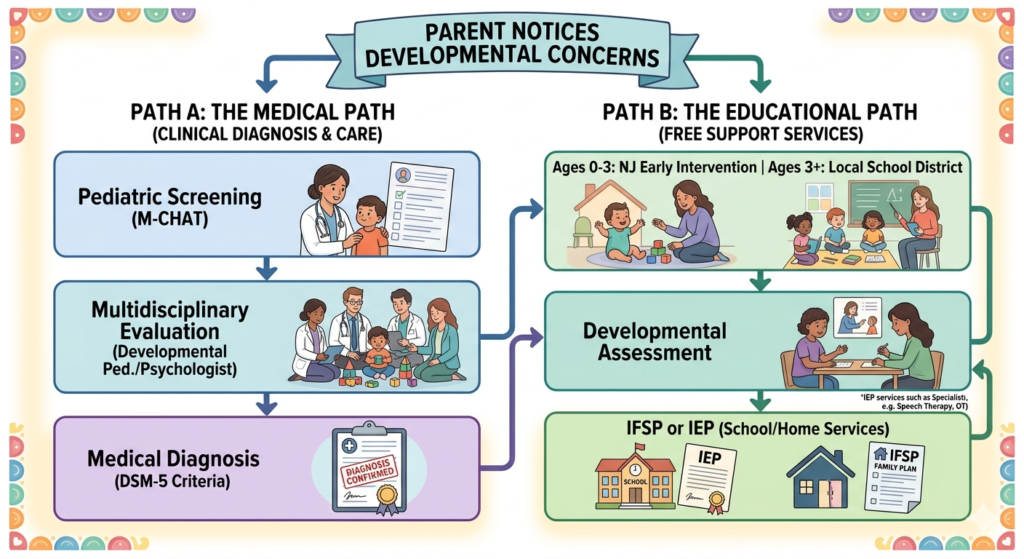
Path A: The Medical/Clinical Path
- Who handles it: Pediatricians, clinical psychologists, developmental pediatricians, child neurologists, or psychiatrists.
- The Goal: To obtain an official clinical diagnosis based on the criteria outlined in the DSM-5 (Diagnostic and Statistical Manual of Modern Disorders).
- Why it matters: A medical diagnosis is generally required by private health insurance providers in New Jersey to cover specialized clinical therapies (like DIRFloortime speech, occupational, or developmental therapies).
Path B: The Educational/State Service Path
- Who handles it: The New Jersey Department of Health (for infants and toddlers under 3) or your local public school district (for children age 3 and older).
- The Goal: To evaluate if your child has a developmental delay or educational disability that qualifies them for free, state-funded support.
- Why it matters: This path does not require a medical diagnosis. If a state evaluation shows your child has a delay, New Jersey is legally required to provide support services immediately, even while you sit on a medical waiting list.
Part 3: Step-by-Step Guide to the Medical Path (Clinical Evaluation)
Securing an autism diagnosis in New Jersey requires specific clinical steps to ensure accuracy and to provide a comprehensive view of your child’s cognitive, language, and adaptive needs.
Step 1: Start with Your Pediatrician and the M-CHAT
Schedule a dedicated developmental tracking visit with your pediatrician. The AAP explicitly recommends that pediatricians screen all children for autism during standard well-child visits at 18 and 24 months, or at any time a parent expresses a concern.
Your pediatrician will typically ask you to complete the Modified Checklist for Autism in Toddlers (M-CHAT-R/F). This is a brief, 20-question, parent-completed screening tool consisting of yes/no items regarding your child’s day-to-day behavior.
- Note: The M-CHAT is merely a screening tool, not a diagnostic instrument. A high score simply indicates that a comprehensive, multidisciplinary evaluation is warranted. Ask your pediatrician for a formal prescription/referral for a “Comprehensive Autism Diagnostic Evaluation.”
Step 2: Navigating the Waiting Lists for Specialists
In New Jersey, there is a known shortage of pediatric developmental specialists, which can cause waitlists for a medical diagnostic evaluation to range anywhere from 3 to 12 months.
To schedule your appointment, you will want to contact one of the state’s major specialized pediatric health networks or qualified independent psychologists. Major diagnostic centers across NJ include:
- Children’s Specialized Hospital (RWJBarnabas Health): The largest provider of pediatric developmental care in the state, with multiple sites across NJ.
- Hackensack Meridian Children’s Health: Offering specialized neurodevelopmental diagnostic teams through Joseph M. Sanzari Children’s Hospital (Hackensack) and K. Hovnanian Children’s Hospital (Neptune).
- Atlantic Health System: Goryeb Children’s Hospital developmental medicine centers.
- State-Designated Child Evaluation Centers (CECs): New Jersey Department of Health funds a specialized network of ten county-based Child Evaluation Centers designed specifically to provide comprehensive, multidisciplinary developmental diagnostics.
Step 3: What to Expect During the “Gold Standard” Assessment
When your evaluation date arrives, the assessment will likely take between two to four hours and may span across multiple visits. It should be conducted by a qualified clinician (such as a developmental pediatrician or a licensed child psychologist) utilizing the international clinical “gold standard” protocols:
| Assessment Component | What It Evaluates | Common Tools Used |
| Caregiver Interview | A deep dive into your child’s early developmental milestones, medical background, medical history, and behavioral patterns from birth onward. | ADI-R (Autism Diagnostic Interview-Revised) |
| Direct Clinical Observation | A semi-structured, play-based interaction where the clinician introduces specific activities to directly observe the child’s communication, joint attention, and social play. | ADOS-2 (Autism Diagnostic Observation Schedule) |
| Cognitive Assessment | Evaluates foundational processing skills and tracks early learning styles, adapted to your child’s age and communication level. | Bayley-4 (under 42 months) or Leiter-3 (non-verbal) |
| Adaptive Behavior Measures | Questionnaires assessing daily living skills, functional communication, and self-help capabilities within the home. | Vineland-3 or ABAS-3 |
Following the assessment, the specialist will schedule a follow-up feedback meeting (usually 1 to 2 weeks later) to deliver a comprehensive written report detailing their findings, diagnostic determinations according to the DSM-5, and targeted therapeutic recommendations.
Part 4: Step-by-Step Guide to the Educational Path (Free State Services)
Do not wait for Step 3 of the medical path to finish before initiating this process. If your child is struggling to communicate or connect right now, they qualify for an evaluation through the state immediately.
If Your Child is Under 3 Years Old: New Jersey Early Intervention System (NJEIS)
The New Jersey Department of Health oversees the NJEIS, which provides therapeutic services right in your home or your child’s natural environment (such as a daycare center).
- How to Refer: You do not need a doctor’s note or a formal diagnosis to call. Anyone can make a referral. Contact the NJEIS state toll-free referral line at 1-888-653-4463.
- The Initial Evaluation: Within 45 days of your phone call, a service coordinator and an evaluation team will visit your home to conduct a multi-domain developmental assessment of your child’s cognitive, physical, communication, and social-emotional development. This is completely free of charge to New Jersey families.
- The Plan: If your child exhibits a delay of at least 33% in one developmental area (or 25% in two or more areas), they qualify for services under New Jersey Department of Health eligibility rules. Your team will collaborate with you to build an IFSP (Individualized Family Service Plan) outlining the developmental therapies your child will receive at home.
If Your Child is 3 Years Old or Older: Your Local School District
Once a child turns 3, responsibility for developmental and educational services shifts directly to your local New Jersey public school district’s Child Study Team (CST) under New Jersey Administrative Code for Special Education (N.J.A.C. 6A:14).
- The Written Request: Write a formal letter or email to the Director of Special Services in your local school district. State clearly: “I am writing to request a comprehensive evaluation for my child, [Child’s Name, Date of Birth], due to developmental and communication concerns.”
- The Identification Meeting: Within 20 days of receiving your letter, the Child Study Team (consisting of a school psychologist, learning consultant, and speech-language specialist) must meet with you to determine if an evaluation is warranted.
- The IEP: If the team agrees, they will perform evaluations. If your child meets the criteria for special education eligibility, you will collaboratively design an IEP (Individualized Education Program), which may include placement in an integrated preschool program, speech therapy, or occupational therapy at no cost to you.

Part 5: Maximizing Your Waiting Period—What Parents Can Do Today
Sitting on a medical waiting list for months can leave you feeling helpless, but this time does not have to be wasted. You are your child’s ultimate advocate and their safest regulatory partner. You can build a deeply supportive environment at home starting today.
1. Shift from Behavior Modification to Co-Regulation
When a child is processing the world through a sensitive or neurodivergent nervous system, ordinary sensory environments can trigger an internal fight-or-flight response. Traditional advice might tell you to ignore the resulting meltdown or use token reward systems.
Instead, try practicing co-regulation. When your child is distressed, bring your own calm nervous system to their side. Lower your voice, slow your movements, minimize harsh ambient lights or sounds, and let them feel your steady, safe presence. As emphasized in relationship-based developmental frameworks like the DIR model, before a child can learn to self-regulate, they must experience thousands of hours of shared co-regulation with a trusted adult.
2. Prioritize Relational, Joyful Play
You do not need a clinical setting to support your child’s development. The core of human growth is emotional connection. Set aside 15 to 20 minutes a day for dedicated, uninterrupted play.
Don’t try to teach them or quiz them (e.g., asking “What color is this block?” or “Can you build a tower like mine?”). Instead, get down on the floor, follow your child’s lead, and join them in whatever captures their attention. If they are lining up cars, gently hand them the next car. If they are looking out the window, look out the window with them. By entering their world, you show them that their ideas have value, creating a shared emotional bridge that naturally pulls for spontaneous communication.
3. Build Predictability with Visual Schedules
Unstructured time and unexpected transitions can provoke deep anxiety in neurodivergent toddlers. You can reduce daily distress by introducing visual cues.
Use simple picture cards or a visual sequence drawing on a whiteboard to illustrate the steps of your daily routine (e.g., First breakfast, Then shoes, Then the park). Pointing to these visual cues before transitions helps your child build an internal roadmap of what to expect next, helping them feel safe and grounded.
Frequently Asked Questions (FAQs)
Do I need a referral from my pediatrician to get an autism evaluation in NJ?
For the educational path (Early Intervention or your local school district), you do not need a pediatrician’s referral; you can contact them directly. For the medical path, most pediatric specialists and private insurance companies in New Jersey require a formal referral or prescription from your primary care pediatrician to cover the cost of a multidisciplinary evaluation.
How much does an autism evaluation cost in New Jersey?
State-administered evaluations through the New Jersey Early Intervention System (NJEIS) and local public school Child Study Teams are completely free of charge to families, regardless of income or insurance status. Medical evaluations can vary; however, New Jersey state law mandates that private, state-regulated health insurance plans provide coverage for autism screenings and diagnostic evaluations, though deductibles and co-pays may apply.
Can a school district diagnose my child with autism?
No. A school district’s Child Study Team conducts an educational determination rather than a medical diagnosis. They evaluate whether your child meets the state criteria for the classification category of “Autism” or “Communication Impaired” to qualify for free special education services. To obtain a clinical medical diagnosis for health insurance or medical records, you must see a licensed specialist like a developmental pediatrician or clinical psychologist.
What should I do if my child is over 3 but the school district refuses to evaluate them?
If you submit a written request and the Child Study Team denies the evaluation at the initial meeting, they must provide you with a written notice explaining their decision. Under New Jersey special education law (N.J.A.C. 6A:14), you have the right to challenge this decision by filing a request for Mediation or a Due Process Hearing through the New Jersey Department of Education’s Office of Special Education.
Why are the waiting lists for a developmental pediatrician so long in NJ, and can I bypass them?
The long waitlists (often 6 to 12 months) are due to a national and state-wide shortage of specialized neurodevelopmental clinicians relative to high demand. You can sometimes expedite the process by requesting to be placed on cancellation lists, checking if your insurance allows an evaluation by a licensed private child psychologist rather than a hospital network, and initiating your free state educational evaluations concurrently.
Moving Forward with Confidence
Receiving an autism diagnosis or uncovering a developmental delay isn’t a limitation on your child’s future. It is simply a key that unlocks a deeper, more accurate understanding of how they learn, communicate, and feel.
As you take these first steps through New Jersey’s evaluation systems, remember that you do not have to carry this journey alone. Trust your instincts, lean on local resources, and prioritize building a joyful, relationally rich connection with your child right where they are today.