


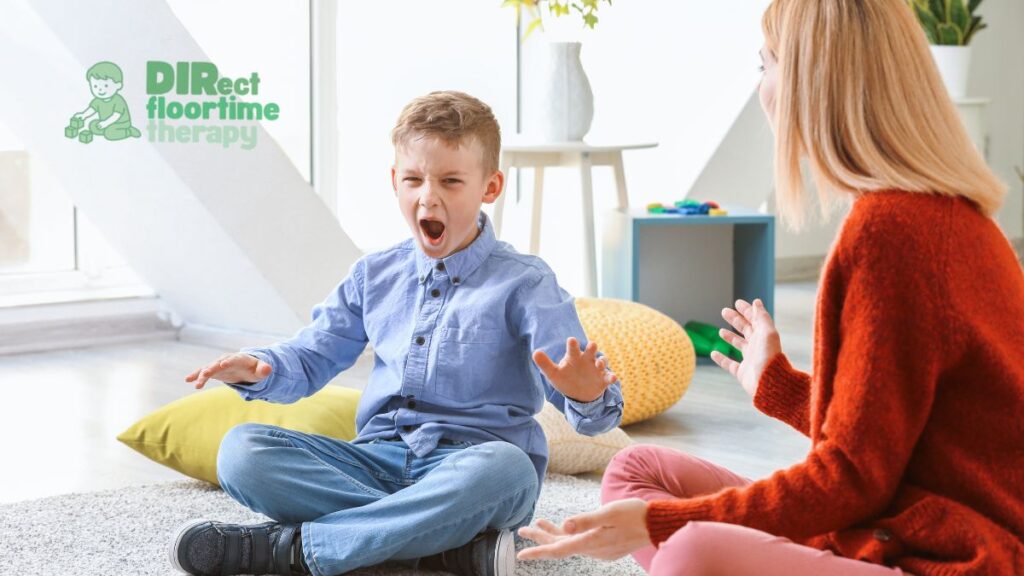
Emotional outbursts can be overwhelming, not just for children but also for parents. One moment, your child may seem regulated, and the next, they’re crying, yelling, or shutting down without warning.
Research increasingly shows that for many children with autism, these moments are not “behavior problems,” but signs of difficulty with emotional regulation – the ability to manage feelings, stress, and sensory input. Studies on early childhood development emphasize that emotional regulation develops through relationships and shared experiences, not through compliance or discipline alone.
This is where DIR/Floortime offers a different, relationship-based path forward.
Why Emotional Regulation Is Difficult for Some Children with Autism
Research published in Development and Psychopathology highlights that children on the autism spectrum often experience differences in how their nervous systems process sensory and emotional information. This can make everyday experiences like noise, transitions, or social demands feel overwhelming much more quickly than they do for neurotypical children.
Stanley Greenspan, MD, the founder of the DIR® model, emphasized that emotional regulation is a developmental capacity, not a skill that can be forced on demand. Children need repeated experiences of being emotionally supported in order to gradually learn how to regulate themselves.
In other words, emotional outbursts are often the result of:
- Sensory overload
- Limited emotional language
- Stress is building without an outlet
- Difficulty organizing internal experiences
DIR/Floortime focuses on strengthening the underlying developmental foundations that support regulation over time.
How DIR/Floortime Addresses Emotional Outbursts
DIR/Floortime is grounded in decades of developmental research showing that children build emotional and social skills through attuned, responsive relationships.
A study published in the Journal of Autism and Developmental Disorders found that relationship-based interventions like Floortime can lead to improvements in emotional functioning, communication, and parent-child interaction. Rather than focusing on stopping behaviors, Floortime focuses on understanding the emotional meaning behind them.
Key elements include:
- Following the child’s emotional lead
- Matching affect and energy levels
- Supporting co-regulation before expecting self-regulation
- Using play as the medium for emotional growth
These strategies align with research showing that co-regulation, an adult helping a child regulate emotions, is a critical step before independent regulation can develop.
Common Emotional Triggers and What They Often Mean
Research in occupational therapy and developmental psychology shows that emotional reactions are frequently linked to unmet sensory or emotional needs.
| Trigger | What You Might See | What Research Suggests | DIR/Floortime Response |
| Loud noises | Crying, covering ears | Sensory processing overload | Reduce stimulation, stay emotionally present |
| Sudden changes | Meltdown, refusal | Stress from unpredictability | Prepare gently, validate emotions |
| Task demands | Shutdown or frustration | Cognitive and emotional overload | Lower demands, follow child’s lead |
| Social pressure | Withdrawal | Emotional fatigue | Parallel play before interaction |
This approach reflects findings from sensory integration research, which emphasizes adjusting the environment before expecting behavioral change.
Why Play Is Central to Emotional Regulation
Play is not just recreation; it is a primary way young children process emotions.
According to research summarized by the Interdisciplinary Council on Development and Learning (ICDL), play-based, relationship-focused interventions support the development of emotional regulation by creating safe opportunities for children to experience challenges with support.
In DIR/Floortime:
- Play allows children to express emotions without pressure
- Shared play supports nervous system regulation
- Emotional themes can be explored safely and repeatedly
Over time, children begin to tolerate frustration, flexibility, and emotional shifts more comfortably, not because they are told to, but because their nervous systems are supported.
What Parents Can Do at Home
1. Start With Emotional Connection
Developmental research consistently shows that learning happens best when a child feels emotionally safe. Before addressing behavior, focus on connection.
This might mean:
- Sitting at your child’s level
- Matching their pace
- Acknowledging feelings before redirecting
2. Be a Regulating Presence
Studies on co-regulation emphasize that calm adults help calm children. Your tone, posture, and pacing matter more than your words.
Instead of correcting immediately, try grounding statements like:
“I’m here with you.”
“That feels really hard right now.”
3. Track Patterns, Not Perfection
Keeping brief notes helps identify patterns over time.
| Day | Trigger | Response | What Helped |
| Monday | Loud sound | Crying | Quiet space |
| Wednesday | Transition | Tantrum | Extra preparation |
| Friday | Task demand | Refusal | Parallel play |
When Additional Support May Be Helpful
Research supports that children benefit most when families receive guidance tailored to their child’s individual developmental profile. If emotional outbursts are frequent or disruptive, working with a DIR/Floortime-trained professional can help refine strategies and provide support.
Final Thoughts
Emotional outbursts are not failures; they are communication.
Here at New Jersey, DIR/Floortime is grounded in developmental science that recognizes emotional regulation as something that grows through relationships, safety, and shared experience. With patience and connection, children can build the internal tools they need to navigate emotions more comfortably over time.

