

Keypoints
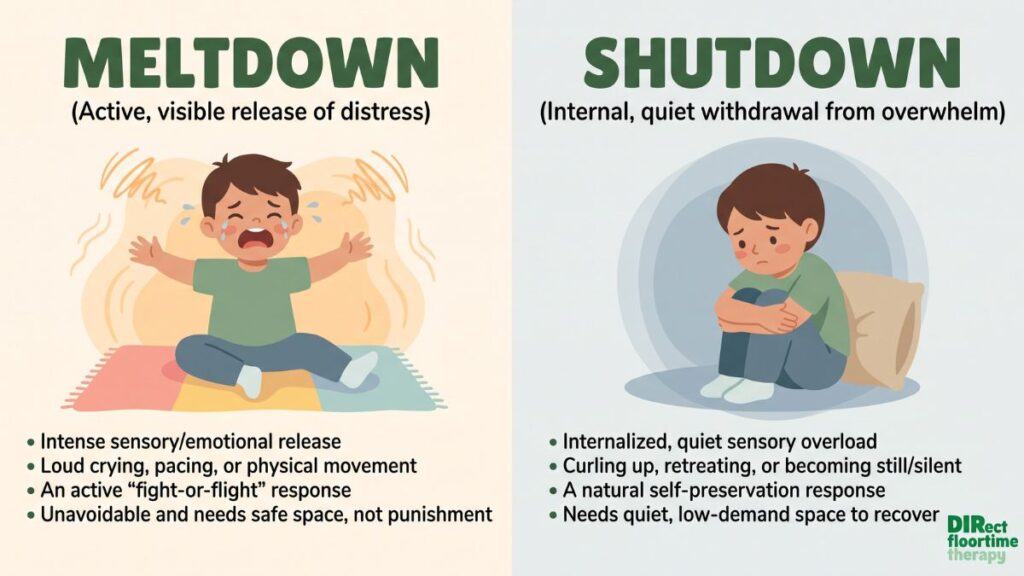
- A meltdown is an outward, explosive stress response; a shutdown is an inward, withdrawal response. Both signal that the child’s nervous system has reached its limit.
- Treating a shutdown like a meltdown, or vice versa, can significantly worsen the child’s distress and damage the parent-child relationship.
- The DIR/Floortime model addresses both responses by focusing on co-regulation, safety, and the relationship, rather than behaviour management.
- New Jersey parents can use IEP language to distinguish these responses and ensure school staff respond appropriately to each.
- Understanding the difference is one of the most practical tools a caregiver can have in their daily toolkit.
The Moment Everything Falls Apart
A parent in Westfield, New Jersey described the same afternoon playing out two completely different ways with her eight-year-old son. On Tuesday, he came home from school and slammed every door, threw his backpack across the hallway, and cried for forty minutes before he could speak. On Thursday, he came home, walked to his bedroom, sat in the corner with his knees pulled to his chest, and said nothing for two hours.
To an outsider, both looked like problems. To his teachers, both might have been logged as “behavioural incidents.” But to his mother, who had been working with a DIR/Floortime therapist, these were two entirely different events happening inside her child’s nervous system, each one asking for a completely different response from the adults around him.
One was a meltdown. The other was a shutdown. And confusing the two is one of the most common, and most costly, mistakes made by parents, teachers, and support staff working with autistic children across New Jersey schools.
Two Responses, One Root Cause
Both meltdowns and shutdowns share the same origin: the child’s nervous system has been pushed past its capacity to cope. In the DIR/Floortime model developed by Dr. Stanley Greenspan, this is understood through the lens of sensory and emotional regulation. When the demands placed on a child, whether sensory, social, cognitive, or emotional, exceed what their nervous system can manage, the brain activates a survival response.
That response can go in one of two directions. It can go outward, producing the explosive, visible distress most people recognise as a meltdown. Or it can go inward, producing the quiet, frozen withdrawal that is a shutdown. Both are distress signals. Neither is a choice. And neither is about defiance, manipulation, or seeking attention.
Research published in the Journal of Autism and Developmental Disorders (Mazefsky et al., 2013) identified emotion dysregulation as one of the most significant and least addressed challenges in autism. The study found that autistic individuals often lack the internal tools to bring their emotional state back to baseline once it has been disrupted, making the role of the caregiver as a co-regulating presence absolutely central to recovery.
What a Meltdown Actually Looks Like
A meltdown is an involuntary, neurological stress response. It is not a tantrum (learn more about how to tell the difference between a meltdown and a tantrum). A tantrum, which occurs in neurotypical development, is a goal-directed behaviour, meaning the child is, on some level, trying to achieve something. A meltdown has no goal. It is the nervous system’s equivalent of a circuit breaker tripping.
Common signs of a meltdown:
- Crying, screaming, or making loud, uncontrolled sounds
- Physical outbursts such as hitting, kicking, throwing objects, or dropping to the floor
- Complete loss of verbal communication, even in children who are usually verbal
- Inability to process instructions, reason, or respond to redirection
- Physical signs of distress including flushing, sweating, trembling, or hyperventilating
- A visible escalation that builds before the peak, often triggered by a specific sensory or emotional event
A 2022 study in Frontiers in Psychiatry (Rattaz et al., 2022) examined caregiver-reported meltdown frequency in autistic children and found that the most commonly reported triggers were sensory overload, unexpected changes in routine, and social demands that exceeded the child’s capacity. These are not disciplinary failures. They are neurological events.
Importantly, during a meltdown the child is not able to learn, reason, or respond to consequence-based strategies. The thinking brain, the prefrontal cortex, is essentially offline. Any attempt to lecture, discipline, or reason with a child in this state will not only be ineffective but can extend the duration and intensity of the episode.
What a Shutdown Actually Looks Like
A shutdown is quieter and, precisely because of that, far more likely to go unnoticed or be misread. Where a meltdown is outward and visible, a shutdown is inward and invisible. The child appears to “switch off.” They become still, unresponsive, and disconnected from the environment around them.
Common signs of a shutdown:
- Becoming very quiet or completely non-verbal, even if they were speaking moments before
- Staring blankly, not making eye contact, appearing to look through people rather than at them
- Moving slowly or stopping movement altogether
- Not responding to their name, to touch, or to direct questions
- Withdrawing physically: pulling away, curling up, hiding under a table or in a corner
- A flat, expressionless face that can look calm but reflects an overwhelmed internal state
Shutdowns are often misread as the child “being fine,” “sulking,” or “choosing not to engage.” In NJ school settings, a child in shutdown may be described as uncooperative, zoned out, or noncompliant. In reality, their nervous system has done the opposite of a meltdown: instead of releasing the distress outward, it has collapsed inward as a form of self-protection.
Research from the Autism Research journal (Morie et al., 2019) examined interoception, the ability to sense one’s own internal bodily states, in autistic individuals. It found that many autistic people struggle to identify and articulate what is happening inside their bodies, which means a shutdown can arrive with very little warning, even for the child themselves. They are not hiding how they feel. They often genuinely do not know.
Why the Confusion Happens, and Why It Matters
The confusion between meltdowns and shutdowns is understandable. Both happen when the child is overwhelmed. Both may follow similar triggers. And from the outside, the aftermath of a shutdown- the stillness and the silence- can sometimes look like the child has “calmed down,” leading adults to move on when the child is actually still in deep distress.
In New Jersey schools, where staff may have limited autism training and large class sizes, the difference is rarely documented or understood. A child who melts down may receive one type of response: removal from the classroom, a call to a parent, a behaviour note. A child who shuts down may receive nothing at all, because they are “not causing a problem.”
But both responses carry real costs. An unaddressed shutdown means a child spends extended time in a state of neurological distress, disconnected from learning, from relationships, and from their own sense of safety. Over time, repeated shutdowns that go unrecognised can deepen anxiety, reduce a child’s willingness to engage in social situations, and erode trust in the adults around them.
The PDA Society’s 2024 guidance on demand avoidance and distress responses specifically notes that children with a Pathological Demand Avoidance (PDA) / Persistent Drive for Autonomy profile are particularly prone to shutdowns that are misread as defiance or passivity, leading to responses from adults that escalate rather than resolve the child’s distress.
What Not To Do: Common Mistakes That Make Things Worse
Understanding what to avoid is just as important as knowing what to do. The following responses, while well-intentioned, consistently make both meltdowns and shutdowns worse.
During a meltdown:
- Trying to reason with the child or explain consequences
- Raising your own voice in an attempt to be heard above the distress
- Touching the child without checking whether touch is wanted
- Removing privileges or issuing threats
- Requiring eye contact or verbal acknowledgement
- Expecting the child to apologise or reflect immediately after the episode ends
During a shutdown:
- Interpreting the silence as deliberate non-compliance and responding with discipline
- Pressing the child with questions, instructions, or demands for response
- Assuming the child is “fine” because they are quiet
- Continuing to load the child with tasks or transitions before they have recovered
- Dismissing the episode because it was not visibly disruptive
A key finding from research by Buckley and Heyman (2022) published in the British Journal of Special Education was that adult responses during and immediately after distress episodes in autistic children had a significant impact on the child’s recovery time and on their long-term trust in caregivers. Calm, predictable, non-punitive responses consistently led to faster recovery and stronger attachment.
The DIR/Floortime Response: Co-Regulation Before Everything Else
In the DIR/Floortime framework, both meltdowns and shutdowns are understood through the lens of the child’s individual sensory and emotional profile, what Dr. Greenspan called the “I” in DIR: Individual differences. The response to both begins with the same principle: the adult must first regulate themselves before they can help the child regulate.
During a meltdown: create safety, not silence
- Lower your own voice and slow your movements. Your nervous system communicates directly to theirs.
- Reduce the sensory load in the environment: dim lights if possible, reduce noise, create physical space.
- Stay nearby without crowding. Presence matters; pressure does not.
- Do not speak in sentences. Single words or short phrases, or no words at all, are more accessible to an overwhelmed brain.
- Wait. The meltdown will peak and begin to subside. Your job during the peak is safety, not resolution.
- Only when the child begins to return, offer a neutral, warm connection: a soft touch if welcomed, a quiet “I’m here,” a familiar comfort object.
During a shutdown: be present without demanding presence back
- Sit nearby without requiring the child to acknowledge you.
- Keep your own energy low and your voice very quiet or silent.
- Do not load the child with questions. A simple “I’m right here” is enough.
- Avoid transitioning the child to another activity until they have shown signs of returning: eye contact, small movements, or initiating sound.
- After the shutdown, offer a gentle re-entry: a preferred activity, a known routine, something that feels safe and familiar.
- Resist the urge to debrief or discuss the episode immediately. Many autistic children need significant time before they can process and communicate what happened.
The Floortime model, as described in Dr. Greenspan’s foundational text Engaging Autism (Greenspan and Wieder, 2006), emphasises that the child’s functional emotional development, their capacity to engage, communicate, and problem-solve, can only progress when they feel genuinely safe in their relationship with their caregiver. A meltdown or shutdown is not a setback in that relationship. It is an opportunity to demonstrate that the relationship can hold the hardest moments.
What NJ Parents Can Do at School: IEP Language That Works
One of the most practical things a New Jersey parent can do is ensure that the distinction between meltdowns and shutdowns is written into their child’s Individualised Education Program (IEP). Without this language, school staff may apply a one-size-fits-all behavioural response to two very different neurological events.
Specific language to request in the IEP:
- A child may experience two distinct distress responses: expressive episodes (meltdowns) and withdrawal episodes (shutdowns). Each requires a different staff response as outlined in the Behaviour Support Plan.
- During expressive episodes, staff will: reduce environmental stimulation, maintain calm presence, avoid verbal demands, and allow the episode to resolve before re-engaging.
- During withdrawal episodes, staff will: interpret silence as distress rather than non-compliance, avoid additional demands, maintain quiet nearby presence, and allow child-led re-entry to activity.
- Staff will not apply consequence-based discipline during or immediately after either type of episode.
- A post-episode recovery period of [X minutes, based on the child’s profile] will be provided before the child is expected to return to academic tasks.
Under the Individuals with Disabilities Education Act (IDEA) Part B, New Jersey school districts are required to provide a Free Appropriate Public Education (FAPE) in the Least Restrictive Environment. If a child’s distress responses are being mismanaged in ways that prevent access to learning, that is a FAPE concern. Parents have every right to request a Functional Behaviour Assessment (FBA) and a Behaviour Support Plan that distinguishes between these two response types.
After the Storm: What Recovery Looks Like
Recovery from both a meltdown and a shutdown takes longer than most adults expect. In the immediate aftermath, the child’s nervous system is still working to return to baseline. This is not the time for discussion, apology, or learning.
Research from the Journal of Child Psychology and Psychiatry (Iarocci and McDonald, 2006) on sensory processing and emotional regulation in autism found that autistic children typically require significantly longer recovery periods after high-distress events compared to neurotypical peers, and that premature re-engagement from adults, however well-intentioned, extended rather than shortened the recovery window.
In DIR/Floortime terms, recovery is the time when the relationship does its most important work. Sitting quietly with your child, following their lead into a low-demand activity, and allowing them to set the pace of re-engagement sends a clear message: you are safe here. What just happened does not change how I see you. We are still connected.
Over time, this consistent response builds what Greenspan called the social-emotional foundation: the child’s internal sense that the world, mediated through their caregiver, is safe enough to engage with. That foundation is what makes everything else- language, learning, social connection- possible.
FAQs
How do I tell in the moment whether my child is having a meltdown or a shutdown?
Look at direction. A meltdown goes outward: sound, movement, physical expression. A shutdown goes inward: silence, stillness, withdrawal. If you are not sure, respond the same way for both: reduce demands, stay calm and close, and wait. You cannot go wrong with safety and presence.
My child sometimes switches from a meltdown to a shutdown mid-episode. Is that normal?
Yes, and it is more common than people realise. The nervous system may shift from explosive release to exhausted withdrawal, especially if the meltdown was prolonged or if the environment remained overwhelming. Treat the shutdown phase with the same calm presence as a standalone shutdown.
My child’s teacher says they were “fine” after the episode. What should I do?
Ask for the specifics. “Fine” after a shutdown often means “quiet,” which is not the same as recovered. Ask the school to document the episode in writing, including its duration, staff response, and when the child returned to academic engagement. This documentation supports future IEP conversations and helps establish patterns.
Should I talk to my child about the meltdown or shutdown afterwards?
Yes, but timing matters enormously. Wait until the child is genuinely back to baseline, which may be hours later or even the next day. Keep the conversation brief, warm, and non-judgmental. Focus on what they felt in their body rather than what they did. “I noticed your body was really worked up yesterday. What did that feel like?” is far more useful than “Why did you do that?”
Is one type more serious than the other?
Neither is more or less serious. Both indicate that the child has reached their regulatory limit and needs support. The risk with meltdowns is the potential for physical harm and the social visibility that can feel humiliating for the child. The risk with shutdowns is that they go unnoticed and unaddressed, leaving the child in distress without support. Both deserve the same attentiveness.
Can DIR/Floortime reduce the frequency of these episodes over time?
Yes. While meltdowns and shutdowns are a normal part of the autistic experience and are unlikely to disappear entirely, consistent DIR/Floortime practice builds the child’s regulatory capacity over time. As the parent-child relationship deepens and the child internalises co-regulation, the threshold at which they reach their limit tends to rise, and recovery tends to become faster. The goal is not elimination but resilience.
Knowing the Difference Changes Everything
The difference between a meltdown and a shutdown is not a clinical technicality. For a child in Ridgewood whose teacher responds to his shutdown with a behaviour referral, it is the difference between feeling seen and feeling punished. For a family in Cherry Hill navigating a meltdown in the school parking lot, it is the difference between a response that shortens the episode and one that extends it.
At Direct Floortime, we help NJ families understand these distinctions and build practical, relationship-centred skills to respond. Whether your child is in Early Intervention, navigating a new IEP, or in the middle of a difficult school year, our team is here to help you read what your child is telling you, even when they cannot use words.
Contact Direct Floortime today to learn how our parent coaching and DIR/Floortime approach can help your family respond with confidence to your child’s most difficult moments.