

Key Points:
- Special interests become powerful learning tools when adults follow the child’s lead.
- DIR co-regulation builds engagement, emotional growth, and communication through playful interactions.
- Motivation-based learning strengthens attention, confidence, and skills without pressure or frustration.
Have you noticed your child diving deep into a single topic, like trains, numbers, or dinosaurs, spending hours learning every detail? These autism special interests aren’t just hobbies, they can become powerful pathways for learning, self-expression, and connection. Through DIR co-regulation, parents can turn these passions into meaningful learning moments while supporting emotional growth. DIR focuses on understanding each child’s developmental profile and emotional world, guiding interactions that boost engagement, curiosity, and communication. When used thoughtfully, special interests help children explore new skills, strengthen social connections, and improve focus without feeling pressured. Discover practical strategies to transform your child’s fascination into purposeful learning. Keep reading to see how you can make their passions not just fun, but also a tool for growth and skill-building.
The Three Pillars of DIR
The DIR model rests on three connected ideas:
- Developmental (D): Understand where the child is on the ladder of emotional skills, like self-regulation or shared attention.
- Individual-Difference (I): Recognize the child’s unique ways of processing information, including sensory preferences and motor planning.
- Relationship-Based (R): Focus on emotional relationships to support growth and learning.
Integrating Interests with DIR Play Themes
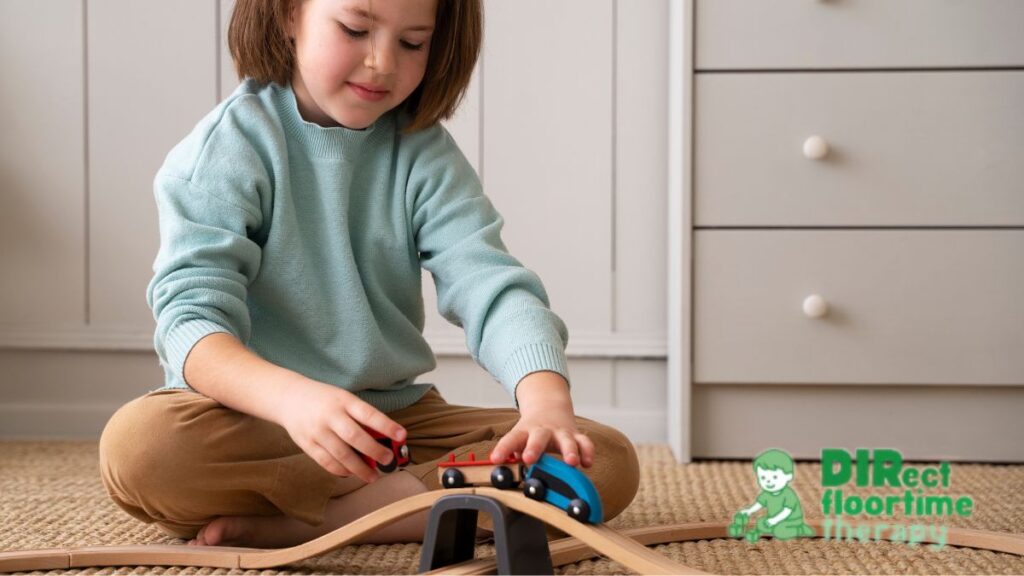
How can you use a child’s love for dinosaurs or coding in a DIR framework? Turn that interest into a two-way interaction. DIR play themes make this possible.
Examples of DIR Play Themes:
| Special Interest | DIR Play Theme Integration | Developmental Goal Addressed |
| Trains | Build a “train station” from blocks. Role-play as ticket agent and passenger. Let the train “crash” then “fix” it. | Symbolic thinking, problem-solving, emotional range (excitement, frustration) |
| Astronomy | Draw a star chart together. Take turns naming planets. Pretend to be astronauts exploring a new world. | Joint attention, shared imagination, two-way communication |
| Video Games | Act out a game scene. Take turns as hero and villain. Negotiate the “rules” in real life. | Social reciprocity, turn-taking, shared storytelling |
Using a child’s special interest this way means the adult follows the child’s lead. It’s not just play. It taps into the child’s strongest motivation to practice complex skills.
How to Implement DIR Play Themes
- Observation first: Notice what captivates your child, from favorite toys to preferred topics.
- Follow their lead: Let the child decide the pace, direction, and focus of play.
- Scaffold learning: Introduce new skills within the context of the child’s interest, keeping tasks achievable and engaging.
- Integrate multiple senses: Use visual, auditory, and tactile materials to enrich experiences.
Research by Greenspan and Wieder (2006) shows that play-based interventions in DIR enhance social, cognitive, and emotional development in children with autism. Hypothetically, a child interested in animals could create a “zoo” with figurines while practicing categorization and early math skills.
Motivation-Based Learning
Motivation-based learning leverages what naturally excites the child, turning engagement into skill-building without coercion. Motivation drives learning, attention, and memory retention, especially for autistic children with strong special interests.
For instance, if a child loves astronomy, you could:
- Use planets and stars to teach counting or basic physics concepts.
- Incorporate storytelling about space missions to enhance literacy.
- Introduce simple experiments to illustrate gravity or orbital paths.
This approach aligns with findings by Koegel et al. (2010), who reported that children with autism learn more effectively when instruction is embedded within their special interests. Motivation-based learning also encourages self-expression and fosters emotional regulation, as children remain calm and engaged in activities they genuinely enjoy.
| Interest Area | Learning Opportunities | Example Activities |
| Trains | Math, history, storytelling | Build a model railway, track schedules, write train stories |
| Animals | Biology, social skills | Create a zoo diorama, research animal habitats, role-play caretakers |
| Technology | Coding, problem-solving | Program simple apps, take apart and reassemble devices |
| Art & Music | Creativity, fine motor skills | Compose songs, paint characters, explore visual design |
Following the Child’s Lead
DIR emphasizes following the child’s lead to strengthen engagement and co-regulation. This technique respects the child’s pace, reduces frustration, and encourages voluntary participation.
Practical ways to follow the child’s lead include:
- Let the child choose: Allow them to select the activity, topic, or toy.
- Mirror actions and words: Reflect their gestures or vocabulary to build rapport.
- Offer gentle expansions: Introduce new ideas or challenges within the context of their interest.
- Observe for cues: Pay attention to signs of excitement, fatigue, or overwhelm to guide the interaction.
For example, a child who enjoys superheroes might start by drawing a favorite character. Parents could follow by asking questions about the character’s abilities, introducing problem-solving tasks, or encouraging the child to create a story around the character. Child-led interactions enhance social communication and emotional regulation.
Benefits of DIR for Special Interests

DIR strategies provide several key benefits:
- Enhanced engagement: Children focus longer on tasks that connect to their interests.
- Cognitive growth: Special interests can support problem-solving, memory, and sequencing skills.
- Social connection: Sharing interests provides natural opportunities for collaboration and conversation.
- Emotional regulation: Engagement in familiar topics reduces stress and helps children manage emotions.
For example, a child absorbed in a fascination with robotics can practice counting, sequencing, and teamwork by constructing simple machines. Simultaneously, following the child’s lead ensures that learning feels voluntary and enjoyable rather than forced.
Strategies to Turn Passions Into Learning
Parents and educators can use several strategies to leverage special interests:
- Integrate interests into academics: Align schoolwork with their passions. A math lesson could involve calculating train schedules, or a science activity could explore dinosaur habitats.
- Create multi-sensory experiences: Combine visual, auditory, and tactile elements to enrich engagement.
- Encourage storytelling: Let children narrate what they know about their interest, improving language and comprehension skills.
- Use interests for social learning: Facilitate group activities where children teach peers about their passions.
- Track progress: Record new skills and behaviors developed through these interest-based activities.
Incorporating special interests into learning fosters higher motivation, better skill retention, and improved social outcomes. Hypothetical cases include using LEGO structures to teach geometry concepts or exploring local wildlife to practice research skills.
Balancing Interests With Flexibility
While special interests are powerful tools, balance is key. Children should experience a variety of activities to ensure well-rounded development. Transition strategies include:
- Gradual integration: Introduce new activities slowly while maintaining familiar interests.
- Connect interests to other tasks: Use a love of animals to teach empathy or science.
- Monitor for rigidity: Ensure interests don’t limit exploration or social opportunities.
Flexible use of special interests enhances adaptability, promotes problem-solving, and supports emotional growth.
FAQ
1. How do I discover my child’s true special interest?
Observe patterns in play, questions, and enthusiasm. Notice what they return to repeatedly and explore deeply.
2. Can special interests change over time?
Yes. Interests evolve as children grow, influenced by new experiences and social exposure. Supporting transitions gently helps children adapt positively.
3. How can I use special interests to improve social skills?
Encourage peer activities around shared interests. Children often communicate more freely when discussing topics they love.
4. What if my child’s interest is very niche or unusual?
Any interest can be meaningful. Use it as a bridge to learning and social engagement, even if uncommon.
5. Are there ways to measure progress using special interests?
Yes. Track emerging skills, social interactions, and problem-solving within activities tied to their interests. Over time, these markers show growth and engagement.
Nurturing Growth Through Special Interests
Supporting autistic children through their special interests opens doors to learning, connection, and emotional growth. With DIRect Floorttime, parents can watch their child’s passions, follow their lead, and create motivation-driven learning moments. If you’re in New Jersey and want tips on using these strategies at home, reach out to us, we’re happy to help. DIR play themes give structure while staying flexible, letting children explore safely and confidently. Using their interests in school tasks, social activities, or daily routines boosts learning while building communication, problem-solving, and emotional regulation. Gentle guidance and creative approaches help children learn new skills without pressure. They discover ways to express themselves, share knowledge, and connect with others. DIRect Floorttime turns everyday play into meaningful growth, helping children flourish naturally while keeping learning fun and motivating.

