
Key Points
- The inability to wait is not a behavioral problem or a parenting failure. For autistic children, waiting is neurologically and developmentally demanding in ways that require specific, targeted support.
- Interoception, the brain’s ability to sense internal body states, plays a central role in frustration tolerance. Many autistic children struggle to read their own rising frustration until it has already reached a tipping point.
- Punishment and reward systems address the surface behavior of not waiting without building the underlying neurological capacity for tolerance. In many cases, they actively worsen the problem.
- DIR/Floortime builds frustration tolerance from the inside out, by strengthening emotional co-regulation, expanding the child’s window of tolerance, and using play to rehearse the experience of waiting in low-stakes, joyful contexts.
It is 5:15 PM on a Tuesday in Westfield, New Jersey. Dinner is twelve minutes away. The child knows this. He has been told. He has been shown the timer. And yet, from the kitchen, his mother can hear the sound that signals the beginning of the end of the evening: a low, rising whine that builds with mathematical precision into a full meltdown before the pasta has finished boiling.
“He cannot wait for anything,” she tells us in our first session. “Waiting for the bathroom. Waiting for his turn in a game. Waiting for me to get off the phone. It does not matter how long it is. Even thirty seconds is too long. And when I try to make him wait anyway, it gets so much worse.”
What this mother is describing is not a behavior problem. It is a neurological one. Research by Barkley (1997) in Psychological Bulletin established that the capacity to delay gratification and tolerate frustration is directly linked to executive functioning, specifically the ability to inhibit an immediate response while holding a goal in mind across time. For autistic children, executive functioning differences make this process significantly more effortful than it is for neurotypical peers. Asking an autistic child to simply wait is, in neurological terms, asking them to perform a feat of mental endurance that their current brain architecture is not yet equipped to sustain.
Understanding this does not mean accepting unlimited meltdowns at dinnertime. It means building the capacity for waiting in a way that actually works.
The Neuroscience of Waiting: What Is Actually Happening
Executive Functioning and the Waiting Brain
Waiting requires several executive functioning skills working simultaneously: impulse control, the ability to hold a goal in working memory, the capacity to regulate the emotional response to delay, and the ability to shift attention away from the desired outcome and toward an alternative focus. Research by Kenworthy et al. (2008) in the Journal of Autism and Developmental Disorders confirmed that autistic children show significant differences in executive functioning across all of these domains, with particular difficulty in cognitive flexibility, which is the ability to shift attention from one focus to another. When a child fixates on the fact that dinner is not yet ready, their brain is genuinely struggling to redirect attention elsewhere. This is not stubbornness. It is a neurological constraint.
Interoception: The Hidden Sensory System
One of the least discussed but most clinically significant factors in frustration tolerance is interoception, the brain’s ability to sense and interpret internal body states such as hunger, thirst, fatigue, and, critically, the physical sensations of rising frustration. Research by Mahler (2015), building on the foundational work of Craig (2002) in Nature Reviews Neuroscience, established that many autistic individuals have significant differences in interoceptive processing. They may not notice the early, subtle physical signals of frustration, the slight tension in the chest, the quickening of breath, the clenching of the hands, until those signals have escalated to a level that is already past the point of self-regulation. By the time they feel frustrated, they are already overwhelmed. There is no gentle warning system. It is zero to a hundred.
Time Perception Differences in Autism
Autistic individuals frequently experience time differently from neurotypical peers. Research by Szelag et al. (2004) in Acta Neurobiologiae Experimentalis found that autistic children show differences in temporal processing, making the subjective experience of waiting significantly more distorted than a clock would suggest. Twelve minutes until dinner does not feel like twelve minutes to an autistic child. It may feel like an indeterminate, unanchored stretch of time with no clear end. Without a reliable internal sense of time passing, waiting becomes not just uncomfortable but genuinely disorienting.
Why Punishment and Reward Systems Do Not Build Waiting Capacity
The most common approaches families are given for addressing waiting difficulties involve some form of consequence: a reward for waiting successfully, a punishment or loss of privilege for not waiting. These approaches are not without logic, and they can produce short-term behavioral compliance in some contexts. But they do not build the neurological capacity for frustration tolerance, and there are several reasons why.
They Address the Surface, Not the Foundation
A sticker chart for waiting successfully teaches a child to suppress the visible signs of frustration in order to earn a reward. It does not reduce the underlying neurological distress of waiting. The child is still experiencing the same interoceptive confusion, the same executive functioning demands, the same time perception differences. They are just masking the response. Research by Kapp et al. (2019) in Autism: The International Journal of Research and Practice confirmed that masking of this kind carries significant psychological and physiological costs over time, including elevated anxiety and increased likelihood of post-masking meltdowns.
They Can Damage the Regulatory Relationship
When a child is punished for a neurologically driven behavior that they genuinely cannot yet control, the message received is not ‘you need to try harder.’ It is ‘the people who are supposed to keep me safe are threatening me when I am already in distress.’ Porges’ Polyvagal Theory (2011) explains that a child’s nervous system is acutely attuned to signals of safety and threat from caregivers. Punishment during a state of neurological overwhelm activates the threat response and can undermine the very regulatory relationship that is the foundation of DIR/Floortime intervention.
They Skip the Step That Actually Matters
Before a child can learn to wait independently, they need to be able to wait co-regulatively, to tolerate the discomfort of delay while in the regulated, supportive presence of a calm adult. This step, which DIR/Floortime calls co-regulation, is skipped entirely in purely behavioral approaches. And without it, independent frustration tolerance has no foundation on which to build.

The DIR/Floortime Approach: Building Tolerance from the Inside Out
In the DIR/Floortime model developed by Dr. Stanley Greenspan and Dr. Serena Wieder, frustration tolerance is not a behavior to be trained. It is a developmental capacity to be grown, through relationship, emotional attunement, and gradually expanded co-regulatory experiences.
Stage One: Co-Regulation Before Self-Regulation
The starting point is not teaching the child to wait alone. It is teaching the child to wait with you. This means:
- Staying present. When your child is approaching their frustration threshold, move toward them rather than issuing a command from across the room. Your regulated nervous system is a resource their nervous system can borrow.
- Naming the internal experience. ‘I can see your body is feeling really impatient right now. That is a hard feeling.’ Naming the feeling without judgment supports the development of interoceptive awareness, giving the child language for the internal state they are struggling to identify.
- Bridging to the outcome. ‘Dinner is almost ready. Can you hear the water boiling? That means it is very close.’ Connecting the present moment to the anticipated outcome makes the waiting feel bounded and navigable rather than infinite.
Stage Two: Play-Based Rehearsal of Waiting
One of the most powerful and underused tools in DIR/Floortime is play-based rehearsal, using joyful, low-stakes play to practice the experience of waiting before the real-world demand arrives. Research by Whitebread and Basilio (2012) in the Journal of Psychological Issues in Education confirmed that children who rehearse self-regulatory behaviors in play contexts show significantly greater transfer of those behaviors to real-world situations than children who receive only direct instruction.
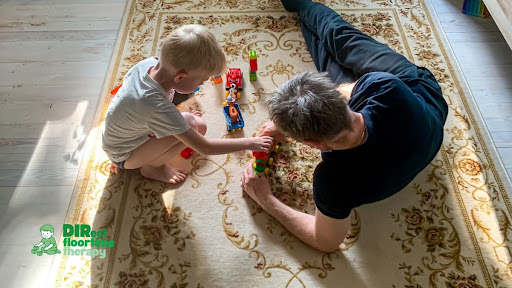
In NJ homes, this might look like:
- Slow-motion games. Race to put on shoes, but in slow motion. Who can move the slowest? This builds voluntary inhibition of impulse in a context where inhibiting feels funny rather than frustrating.
- Turn-taking with a meaningful wait. Play a game where each person takes a turn doing something the child genuinely enjoys, spinning a top, blowing a bubble, knocking down blocks. The wait is real and feels long, but the payoff is immediately rewarding and the context is safe.
- The ‘Pause’ game. In the middle of a favorite song or story, pause and wait. How long can both of you hold the pause before the child bursts with excitement? Extend it by a second each time. This is waiting made joyful.
Stage Three: Expanding the Window Gradually
Once a child can tolerate a brief wait in a playful, co-regulated context, the goal is to expand that window incrementally, always staying within the child’s current regulatory capacity.
- Start with seconds, not minutes. A child who cannot tolerate thirty seconds of waiting is not going to learn to wait five minutes through direct practice. Start at ten seconds of successful, co-regulated waiting and build from there.
- Use visual anchors for time. Visual timers, particularly sand timers or color-changing countdown timers, externalize the passage of time in a way that compensates for the internal time perception differences many autistic children experience. The Time Timer brand is widely used and recommended by OTs across New Jersey.
- Celebrate the window, not the outcome. When a child waits successfully, the celebration should be about the effort of waiting, not just the arrival of what they were waiting for. ‘You held on through that really hard part. That was incredible.’ This builds intrinsic awareness of their own regulatory capacity.
Stage Four: Interoception-Building Activities
Because so much of the frustration tolerance challenge is rooted in interoceptive differences, building interoceptive awareness is a direct and evidence-based pathway to improving waiting capacity. Occupational therapist Kelly Mahler’s research on interoception has produced a widely used curriculum of body-awareness activities that help autistic children develop greater sensitivity to their internal states before those states reach a crisis point. In NJ, many occupational therapists incorporate interoception-focused activities into their sessions. Ask your child’s OT specifically about interoception if waiting and frustration tolerance are significant challenges.
Practical Strategies for NJ Families Right Now
- Create a ‘waiting kit.’ A small bag containing two or three highly preferred, portable items, a fidget, a small book, a sensory toy, that your child only has access to during waiting periods. The waiting kit makes waiting associated with access to preferred items rather than deprivation.
- Give advance warning, consistently. Five-minute warnings before any transition or anticipated wait. Two-minute warnings. One-minute warnings. Predictability reduces the anxiety that amplifies frustration. Inconsistent warnings are almost as disruptive as no warnings at all.
- Teach ‘waiting words.’ Help your child develop a small vocabulary for communicating their waiting state: ‘I am waiting,’ ‘This is hard,’ ‘How much longer?’ A child who can communicate their distress is a child who has more options than a meltdown.
- Reduce unnecessary waiting wherever possible. Not all waiting is necessary. Where it can be eliminated without undermining development, eliminate it. Save the waiting practice for contexts where it genuinely matters.
- Stay regulated yourself. Your child’s nervous system is reading yours. A parent who is tense and impatient during a child’s waiting struggle amplifies the child’s distress. Taking a slow breath, softening your posture, and speaking in a lower, slower tone are not small things. They are regulatory inputs for your child’s nervous system.
FAQs
Is the inability to wait a sign of autism or just typical toddler behavior?
Frustration with waiting is developmentally normal in young children. The distinction lies in persistence, intensity, and the underlying neurological pattern. A five-year-old who consistently cannot wait for more than thirty seconds, who escalates rapidly to a meltdown, and who shows no improvement with typical parenting strategies may be experiencing executive functioning or interoceptive differences that warrant professional evaluation. Context always matters. Bring your observations to a developmental specialist.
My child can wait at school but falls apart at home. Why?
This is one of the most common patterns we see across NJ. School typically provides external scaffolding for waiting, structured routines, visual schedules, predictable transitions, and a teacher who manages the whole group’s pacing. At home, that scaffolding is absent, and the child is also carrying the regulatory debt of a full school day of masking and effort. The meltdown at home is not evidence that your child ‘can’ wait. It is evidence that they used all of their waiting capacity at school and have none left.
How long does it take to build frustration tolerance with DIR/Floortime?
There is no universal timeline. Research by Solomon et al. (2007) in Developmental and Behavioral Pediatrics found that families who engaged consistently in DIR/Floortime-based intervention saw measurable improvements in emotional regulation within three to six months. The key variables are consistency, the parent’s own regulatory capacity, and how well the intervention is matched to the child’s current developmental level.
Should I use a visual timer?
For most autistic children in NJ who struggle with waiting, yes. Visual timers externalize the passage of time in a concrete, non-abstract way that compensates for internal time perception differences. The Time Timer is the most widely recommended option by occupational therapists and is available at most major retailers in New Jersey and online.
Waiting Is a Skill, Not a Given
The capacity to wait is not something children are born with or without. It is a developmental achievement that grows from a foundation of neurological readiness, emotional safety, and repeated, supported practice. For autistic children, that foundation requires more careful construction than it does for neurotypical peers. But it can be built.
DIR/Floortime does not promise that your child will never struggle with waiting. It promises something more meaningful: that as the relationship deepens, as the co-regulatory capacity grows, and as the child’s own interoceptive awareness expands, the window of tolerance will widen. The meltdowns will become less frequent. The recovery will become faster. And the moments of genuine, joyful waiting, the pause before the bubble pops, the held breath before the jack-in-the-box springs, will begin to feel less like a battle and more like a game.
Contact Direct Floortime today to learn how our parent coaching program can help your family build genuine frustration tolerance through a relationship-first approach.