Key Points:
- Lining up, sorting, and spinning are not random or meaningless. They are the nervous system’s most efficient available tool for creating order, predictability, and regulatory calm: When a child with autism arranges objects with meticulous precision or spins a wheel for twenty uninterrupted minutes, their brain is doing something very specific and very purposeful. Understanding what it is doing changes everything about how a parent or therapist responds to it.
- These rituals are not obstacles to development; they are the current leading edge of it: A child’s lining behavior, their color-sorting system, their wheel-spinning ritual is the place where their nervous system is currently most organized, most engaged, and most available. DIR/Floortime enters that place rather than redirecting away from it, because entering is what opens the door to everything beyond.
- Disrupting a ritual without understanding its function often produces the opposite of the intended effect: Parents and teachers who interrupt lining or spinning in an attempt to ‘redirect to more appropriate play’ often trigger the exact dysregulation they were trying to prevent, because they have removed the regulatory scaffold the child’s nervous system was depending on. Understanding the function comes before any intervention.
- Restricted interests and repetitive behaviors are clinically distinct, and the distinction matters for how DIR/Floortime approaches them: A child who sorts by color because it produces sensory-regulatory calm is using a different neurological mechanism than a child who lines up cars in a specific order because the order encodes a narrative with emotional significance. The intervention that works for one may not work for the other, and a skilled Floortime therapist in New Jersey will assess which is operating before deciding how to engage.
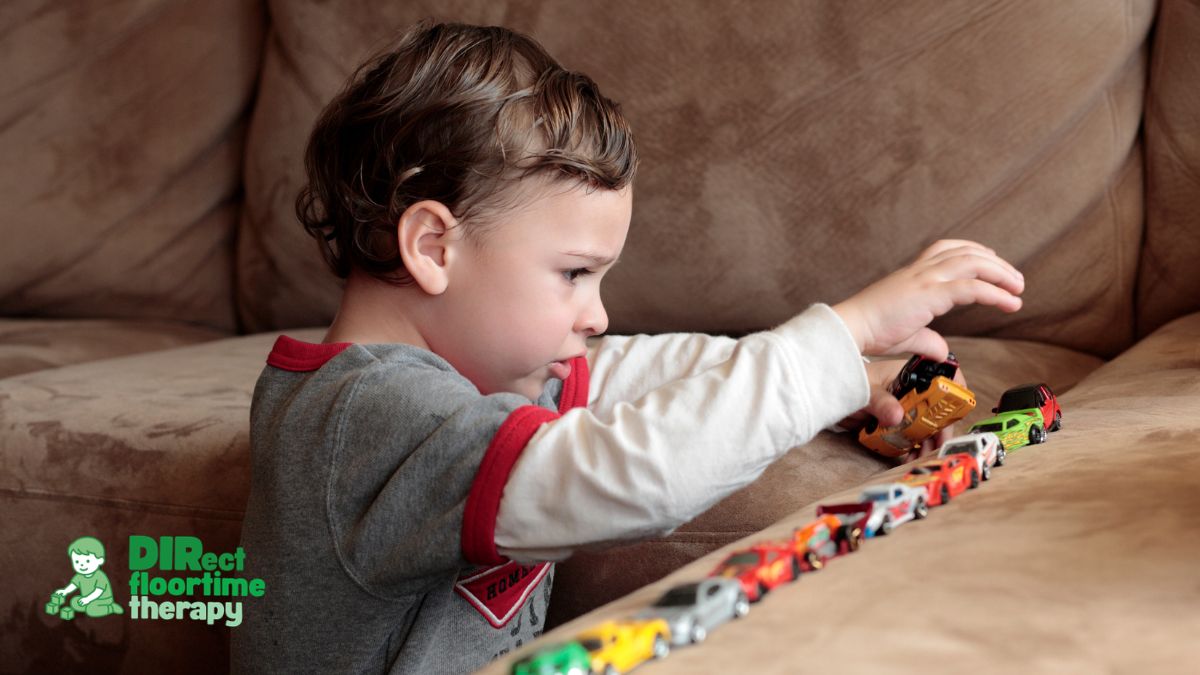
Lining up, sorting, and spinning are not random or meaningless. For a child with autism, these actions are the nervous system’s most efficient tools for creating order, predictability, and regulatory calm. When a child arranges objects with meticulous precision or spins a wheel for twenty uninterrupted minutes, their brain is performing a purposeful task. Understanding what the brain is doing changes everything about how a parent or therapist responds.
In the DIR/Floortime model, these rituals are not viewed as obstacles to development; they are the current leading edge of it. A child’s lining behavior or color-sorting system is the place where their nervous system is currently most organized and engaged. By entering that world rather than redirecting away from it, we open the door to everything beyond.
The Story of the Windowsill: A Lesson from Toms River
Rodrigo had kept his rock collection in a specific order for fourteen months on the windowsill of his bedroom in Toms River, New Jersey. They were arranged by size, with three mysterious exceptions: a piece of white quartz always third from the left, a flat gray slate in the exact center, and a small piece of red jasper at the end.
His father, David, had tried to engage for months by buying identification books and suggesting display cases. Frustrated by the “obsessive” nature of the sorting, David eventually lost patience during a “full reset” and swept the rocks into a box on a high shelf.
The result was the “worst night in months.” David realized later that the rocks weren’t just a collection; they were a regulatory scaffold. By removing them, he hadn’t encouraged “better play”—he had dismantled his son’s sense of safety. Through DIR/Floortime, David learned that the windowsill wasn’t a barrier; it was a sanctuary.
What the Brain Is Actually Doing
The clinical term for these behaviors is Restricted and Repetitive Behaviors (RRBs). While the DSM-5 uses this for diagnosis, it doesn’t explain the function. Modern neuroscience suggests three primary drivers:
1. The Regulatory Function: Managing Environmental Chaos
For many children, the world is a barrage of unpredictable sounds, shifting social cues, and unexpected textures. Against this chaos, a line of cars offers absolute, controllable order.
2. Predictive Processing: The Brain That Craves Certainty
The “Predictive Processing” theory suggests the autistic brain is highly sensitive to “prediction errors”—moments when the world doesn’t match expectations. Repetitive behaviors minimize these errors. A spinning wheel produces the same visual and auditory input every single time, creating an “island of predictability.”
3. The Communicative Function: The Arrangement as Narrative
For many children, especially gestalt language processors, the arrangement encodes meaning. The order of objects may represent a story, a hierarchy, or an emotional state that the child cannot yet express in words.
The Six Most Common Rituals New Jersey Parents Ask About
| Ritual | Functional Explanation | Floortime Entry Point |
| Lining Up Objects | Creating a relational hierarchy or encoding a narrative. | Observe the “logic” of the line. Don’t touch; just wonder. |
| Spinning Wheels/Tops | Visual input (rotational blur) that calms the arousal system. | Parallel play. Spin your own object nearby and wait for a glance. |
| Color Sorting | Cognitive drive for categorical order and aesthetic satisfaction. | Add an object to the pile. See if they accept or correct you. |
| Specific Routes | Minimizing “prediction error” during navigation. | Narrate changes early. Use co-regulation to handle transitions. |
| Geometric Alignment | High sensitivity to spatial deviation; architectural precision. | Misalign an object slightly and let the child “correct” you. |
| Restricted Interests | Mastery, self-esteem, and a primary narrative framework. | Become a student of the topic. Ask real, curious questions. |
Entering vs. Redirecting: Why the Difference Matters
Most behavioral approaches use redirection—interrupting the behavior to point the child toward something “appropriate.” However, removing a regulatory tool often leads to destabilization.
DIR/Floortime uses Entering. We join the child’s world to build a relationship from the inside out.
The Four Stages of Floortime Entry
- Observation: Watch for two minutes. What is the rule? How does their body look?
- Parallel Engagement: Do the same thing in your own space. Spin your own coin; sort your own blocks.
- Gentle Intersection: Create a point of contact. Let your car “bump” their line or place an object slightly out of place.
- Collaborative Elaboration: The ritual becomes a shared game. The “solitary” act becomes a circle of communication.
What NJ Parents Can Practice at Home Right Now
- Observe Before You Intervene: Build the habit of watching with curiosity rather than a plan to “fix.”
- Join Before You Expand: Whether you are in Manalapan, Montville, or Moorestown, get on the floor. Let your child notice you without making a demand.
- Protect the Tool: During high-stress times (like starting a new school year in New Jersey), allow the repetitive behavior. It is helping them cope.
- Treat Interests as Invitations: If your child loves NJ Transit rail history or the geology of the Palisades, learn it with them. Authentic interest is the most powerful gift you can give.
“The rituals your child performs are not walls. They are doors, built by a nervous system that is doing its best.”
Frequently Asked Questions
When is a behavior concerning?
Look for “red flags” like self-injury, extreme distress that cannot be regulated even with the ritual, or behaviors that prevent eating and sleeping. Otherwise, it is likely functional.
What about school?
The goal isn’t to stop the behavior but to find “context-appropriate” sensory tools. A DIR/Floortime therapist can help your child’s IEP team understand that a fidget tool or a transition ritual is a neurological necessity, not a distraction.
Does using the behavior as a reward work?
Withholding a “spinning toy” until a task is done might get compliance, but it turns a safety tool into a bribe. Floortime avoids this, treating the interest as an unconditional bridge to connection.
The Rocks Come Back
David eventually returned the rocks to the windowsill. He didn’t just put them back; he sat with Rodrigo and watched the white quartz go third and the red jasper go last. He realized it was a sentence he hadn’t learned to read yet.
When David picked up a small rock and held it out, Rodrigo didn’t pull away. He took it, placed it, and then—for the first time—picked up another and handed it to his father. The doorway had finally opened.
At Direct Floortime, our New Jersey therapists are here to help you find the key to those doors.