
Key Takeaways:
- Floortime supports six core social-emotional developmental stages, from self-regulation to emotional thinking.
- Through child-led play, Floortime builds deeper relationships and enhances communication.
- Regular Floortime interaction promotes problem-solving, symbolic play, and logical thinking.
Ever find yourself wondering how to help your child grow with confidence and curiosity? One of the most powerful ways to support their development is through meaningful, playful connection. Floortime makes this easier by turning everyday moments into opportunities for emotional, social, and cognitive growth.
Children learn best when they feel understood, supported, and encouraged to explore at their own pace. This approach nurtures developmental milestones naturally while keeping play at the heart of learning. Want to see how these moments build real progress? Let’s look at the milestones Floortime helps your child achieve.
Shared Attention and Interest in the World
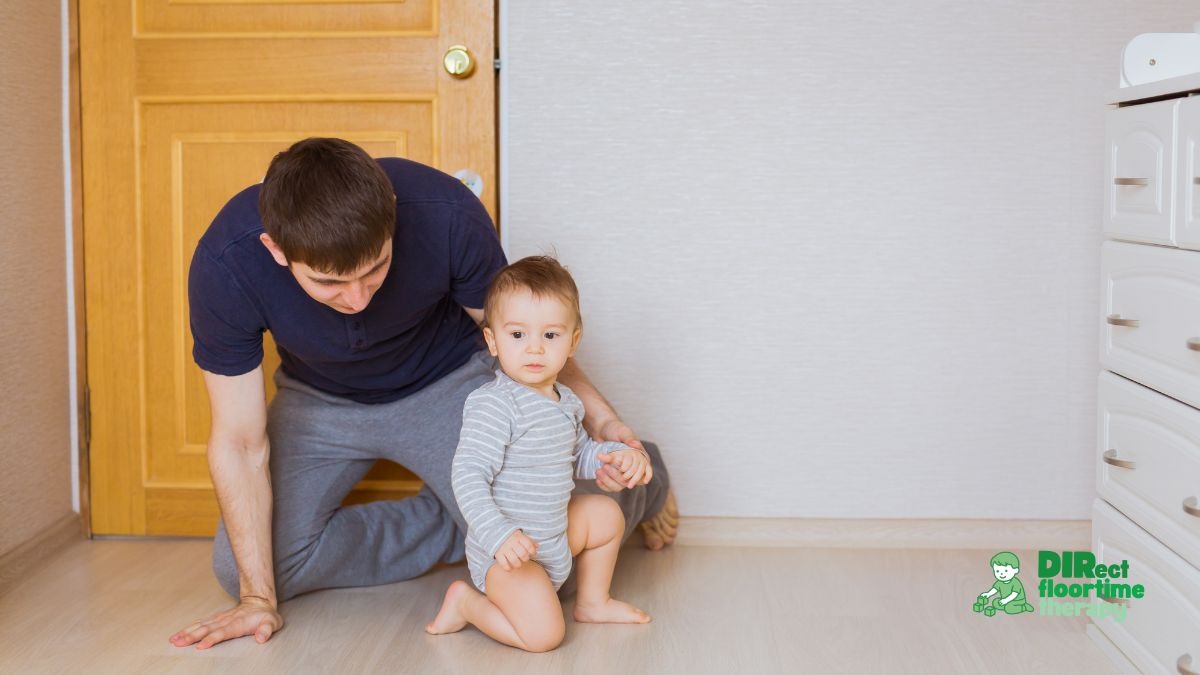
One of the first milestones in the DIR/Floortime model is self-regulation and interest in the world. At this stage, a child learns to stay calm, feel safe, and focus on both people and objects. According to Wright-founded Floortime resources, this sets the foundation for all further learning.
In practice, a caregiver might simply sit beside a child, tuning into their breathing, voice, and movements, offering a steady presence without overstimulation. This environment helps the child feel grounded, emotionally and physically. Over time, as a child becomes more regulated, they’re better equipped to pay attention, stay engaged, and respond to their surroundings in meaningful ways.
Supporting self-regulation this way isn’t just about quiet play. It builds neural capacity for sustained attention and helps the child gradually handle emotional arousal. In Floortime, this early milestone allows for a gentler, relationship-centered path forward.
Engagement and Building Relationships
The second milestone is engagement and relating. Here, a child learns to form meaningful connections with others, showing interest in people, not just objects. s In DIR theory, this emotional bond establishes trust and a sense of safety, two ingredients critical for later communication and thinking.
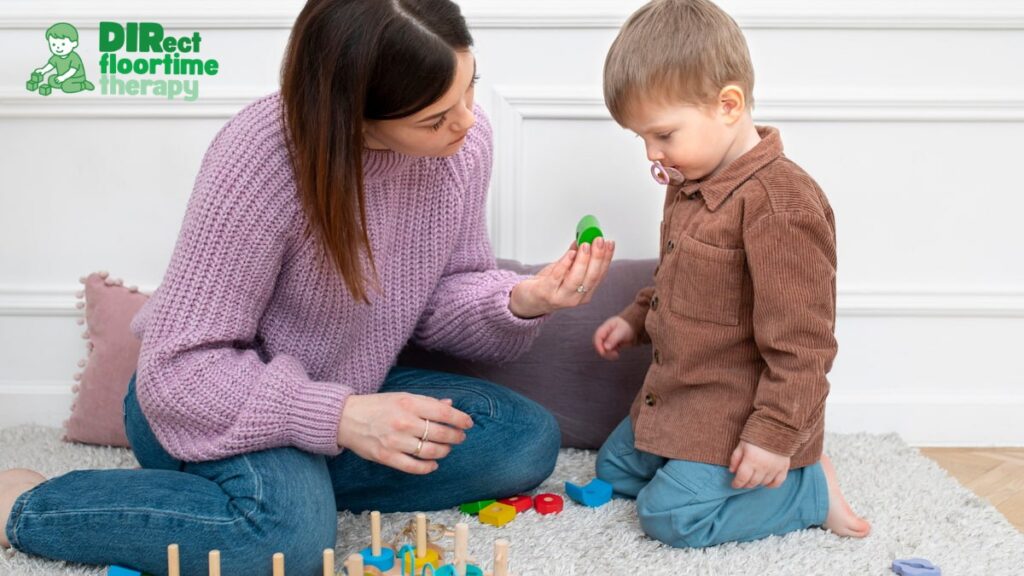
During Floortime, caregivers encourage relational play by following the child’s interests, mirroring actions, and using warm, responsive interaction. For example, if a child is lining up toy cars, a parent might bring in their own car and match the pace, inviting shared attention and co-play.
Strengthening these relationships creates a secure base for the child. They learn that others are predictable and responsive, which fosters further exploration, confidence, and willingness to engage in more complex interactions.
Two-Way Intentional Communication
At this third milestone, two-way intentional communication begins to take shape. The child learns to open and close “circles of communication,” by initiating interaction, waiting for a response, and responding back.
This can start through simple gestures, vocalizations, or facial expressions. Through back-and-forth exchanges, even nonverbal ones, the child begins to understand cause and effect in social interaction. Caregivers support this by following the child’s lead, waiting, and then responding meaningfully.
Such reciprocal exchanges help the child feel heard and understood, which in turn encourages more communication. Over time, this builds the foundation for more complex language, shared play, and social problem-solving.
Social Problem-Solving and Interactive Flow
The fourth milestone is social problem-solving – continuous two-way interaction. Here, children begin using gestures, vocalizations, or play to express needs, desires, or ideas, and to ask for help or cooperation.
In Floortime play, caregivers can gently introduce challenges: delay handing over a toy, make a small “mistake” and invite the child to help, or pause and look expectantly. These moments provide natural opportunities for the child to communicate solutions, negotiate, wait, or persist, all central to problem-solving.
This flow builds not only pragmatic interaction skills, but also resilience. When the child notices their actions influence another person’s behavior, they gain confidence. They learn how to handle frustration, collaborate, and persist in a playful, supportive space.
Symbolic Play and Use of Ideas
Milestone five is symbolic play, or the meaningful use of symbolic ideas. This involves using words, imaginations, and symbolic actions (like pretend play) to express thoughts, feelings, and creativity.
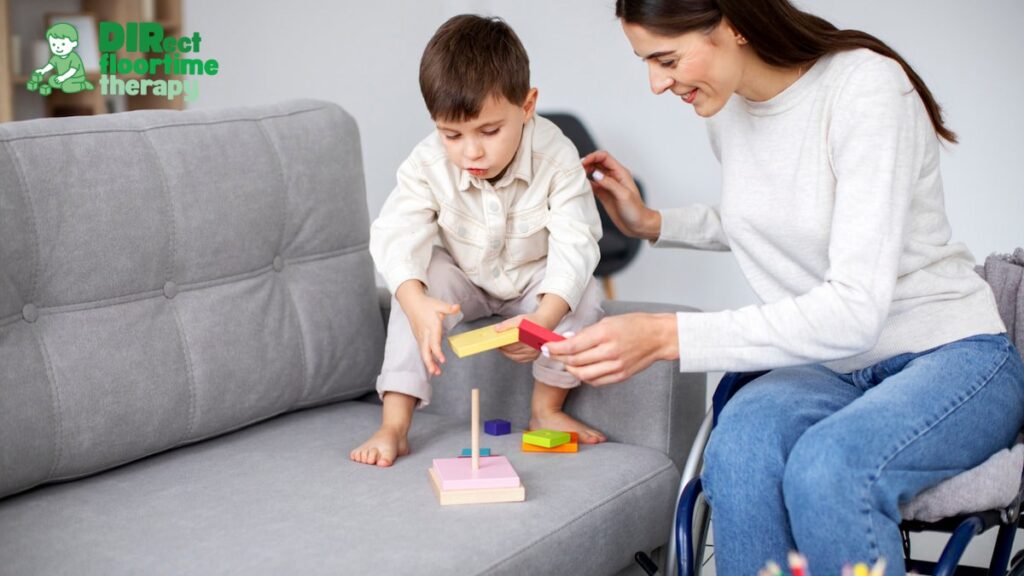
At this stage, a child might begin imaginative play: pretending a block is a car, using a spoon to “feed” a teddy bear, or telling stories about make-believe worlds. As caregivers join in, they can expand on these ideas, suggesting new roles, introducing new characters, or asking open-ended questions.
Symbolic play is powerful. It strengthens language, helps children externalize, and therefore process emotional experiences, and supports flexible thinking. It marks a shift from responding only to immediate needs, to exploring abstract ideas, emotions, and narratives.
Emotional Thinking and Bridging Ideas
The sixth milestone is emotional thinking, sometimes called “bridging ideas.” This is where a child begins to reason, make logical connections, and consider emotional states, both their own and others’.
At this advanced level, a child might talk about past experiences, imagine future scenarios, or consider how someone feels. In Floortime, caregivers can gently guide this by expanding on ideas, asking reflective questions (“How do you think Teddy felt when…?”), or helping the child predict “what might happen next” in their play.
This stage supports empathy, moral reasoning, and complex problem-solving. It allows children to make sense of their world in a richer, more emotionally nuanced way, and to think logically while still honoring feelings.
Putting It All Together: How These Milestones Help Day to Day
Here’s a quick look at how these developmental milestones map onto real-life growth:
| Milestone | Daily Benefit |
| Self-regulation | Ability to calm down, focus, and stay present |
| Engagement | Stronger relationships with caregivers and peers |
| Two-way Communication | More back-and-forth interaction and understanding |
| Problem-solving | Increased resilience, negotiation, and collaboration |
| Symbolic Play | Imagination, creativity, and emotional expression |
| Emotional Thinking | Empathy, reasoning, and deeper self-awareness |
Why These Milestones Matter for Your Child’s Future
Helping your child reach these milestones isn’t just about “therapy.” It’s about supporting their ability to engage meaningfully with the world and with others. When a child builds these skills:
- They are more emotionally resilient.
- Their relationships become richer and more trusting.
- They communicate more effectively.
- They navigate social challenges with confidence.
- They can plan, imagine, and reflect, all critical skills for lifelong learning.
Research supports that DIR/Floortime-based programs can lead to measurable gains in socio-emotional development. A systematic review found most improvements in social and emotional capacity among participating children. Another review showed that greater parental engagement in Floortime is linked with stronger social outcomes.
Tips for Parents to Support These Milestones
- Be consistent. Aim for regular one-on-one Floortime sessions, ideally 20–30 minutes, multiple times a day.
- Follow your child’s lead. Let them guide the play, and join in gently without taking over.
- Use emotional rewards. Smile, echo their sounds, reflect their feelings, these are powerful motivators.
- Introduce small challenges. Build problem-solving by pausing, delaying a toy, or making mild “mistakes” in play.
- Expand symbolic play. Use imaginative scenarios, pretend games, and storytelling to deepen creativity.
- Reflect together. Ask open-ended, gentle questions about thoughts or emotions your child expressed during play.
Evidence and Limitations
While Floortime has strong conceptual appeal and many encouraging testimonials, its research base is still emerging. The systematic review mentioned earlier highlighted that most of the nine studies showed improvements in emotional development, but the quality of studies varied.
Some experts note that high intensity and consistent caregiver engagement are key to success. Also, because Floortime is child-led and unstructured by design, results may appear more gradually than in more behaviorist approaches.
Frequently Asked Questions
At what age can Floortime help with these six milestones?
Floortime is effective at almost any age, but it’s often most beneficial when started early, as children naturally progress through these milestones in early childhood.
How much time should we spend doing Floortime?
Ideally, families aim for 20–30-minute sessions multiple times a day, plus incidental interactions throughout daily routines.
Do we need a professional to do Floortime, or can parents lead the process?
Parents play a central role. While professionals can guide the process, much of the development happens through consistent, everyday play with caregivers.
Help Your Child Reach These Key Milestones With Playful Connection
Floortime makes developmental progress feel natural and engaging by turning everyday interactions into learning opportunities. Through guided play, your child practices problem solving, emotional regulation, shared attention, and early thinking skills. DIRect Floortime Therapy gives your child the chance to build these skills at a pace that feels comfortable and encouraging.
Families across New Jersey and nearby areas often notice that their child becomes more expressive, more curious, and more connected when therapy focuses on shared play and warm interaction. With the right guidance, each milestone becomes easier to reach and more enjoyable to practice.
If you want a supportive path that builds confidence along with developmental progress, we can help you get started. Contact us today to learn how this approach can support your child’s growth.