

Key Points:
- Relationship-first results: DIR/Floortime builds genuine emotional connections and communication skills by following the child’s natural interests, not scripted drills.
- New Jersey families are noticing the difference: Parents across Central and Northern New Jersey report that Floortime therapy sparks joyful engagement, reduced meltdowns, and stronger parent-child bonds.
- Child-led means more lasting change: When children drive the learning, they internalize skills organically making progress that holds up at home, in school, and in the community.
- Not an either/or: Many NJ families successfully combine DIR/Floortime with speech therapy or OT for a well-rounded developmental plan.
If you are a parent in New Jersey raising a child with autism spectrum disorder (ASD) or developmental delays, you have likely heard about Applied Behavior Analysis (ABA) therapy. For decades, ABA has been the dominant approach recommended by schools and insurance providers. But across Central Jersey, Northern Jersey, and beyond, a growing number of families are asking a different question: Is there another way?
The answer, for many, has been DIR/Floortime; a developmental, relationship-based therapy model that centers the child’s emotions, sensory needs, and natural curiosity. This is not just a trend. It reflects a deeper shift in how parents, pediatric therapists, and developmental specialists in New Jersey are thinking about what children with autism truly need to thrive.
Understanding the Core Difference: ABA vs. DIR/Floortime
Before exploring why New Jersey families are making the switch, it helps to understand what sets these two approaches apart at their core.
What Is ABA Therapy?
Applied Behavior Analysis is a structured, reinforcement-based approach that targets specific behaviors. Sessions typically involve a therapist presenting a task, the child completing it, and receiving a reward (like a sticker, praise, or a preferred snack) for correct responses. ABA focuses heavily on measurable behavioral outcomes, reducing behaviors deemed problematic, such as stimming or aggression, and increasing desired behaviors like eye contact or following directions.
While ABA has documented short-term behavioral gains, critics including many autistic adults and developmental researchers have raised concerns about its focus on compliance over connection, and its tendency to suppress natural self-regulatory behaviors without addressing the underlying emotional or sensory causes.
What Is DIR/Floortime?
The Developmental, Individual Difference, Relationship-Based (DIR) model, developed by Dr. Stanley Greenspan and Dr. Serena Wieder, takes an entirely different starting point. Instead of shaping behavior from the outside in, DIR/Floortime works from the inside out, meeting the child exactly where they are emotionally and developmentally.
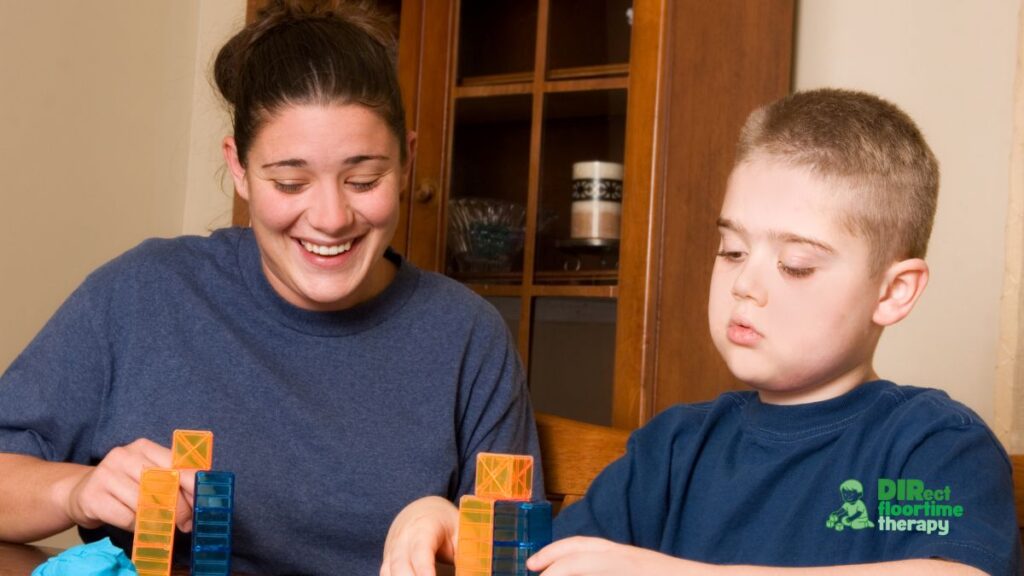
In a Floortime session, the therapist (or parent) gets down on the floor with the child and joins their world. If a child is spinning a toy car wheel, the therapist doesn’t redirect that behavior they follow it, engage with it, and use it as a doorway to genuine communication and emotional connection. The goal is not compliance. The goal is joyful engagement, two-way communication, and authentic developmental growth.
5 Reasons New Jersey Families Are Choosing DIR/Floortime
1. It Addresses the Why, Not Just the What
One of the most common frustrations parents in New Jersey express about traditional ABA is that their child may learn to stop a behavior in a therapy room but still struggle to regulate at home, at school, or on the playground. That is because ABA targets the behavior — the what — without always addressing the sensory, emotional, or neurological reasons behind it.
Consider a child who hits their head when overwhelmed by loud sounds in a grocery store. ABA might train the child not to hit their head by rewarding alternative behaviors. DIR/Floortime asks: Why is this child overwhelmed? What is their sensory profile? How can we build their capacity to process auditory input and communicate distress before it reaches a crisis point?
By addressing root causes ; sensory hypersensitivity, emotional dysregulation, limited communication tools — DIR/Floortime creates more durable change.
2. It Honors the Child’s Individuality
Every child with autism is different. Some are hypersensitive to sound, light, or touch. Others seek intense sensory input; craving deep pressure, loud noises, or constant movement. Some children are natural visual thinkers. Others process the world through movement or rhythm.
The “Individual Difference” component of DIR/Floortime means that no two therapy plans are the same. A child in Middlesex County, NJ who shuts down in bright, noisy environments will receive a completely different sensory and developmental roadmap than a child in Monmouth County who seeks constant stimulation. Therapists assess each child’s unique sensory processing profile, motor planning abilities, and emotional regulation patterns — then design activities that work with, not against, how that child’s brain is wired.
3. Parents Become Partners, Not Observers
One of the most transformative aspects of DIR/Floortime for New Jersey families is the active role parents play. Unlike many traditional ABA programs where therapy happens in a clinic with limited parent involvement, DIR/Floortime is designed to be practiced at home, every day, in natural settings.
Parents learn to follow their child’s lead during bath time, meals, and backyard play. They discover how to turn a spontaneous interest in lining up toy trucks into a rich back-and-forth interaction that builds language, problem-solving, and emotional security. A 2021 systematic review published in developmental psychology literature found that home-based DIR/Floortime led to significant improvements in parent-child interaction quality and child social-emotional functioning — outcomes that extended well beyond the therapy session itself.
For families in New Jersey juggling busy schedules, school IEPs, and the emotional weight of parenting a child with developmental differences, the empowerment that comes from knowing exactly how to connect with your child is invaluable.
4. It Works Across Multiple Diagnoses and Developmental Levels
DIR/Floortime is not exclusively for children with autism, though it has an especially strong evidence base in that area. In New Jersey, families of children with the following profiles have found meaningful benefit from Floortime therapy:
- Autism Spectrum Disorder (ASD): Improved social engagement, eye contact, and two-way communication
- Sensory Processing Disorder (SPD): Better tolerance for textures, sounds, and transitions
- Speech and Language Delays: Increased spontaneous vocalization and functional communication
- ADHD: Improved attention and emotional self-regulation through co-regulation strategies
- Global Developmental Delays: Progress across motor, cognitive, and social-emotional domains
Because DIR/Floortime starts by assessing where a child currently is on the developmental ladder, it is effective even for children who are pre-verbal, have co-occurring sensory challenges, or have not responded well to other intervention models.
5. It Aligns With What the Research and Autistic Adults Are Saying
The conversation around autism therapy has evolved significantly over the past decade. Autistic self-advocates have been vocal about the harm that can come from therapies that prioritize appearing neurotypical over genuine wellbeing. Many autistic adults who experienced intensive ABA as children describe anxiety, trauma responses, and a deep sense of shame around their natural way of being.
DIR/Floortime, by contrast, celebrates neurodiversity. It does not ask a child to suppress their interests, mask their sensory needs, or perform neurotypical behavior. Instead, it asks: What does this child love? What brings them alive? How can we use that as the foundation for growth?
Research increasingly supports this approach. Studies show that DIR/Floortime improves core developmental capacities including emotional regulation, intentional communication, and adaptive behavior and that these gains generalize across settings in ways that purely behavioral approaches often do not.
What Does a DIR/Floortime Session Look Like in Practice?
For New Jersey parents who have only experienced structured ABA sessions, a first Floortime session can feel surprisingly… playful. Here is a realistic picture of what to expect:
A six-year-old boy with autism and significant sensory sensitivities arrives at the session. He immediately gravitates toward a bin of kinetic sand in the corner. Rather than redirecting him to a table task, the therapist sits beside him, mirrors his movements — pressing hands into the sand, making tracks, observing his facial expressions. When the child looks up briefly, the therapist mirrors a smile. The child looks again, this time with intention. A back-and-forth begins not with words, but with shared attention and gesture. The therapist introduces a small toy car, and for a moment, the child pauses, considers, then runs the car through the sand toward the therapist’s hands. Contact. Connection. Communication.
This is DIR/Floortime in action. From that single moment of shared sand play, the therapist is tracking: sensory tolerance (tactile input via the sand), social referencing (looking up at the therapist), intentional communication (directing the car), and emotional co-regulation (staying calm and engaged in an interactive exchange).
Over time, these micro-moments of connection stack into foundational developmental skills — skills that show up not just in therapy, but in the cafeteria, on the soccer field, and at the dinner table.
Can DIR/Floortime and ABA Work Together?
This is a question many New Jersey parents ask especially those whose children are currently enrolled in ABA programs through their school districts or early intervention services. The answer is: it depends, and it is worth a careful conversation with your child’s treatment team.
Some families find that modern, naturalistic ABA which has evolved considerably from older, more rigid formats can complement DIR/Floortime principles. Others find that the underlying philosophies create friction, particularly when ABA components focus heavily on compliance and Floortime focuses on child-led autonomy.
What DIR/Floortime pairs exceptionally well with, consistently, is occupational therapy (OT) for sensory integration and speech-language therapy. In New Jersey, many developmental pediatricians and child psychologists now recommend a Floortime-centered model that incorporates OT and speech as complementary supports rather than treating behavioral compliance as the primary goal.
Frequently Asked Questions from New Jersey Families
Is DIR/Floortime covered by insurance in New Jersey?
Insurance coverage for DIR/Floortime varies. New Jersey’s autism insurance mandate (NJ S1651) requires coverage for medically necessary autism treatments, though specific coverage for Floortime-based services depends on your plan and how services are coded. We recommend contacting your insurance provider and asking specifically about coverage for developmental therapy or relationship-based intervention. Our team at Direct Floortime can assist families in navigating this process.
How early can my child start DIR/Floortime?
The earlier, the better. The brain is most neuroplastic in the first five years of life, making early intervention the highest-leverage window for developmental support. DIR/Floortime can begin as early as 12 to 18 months, as soon as developmental differences are noticed. In New Jersey, early intervention services for children under three are available through the Early Intervention Program (EIP), and Floortime principles can often be incorporated into those services.
What if my child is non-verbal or has significant support needs?
DIR/Floortime is particularly powerful for pre-verbal and minimally verbal children because it does not require language to begin. Communication in Floortime starts with gesture, gaze, shared attention, and affect all of which are accessible to non-verbal children. Many of the most significant Floortime success stories involve children who were non-verbal at age three and developed functional, spontaneous communication by age six or seven through consistent Floortime engagement.
How is progress measured in DIR/Floortime?
Progress in DIR/Floortime is tracked through the Functional Emotional Developmental Levels (FEDLs), the six stages of social-emotional development that the DIR model is built around. Clinicians observe and document changes in a child’s ability to self-regulate, engage reciprocally, communicate intentionally, participate in complex social problem-solving, and integrate emotional and logical thinking. Progress is also tracked through parent-report tools and video review of sessions over time.
Helping Your Child Connect, Communicate, and Thrive in New Jersey
The shift we are seeing among New Jersey families is not about rejecting all that behavioral therapy has offered. It is about asking a bigger question: What does my child need to feel safe, connected, and capable not just in a therapy room, but in their whole life?
DIR/Floortime answers that question with warmth, research, and deep respect for each child’s unique developmental profile. By building from the inside out , from emotional security to communication, from sensory regulation to complex thinking, it creates the kind of growth that sticks.
If you are based in Central Jersey, Northern New Jersey, or the surrounding areas and are ready to explore what DIR/Floortime could look like for your child, we invite you to reach out to our team at Direct Floortime. Whether your child is newly diagnosed, currently in ABA, or somewhere in between, we are here to help you find the path that honors who your child truly is and helps them become all they are capable of being.
Contact Direct Floortime today to schedule a consultation. Let’s take the first step together.