Key Points
- Declarative pointing is a major developmental milestone that signals a child’s desire to share an experience with another person, rather than just requesting an object.
- Joint attention, the ability to focus on the same thing as another person, is the foundation for language, social learning, and emotional connection in autism.
- DIR/Floortime strategies focus on building the “internal desire” to communicate, moving beyond teaching a child to point for “things” to helping them point for “connection.”
For a family in Princeton, New Jersey, the realization came during a walk through a local park. Their eighteen-month-old daughter was physically capable and curious; she would reach for her juice cup and pull her mother toward the swing set. But as a brightly colored hot air balloon drifted across the sky, she didn’t look up. She didn’t point. She didn’t look at her mother to see if she saw it, too. While she was communicating her needs, she wasn’t yet communicating her interests.
In the world of autism development, pointing is often called “the body’s first sentence.” It is one of the earliest and most vital indicators of how a child is connecting with the people around them. When a child doesn’t point by 15 to 18 months, NJ parents often feel a sense of unease, but they may not know why this specific gesture carries so much clinical weight.
By utilizing the DIR/Floortime model, we look at pointing not as a “skill to be drilled,” but as a milestone in Social-Emotional Development. We want to understand the Individual-difference in how a child processes social information and help them find the joy in sharing their world with us. This article breaks down the different types of pointing and how New Jersey families can foster this essential connection through play.
The Clinical Distinction: Why “The Why” Matters
Not all pointing is created equal. To understand your child’s development in Montclair or Cherry Hill, it is helpful to distinguish between the two primary types of gestures:
1. Imperative Pointing (The “I Want”)
This is a functional gesture. The child points at a cookie or a toy because they want to get the object. It is a tool used to achieve a goal. Many autistic children develop imperative pointing or “hand-leading” (see Blog 6) because it serves a clear, logical purpose.
2. Declarative Pointing (The “Look at That!”)
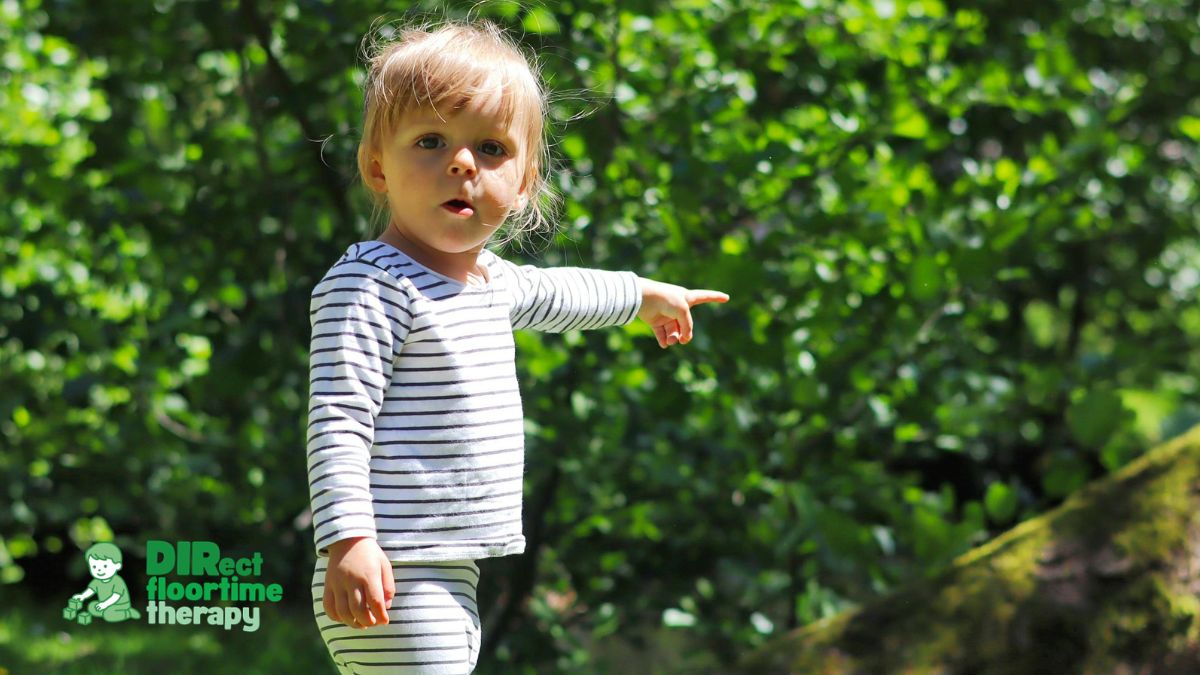
This is the milestone clinicians look for. Declarative pointing happens when a child points at a dog, a plane, or a “nothing” in the distance simply because they want you to see it too. The goal isn’t to get the object; the goal is to share the experience.
A landmark study by Baron-Cohen (1989) identified that the absence of protodeclarative pointing is one of the most reliable early screening signals for autism. It represents a “Theory of Mind”, the understanding that another person has a different perspective and might find something interesting.
The Foundation of Joint Attention
Joint attention is the “bridge” between two people. As researched by Mundy et al. (2007) in the Journal of Child Psychology and Psychiatry, joint attention is a pivotal predictor of later language development. If a child and parent aren’t looking at the same thing, the “labels” we give objects (e.g., “Look, a doggie!”) don’t stick. The brain needs that shared visual anchor to build a vocabulary.
Why Is Pointing Challenging for Autistic Children?
For many children in Jersey City or Middletown, the challenge isn’t physical, it’s neurological and social.
- Social Motivation: The “reward” for declarative pointing is a social smile or a shared laugh. For some autistic children, the internal “wiring” for social rewards is less intense than the “wiring” for physical rewards.
- Motor Planning (Praxis): Isolating a single finger and extending the arm while looking back and forth between a person and an object is a complex motor task.
- Visual Integration: Following another person’s point (gaze following) requires the brain to calculate the trajectory of a finger and shift focus rapidly.
In New Jersey home programs, we often find that when we lower the stress and increase the “wow factor” of the environment, these gestures begin to emerge naturally. Research by Kasari et al. (2006) confirms that structured joint attention interventions significantly improve both joint attention behaviors and spoken language in young children with autism.

The DIR/Floortime Approach: Building the “Internal Spark”
In traditional behavioral therapy, a child might be “prompted” to point to a picture of an apple to get a reward. In DIR/Floortime, we don’t want a “prompted” point; we want a spontaneous point born out of genuine excitement. Greenspan and Wieder’s research consistently emphasized that functional emotional development, not isolated skill drilling, is the engine of real communication growth.
Strategies to Foster Joint Attention in NJ Homes
- Follow the Lead: Instead of pointing at what you want the child to see, wait. Watch what they are looking at. If they are staring at a ceiling fan, get excited about the fan! “Wow! Spin, spin, spin!” By joining their focus, you are creating a “Circle of Communication.”
- The “Sensory Surprise”: Use things that are hard to ignore, such as bubbles, a light-up toy, or a sudden “pop” from a jack-in-the-box. When the child looks at the object in surprise, look at them and then point at the object. You are modeling the “share.”
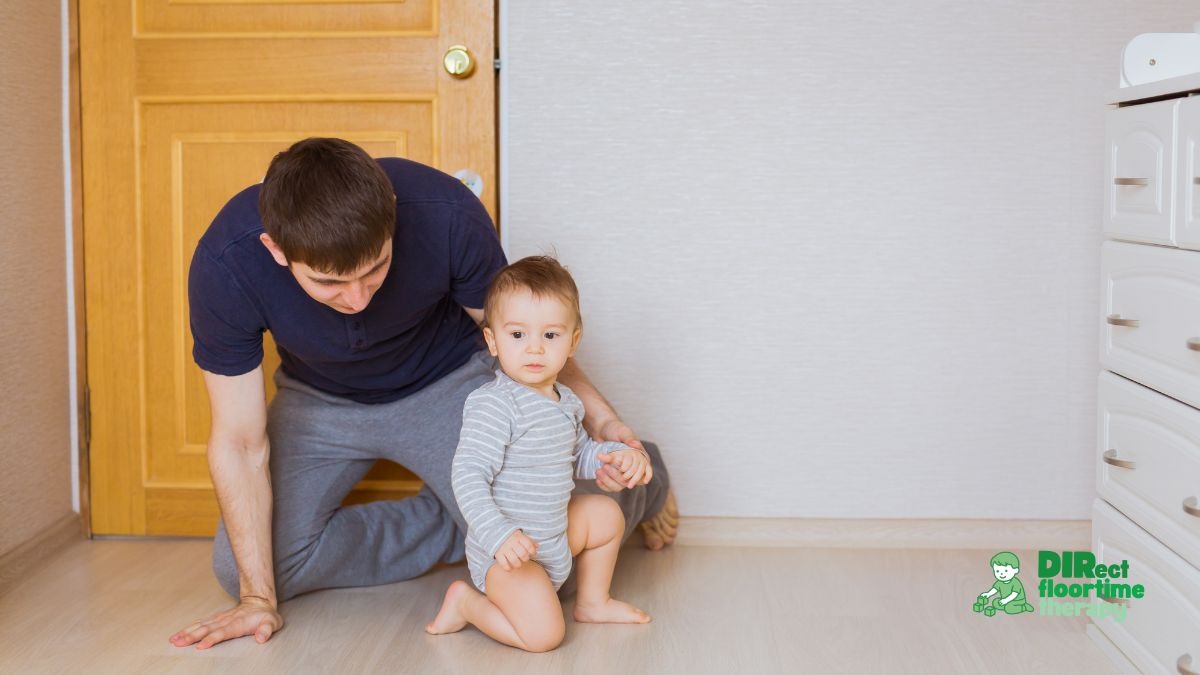
- Positioning for Connection: Get down on the floor. If you are standing up, you are too far away for the child to easily look between you and the object. Being at eye level makes joint attention physically easier for the child.
- Celebrate the “Glimmers”: Even a brief look toward you after they see something cool is a win. Acknowledge it: “Yeah! You saw the big truck!”
Parent Coaching: Becoming the “Most Interesting Thing”
At Direct Floortime, we coach parents in Ridgewood and Hoboken to become “affectively charged.” This doesn’t mean being loud or overwhelming; it means using your voice, your eyes, and your body to show the child that interacting with you is the best part of the activity. Studies on caregiver responsiveness show that warm, attuned adult responses consistently increase the frequency of social bids from children with ASD.
Strategies for Caregiver Engagement
- Use “Wait Time”: After something exciting happens, wait 5 to 10 seconds before you speak. Give the child the space to try to tell you about it, even if it’s just through a glance.
- Exaggerated Affect: Use “parentese,” that melodic, high-interest tone of voice. Research shows this helps the autistic brain filter your voice out of background noise and focus on the social connection.
- The “Invisible Point”: Before the finger comes out, use your eyes. Look at the object, then look at the child, then back at the object. This “gaze shifting” is the precursor to the physical point.
Integrating Joint Attention into NJ Life
Joint attention isn’t just for the living room floor; it’s for the Westfield farmers market, the Cape May beach, and the Liberty Science Center.
Advocacy and Early Intervention
- NJ Early Intervention (EI): If your child is under three and isn’t pointing, contact the New Jersey Early Intervention System. Specifically ask for a provider who understands “relationship-based” or “developmental” models like DIR.
- The IEP Connection: For older children, joint attention goals should be included in the “Social-Emotional” or “Communication” section of their IEP under IDEA. It shouldn’t just be about “pointing to a card,” but about “initiating shared attention with peers.”
Building the First “Social Sentence”
When your child finally points at a bird in a New Jersey backyard and looks at you to see if you see it too, it is more than just a gesture. It is a declaration of partnership. It says, “My world is interesting, and I want you to be in it with me.”
Research on DIR/Floortime by Pajareya and Nopmaneejumruslers (2011) consistently shows that focusing on these core social-emotional foundations leads to more robust, meaningful language development than simply memorizing words. By building the desire to share, we give the child a reason to eventually use their voice.
FAQs
What if my child points with their whole hand?
That’s a great start! “Whole-hand reaching” is the developmental precursor to the isolated index finger. Celebrate the intent to share!
My child points at things they want, but never at things just to “show” me. Is that okay?
This is common in autism. It means they have the “imperative” (requesting) part down, but we need to work on the “declarative” (sharing) part through Floortime play.
Is “hand-leading” a form of pointing?
Hand-leading (taking your hand to an object) is a functional communication, but it doesn’t involve “joint attention” in the same way because the child is often looking at the object, not at you. (See Blog 6).
Can older children learn to point?
Absolutely. We work with children of all ages in NJ to build these foundational social circles. Research confirms that joint attention skills can be developed at any age through relationship-based intervention. It’s never too late to build joint attention.
What are the best toys to encourage pointing?
Interactive toys where the child needs “help” to make something happen are great. Think wind-up toys, bubbles, or a jar that is hard to open. These create a “reason” for the child to look at you.
From “Pointing at Nothing” to Shared Everything
The journey of communication begins with a single look and a single finger. By slowing down and meeting your child where they are in their development, you can help them bridge the gap between their internal world and our shared social world.
At Direct Floortime, we are passionate about helping NJ families find these moments of connection. We believe that every child has something they want to share, we just have to learn how to listen to their “body language.” Whether you are in Voorhees or Teaneck, our relationship-based approach provides the scaffolding your child needs to flourish.
Contact Direct Floortime today to learn how our parent coaching can help you foster your child’s first “social sentences.”Pointing is the body’s first shared sentence. But for children who are not yet pointing, the voice is often developing its own communicative vocabulary, one that most NJ parents hear but do not yet know how to read.