

Key Points
- Development is not a race: The DIR/Floortime model prioritizes the Functional Emotional Developmental Milestones (FEDMs) over chronological age, ensuring an individual has a solid neurological foundation before being pushed toward complex, isolated skill accumulation.
- From Regulation to Reflection: The developmental journey moves systematically from basic physiological and sensory calm up to the highest levels of abstract thinking, multi-causal reasoning, and genuine emotional empathy.
- The “Whole Person” focus: Long-term success in the DIR model is never measured by “normalization” or masking behaviors. Instead, it is measured by the individual’s authentic capacity to lead an independent, self-determined life filled with reciprocal, meaningful relationships.
In a quiet suburb of Voorhees, New Jersey, a young man is preparing for his first day of community college. Ten years ago, his parents sat in a clinical evaluation room and were told he might never “function” or participate in a typical classroom setting. Back then, he was the highly dysregulated child who was constantly overwhelmed by the low-frequency hum of the kitchen refrigerator and completely unable to initiate or sustain a single, purposeful circle of communication.
His journey over the next decade did not involve compliance-based behavioral drilling, artificial token economies, or memorizing social scripts that masked his true processing needs. Instead, his progress was forged through thousands of hours of intentional DIR/Floortime interaction. It involved a dedicated mother who learned to look past the surface behavior, following his lead directly into his world of spinning wheels, and a collaborative multi-disciplinary team of New Jersey therapists who helped him find his authentic voice through his core passions.
Today, that young man is still autistic. He still utilizes noise-canceling headphones to navigate the intense sensory overload of a crowded campus cafeteria, and he still actively prefers a quiet, low-demand birthday gathering over a large social event.
However, he also knows exactly how to neuro-collaboratively advocate for his specific sensory modifications, how to form deep, reciprocal friendships based on shared intellectual interests, and how to dynamically solve complex emotional problems without collapsing into a state of nervous system burnout. He isn’t “cured” because autism is an intrinsic processing style, not a disease he is thoroughly, beautifully developed.
This article takes “The Long View.” We look at how the DIR/Floortime framework provides an expansive, lifelong developmental roadmap for families in New Jersey. We will explore the sophisticated higher milestones that emerge long after the early stages of early intervention, and we will discuss how a relationship-centered approach creates a future defined not by diagnostic deficits, but by the strength, agency, and autonomy of the human spirit.
The Pyramid of Development: Why the Foundation Matters
To truly comprehend the trajectory of long-term independence, we must view the DIR/Floortime milestones as a progressive, structural pyramid. In clinical hubs across Princeton, Livingston, and Cherry Hill, many traditional, compliance-focused therapies attempt to rigidly build the “tip” of the pyramid such as academic performance, rote memorization, and artificial social etiquette long before the child’s underlying neurological base is stable.
When you build the top of a structure without a foundation, the entire apparatus remains highly fragile, frequently culminating in what autistic self-advocates describe as severe adolescent burnout or psychological regression.
The Lower Milestones: The “Root” System of the Mind
The first three Functional Emotional Developmental Milestones (FEDMs) Shared Attention and Regulation, Engagement and Relating, and Two-Way Purposeful Emotional Communication serve as the indispensable root system of all human learning.
According to foundational research established by Dr. Stanley Greenspan and Dr. Serena Wieder in The Child with Special Needs (1998), these early milestones dictate how the central nervous system processes, organizes, and responds to environmental stimuli.
Without a secure establishment of these three capacities, higher-level cognitive learning cannot be effectively integrated. A child who is trapped in a chronic state of sensory fight-or-flight cannot accurately process the logical sequence of a mathematical equation, nor can they decipher the complex emotional nuance of a peer’s joke on a New Jersey school playground.
The Higher Milestones: Branching Out into Abstract Logic
As an autistic individual matures, the DIR/Floortime model systematically guides them past early engagement and into the sophisticated cognitive architecture of the upper milestones:
- Milestone 4: Behavioral Organization and Complex Social Problem Solving: This capacity involves the stringing together of multiple circles of communication to solve life’s practical problems. The individual moves past simple, one-word or one-gesture requests and enters the realm of complex relational negotiation. For example, a child dynamically reasoning: “If I complete this sensory-demanding homework task now, can we negotiate an extra ten minutes of my favorite game later?”
- Milestone 5: Creating Emotional Ideas (Symbolic Thinking): This represents the birth of true representational and symbolic capacity. The individual begins utilizing functional language, signs, or augmentative and alternative communication (AAC) systems to explicitly project their internal emotional states, abstract ideas, and creative thoughts into the shared world, rather than merely using language instrumentally to satisfy immediate physical demands.
- Milestone 6: Emotional Thinking and Logical Connections: This milestone marks the intersection of affect and logic. It is the capacity to build logical bridges between multiple abstract ideas. The individual begins to comprehend the concept of causality (“I feel anxious because this room is too bright”), compares distinct emotional concepts, and establishes a foundational sense of time, space, and reality.
Dr. Stanley Greenspan’s extensive longitudinal work emphasized that these higher emotional milestones are the literal “building blocks of intelligence” (Greenspan & Shanker, The First Idea, 2004). Affect or emotion is the architect that actually organizes cognitive thought. By focusing heavily on these milestones during play and daily life, we are not simply conditioning an individual to quietly sit still and passively look like they are behaving; we are actively supporting the neural wiring they need to independently think.
Moving Beyond “Compliance” to “Agency”
The primary philosophical and clinical divergence between the DIR/Floortime journey and traditional, compliance-driven behavioral interventions centers squarely on the concept of Human Agency.
In a strict behavioral modification framework, clinical success is almost universally quantified by Compliance: Did the child promptly emit the exact target behavior requested by the adult instructor? Did they suppress their intrinsic self-regulatory movements (stimming) to look neurotypical?
Conversely, in the DIR/Floortime model, long-term success is strictly measured by Initiative and Intentionality: Does the individual have a self-generated, intrinsic idea, and do they possess the robust relational and emotional tools required to confidently project that idea out into the surrounding world?
| Clinical Domain | Compliance-Based Models (e.g., Traditional ABA) | Relationship-Based Journey (DIR/Floortime) |
| Primary Goal | Behavior Reduction & Functional Skill Acquisition | Integration of Emotional, Sensory, & Cognitive Capacities |
| Definition of Success | External Compliance to Adult Prompts and Standards | Intrinsic Agency, Self-Advocacy, and Mutual Connection |
| Role of Stimming | Treated as non-functional behavior to be systematically extinguished | Understood as an essential neuro-physiological self-regulatory mechanism |
| Source of Motivation | External Reinforcers (Tokens, Edibles, Extrinsic Praise) | Internal Affective Motivation through Shared Meaningful Play |
For an autistic teenager navigating high school settings in Ridgewood, Hoboken, or Westfield, genuine personal agency is the vital dividing line between being a highly vulnerable, passive recipient of adult care and being a resilient, self-determined architect of their own life.
When a parent or therapist profoundly honors a three-year-old child’s natural developmental lead on the playroom floor, they are sending a profound, lasting neurological message to that child’s developing self-concept. They are teaching them that their internal ideas, choices, and boundaries have immense value.
When we honor their communication at age three, we are directly equipping them at age thirteen with the psychological resilience required to confidently say: “No, this environment is currently overloading my sensory system, and I need to step away to regulate.” This is the undeniable, real-world foundation of authentic self-advocacy.
The Role of the Family: You Are the True Developmental Expert
Throughout this comprehensive series, our primary clinical emphasis has consistently returned to one core practice: Parent Coaching.
The long-term DIR/Floortime journey is not a discrete therapeutic event that occurs for two isolated hours a week inside a clinical setting in Teaneck or Montclair. Rather, it is a continuous, lived lifestyle that effortlessly integrates into the daily rhythms of family life. It unfolds naturally across the dinner table, during long drives down the Garden State Parkway to the Jersey Shore, and within the quiet intimacy of the evening bedtime routine.
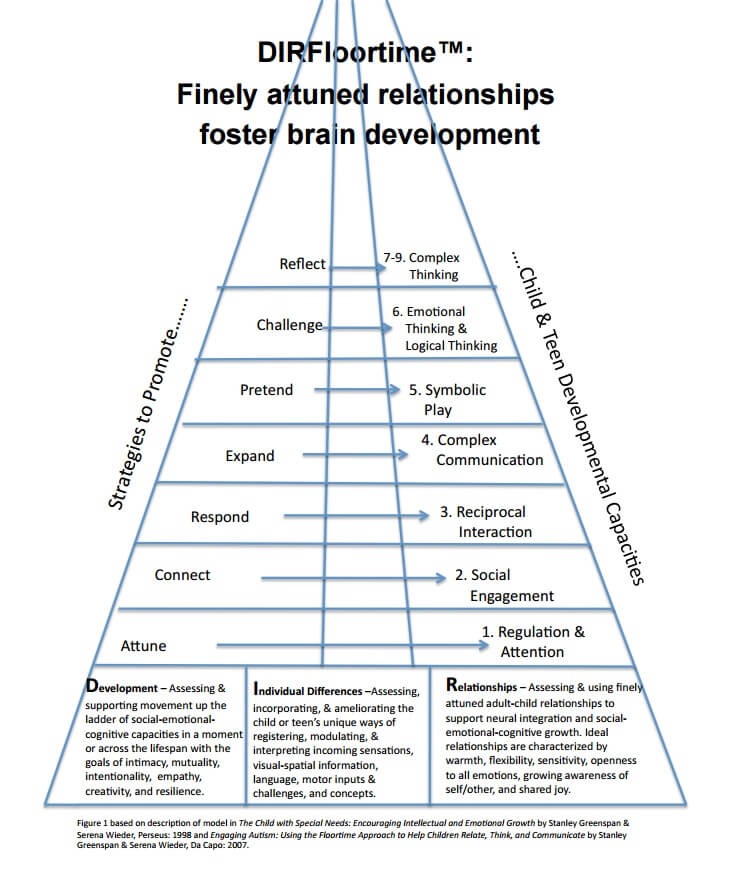
The Developmental Pyramid of the DIR Framework. Source: Affect Autism / A User’s Guide to the Developmental, Individual differences …
The Therapist as a Collaborative Guide
At Direct Floortime, we actively reject the outdated medical model that positions the therapist as an omniscient, detached authority figure who “fixes” a broken child behind closed doors. Instead, we function strictly as developmental consultants to the entire family system. We confidently provide the necessary developmental lens, but you the family bring the essential lived experience.
- Honoring Individual-Differences at Home: No clinical standardized manual can ever replace your innate, deep understanding of your child’s unique sensory profiling. You know precisely which acoustic frequencies trigger their startle responses, and you know how their proprioceptive system coordinates movement when they are calm versus when they are reaching their regulatory threshold.
- The Affective Relationship as the Engine: The “R” in DIR is not a soft, luxury concept, it is a rigorous neurobiological truth. Contemporary developmental neuroscience consistently confirms that the primary vehicle for neural plasticity and cortical reorganization is a secure, affectively charged relationship with a primary caregiver (Schore, Affect Regulation and the Origin of the Self, 2015). Your profound emotional bond with your child is the most potent tool in existence for their ongoing neurological growth.

Navigating the NJ School System, Transition Planning, and Beyond
As your child advances through the complex New Jersey public education system, the DIR/Floortime paradigm transforms from a simple playroom philosophy into a robust, legally defensible framework for systemic educational advocacy.
Transition Planning and the IEP Process
Under New Jersey special education administrative code, when an eligible student reaches the critical age of 14, the school district is legally required to formally initiate Transition Planning within the Individualized Education Program (IEP). This is the pivotal juncture where the cultivation of higher Functional Emotional Developmental Milestones transitions from a theoretical ideal to an absolute necessity for adult survival.
- Self-Regulation in the Workplace: Instead of allowing a school team to enforce artificial goals aimed at completely “extinguishing” an individual’s motor stims, a DIR-informed transition plan actively seeks out and structures post-secondary environments or workplaces that naturally accommodate their sensory profile. It reframes a stim from a behavioral problem into a legitimate, respected accommodation tool.
- Social Problem Solving in Higher Education: In community colleges or vocational programs across counties like Essex, Bergen, or Camden, success depends entirely on the student’s intrinsic ability to navigate what researchers term the “hidden curriculum” of adult environments. Floortime prepares them for this by prioritizing Milestone 4 capacities: teaching them to flexibly read social contexts, dynamically solve novel interpersonal conflicts, and confidently initiate requests for support without relying on an adult aide to prompt them.
By fiercely honoring the individual’s specific profile, we actively construct a supportive, functional “fit” between the unique person and their chosen environment, rather than damaging their mental health by forcing them to break their own autistic identity to fit a rigid, unyielding neurotypical mold.
The DIR/Floortime Community in New Jersey
It is critical for families to know that they are never alone on this long-term journey. New Jersey proudly boasts a deeply connected community of relationship-centered speech-language pathologists, occupational therapists, developmental educators, and passionate parent advocates.
Building Your Neuro-Affirming “Village”
- Parent Support and Resiliency Groups: Connecting with other neuro-affirming families in communities like Middletown, Toms River, or Jersey City provides an indispensable buffer against the systemic isolation that special education systems can often inflict. Celebrating those beautifully nuanced, non-traditional milestones such as the first time your child utilizes an elegant, logic-based argument to passionately debate why they should be allowed to stay up twenty minutes past their bedtime—is essential for sustaining parental emotional resilience.
- Interdisciplinary Team Collaboration: True relationship-centered progress accelerates exponentially when all professional disciplines are fully aligned. It is highly beneficial to ensure that your private speech therapist, your sensory-integration occupational therapist, and your school-based Child Study Team are all “rowing in the exact same developmental direction.” When the core principles of emotional safety, regulatory respect, and child-led interaction are held constant across the home, clinic, and school, the child’s nervous system can finally let down its guard and unlock its full learning potential.
From a Diagnosis to an Authentic, Life Well-Lived
Autism is fundamentally a distinct, vibrant, and entirely valid way of experiencing, processing, and being in the world. It undoubtedly presents real challenges within a society that is not traditionally built for sensory differences, but it also carries exquisite, deeply profound human strengths: intense intellectual focus, refreshing systemic honesty, and a beautifully unique perspective on things the neurotypical world routinely takes for granted.
The long-term DIR/Floortime journey is never about desperately mitigating diagnostic symptoms to appease a checklist. It is about systematically providing the precise relational soil your child requires to bloom into the most authentic, unapologetic, and emotionally secure version of themselves. It represents a permanent paradigm shift away from the anxious, deficit-based question of “What is wrong with my child?” and steps into the empowering, developmental clarity of asking: “Who is my child, and how can I design their environment to help them shine?”
Frequently Asked Questions
Is it ever too late to start a DIR/Floortime approach?
Absolutely not. While early childhood intervention takes beautiful advantage of heightened neuroplasticity, contemporary neurology confirms that the human brain remains fundamentally plastic, dynamic, and capable of structural growth throughout the entire lifespan (Doidge, The Brain’s Way of Healing, 2015).
The core principles of Floortime—respecting individual sensory profiles and building mutual emotional connection—are successfully utilized worldwide with autistic adolescents, young adults, and older individuals to build deep social-emotional capacity and relational safety.
What if my child struggles to reach the highest milestones?
Every single neurodevelopmental trajectory is completely unique. In the DIR/Floortime paradigm, success is strictly measured by individual, sustainable progress over time, never by achieving a rigid, generalized endpoint.
For a highly dysregulated child, moving securely from a fragmented Milestone 1 capacity up into a continuous, joyful, and shared Milestone 2 engagement represents a massive, life-altering victory that instantly elevates the daily quality of life for the entire family system. We celebrate growth, not conformity.
How do I accurately explain the difference between Floortime and traditional ABA to my family or school district?
The clearest way to frame the distinction is this:
Applied Behavior Analysis (ABA) focuses primarily on shaping what the child can externally produce; DIR/Floortime focuses on understanding how the child internally feels, processes, and thinks.
Traditional ABA alters behavior through extrinsic reinforcers like tokens or edible rewards. Floortime builds up the core neuro-developmental foundation from within, using the primary relationship to foster emotional security, self-regulation, and internal thought. When the internal foundation is healthy and stable, functional external behaviors naturally take care of themselves.
Does the Floortime model work effectively for non-speaking individuals?
Unequivocally, yes. Functional Emotional Developmental Milestone 3 (Two-Way Communication) does not require the motor production of spoken vocal speech.
Intentional glances, subtle shifts in posture, vocalizations, manual signs, and high-tech Augmentative and Alternative Communication (AAC) devices are all deeply respected, fully valid methods for closing robust circles of social communication. Floortime fiercely honors all communication forms, ensuring non-speaking individuals exercise full control over their interactions.
How can I practice Floortime when I am completely exhausted?
Do not put pressure on yourself to perform. It is far more effective to engage in twenty minutes of pure, uninterrupted Floortime—where your phone is put away, your own nervous system is calm, and you have zero clinical demands or teaching agendas—than to subject yourself and your child to hours of forced, strained interaction.
Prioritize consistency and emotional presence over mere clock duration. Your peace of mind matters just as much as your child’s regulation.
Your Journey Begins Here
We hope this deep look into relationship-based therapy has provided you with a clear, validating lens through which to view your child’s development. From the acute sensory storms of the skin and ears to the dizzying complexities of school cafeterias, your child’s actions have never been random or broken. They are always communicative.
At Direct Floortime, we are deeply honored to walk this lifelong path alongside families across the state of New Jersey. Whether you are navigating early intervention in Voorhees, advocating for transition plans in Maplewood, or anywhere in between, our mission remains unchanged: to help you look past the behavior, hear the heart beneath the hum, and deeply connect with the incredible person right in front of you.
Contact Direct Floortime today. Let us take the long view together, and begin building a future rooted in safety, understanding, and your child’s brightest, most authentic self.
“You have the tools. You have the heart. Now, get on the floor and play.”