
Key Points
- Siblings of autistic children face a genuinely different family experience from their peers. Research consistently shows elevated rates of anxiety, social difficulties, and emotional dysregulation in siblings, driven not by the autism itself but by the reorganisation of the family system around the child with the highest support needs.
- The sibling who appears to be coping well is frequently not coping as well as they appear. Children who are not the identified patient in the family often learn to minimise their own needs in order to reduce the burden on parents who are already stretched.
- DIR/Floortime’s relational framework is applicable across the whole family. The same principles of following the lead, co-regulation, and building circles of communication that support the autistic child can be applied to every sibling relationship and to the parent-child relationship with non-autistic children.
- New Jersey families who receive support for the whole family system, not only for the autistic child, show better long-term outcomes for every family member, including the autistic child themselves.
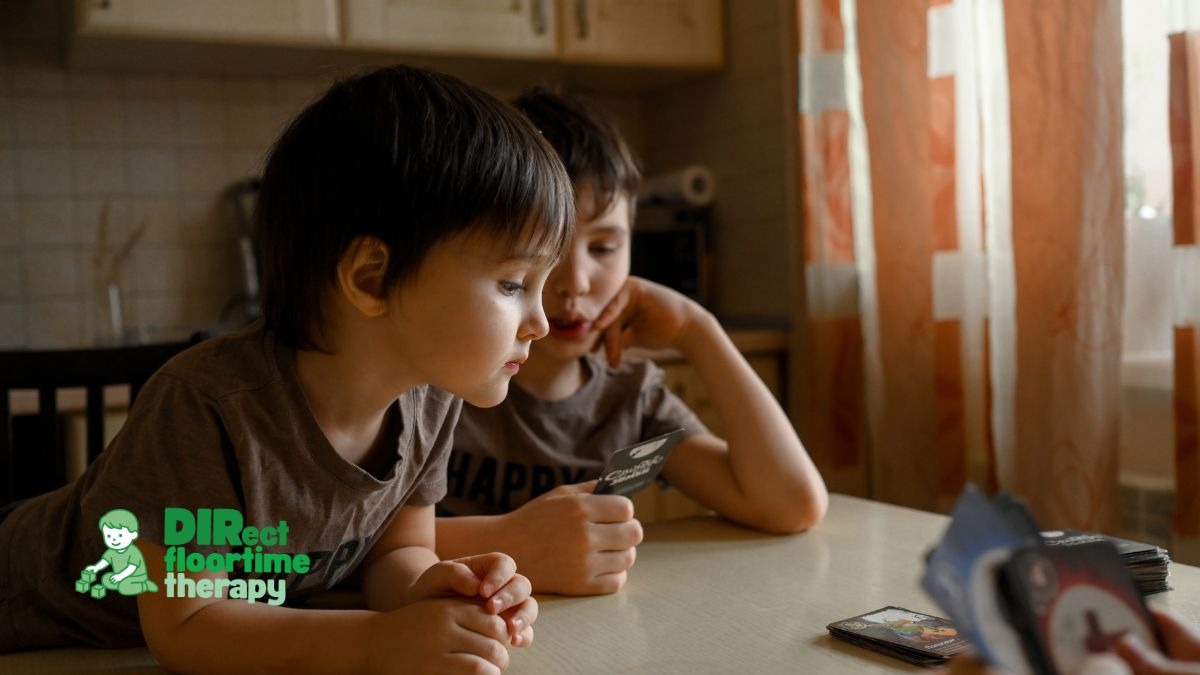
In a house in Westfield, New Jersey, there are two children. The elder is seven. She is the one the appointments are for, the one the school meetings are about, the one the IEP binders are written for, the one whose needs organise the family’s schedule. The younger is five. He is, by all external accounts, doing fine.
He has never been referred anywhere. No one has written a plan for him. When his parents ask how he is doing, he says ‘fine’ with the practiced confidence of a child who has learned that ‘fine’ is the answer that takes the shortest amount of time and requires the least from people who are already very busy.
This family is not failing. They are doing exactly what families do when one child requires an extraordinary level of attention and care: they reorganise. The child who is most urgent becomes the center of gravity—especially when evenings are consumed by after-school meltdowns and the shutdown pattern that leaves everyone depleted. The child who is less urgent orbits around that center, adjusting his trajectory silently, accommodating, minimising, getting on with it.
This reorganisation is not anyone’s fault. It is the predictable systemic response to the demands of raising an autistic child in New Jersey. And it is also a clinical situation that deserves attention. A 2022 review published in the Journal of Autism and Developmental Disorders by Shivers et al. found that siblings of autistic children experience elevated rates of anxiety, internalising behaviors, and social difficulties compared to children in families without a member with autism. The same review noted that the quality of the sibling relationship, specifically whether the autistic child and their sibling have a positive, connected relationship, is one of the most protective factors for both children’s wellbeing.
What the Research Tells Us About Siblings
The Emotional Landscape
Siblings of autistic children experience a complex and often contradictory emotional landscape. They may feel genuine love and protectiveness toward their autistic sibling alongside frustration, jealousy, embarrassment, and grief. A 2023 systematic review published in Clinical Child and Family Psychology Review by Quintero and McCloskey found that sibling adjustment was significantly influenced by the quality of parent-sibling interaction, the degree to which parents explained the autistic child’s behavior to the sibling, and the availability of individual time between the parent and the non-autistic sibling. In other words, what siblings need most is not a formal programme. It is parental attention and honest conversation.
The Silent Coper
One of the most consistently observed patterns in siblings of autistic children is what researchers have called the silent coper: the child who appears functional and untroubled but who is managing significant internal stress through suppression rather than expression. Silent copers frequently develop into adolescents and young adults who struggle to identify and express their own needs, having spent years subordinating those needs to the demands of the family system. They may present in therapy years later describing a childhood in which they felt invisible.
Identifying the silent coper requires attentive parental observation rather than simply accepting the self-reported ‘fine.’ Behavioral signals include unusual compliance, a reluctance to ask for things, a tendency to comfort parents rather than seek comfort from them, and social withdrawal that is not recognised as such because it does not cause problems.
The Protective Factors
The research is clear that sibling wellbeing is not determined by autism’s presence in the family but by the quality of the family relationships surrounding that presence. Families where parents actively explain autism to all children, where siblings have regular individual time with parents, where the sibling relationship is supported and celebrated, and where the non-autistic child’s needs are explicitly and consistently named and met, show significantly better sibling outcomes than families where the autistic child’s needs crowd out attention to everyone else.
The DIR/Floortime Framework Applied to the Whole Family
The principles of DIR/Floortime were developed for the autistic child, but they describe qualities of relationship and interaction that benefit every child in the family. Following the lead is as powerful with a five-year-old who says ‘fine’ as it is with his seven-year-old sister who has an IEP.
Individual Floortime with the Sibling
One of the most important practical recommendations we make to New Jersey families in parent coaching is to implement a brief daily Floortime session with the non-autistic sibling. Fifteen to twenty minutes of uninterrupted, child-led play with each parent, focused entirely on the sibling’s interests and emotional world, is not a luxury. It is a clinical necessity for a child who is growing up in a family where attention is chronically asymmetrically distributed.
This session does not need to be framed as therapy. It can simply be ‘your time’, a consistent daily ritual in which the sibling knows that for this period, they are the center of focus, their lead is being followed, and their world is what matters. Over time, this investment protects against the silent coper pattern and builds the relational security that every child needs to develop healthily.
Explaining Autism in Age-Appropriate Ways
Children who are given honest, age-appropriate explanations of their autistic sibling’s behavior consistently show better adjustment than those who are not. The explanation does not need to be comprehensive or clinical. For a five-year-old, ‘Your sister’s brain works differently from ours. Some things that are easy for you are hard for her, and some things she does that might seem strange are just her way of managing those hard things’ is enough to begin with.
As children grow older, the explanations can grow with them. What they need to know at five is different from what they need at ten, which is different from what they need at fifteen. The important thing is that the conversation is ongoing, honest, and treats the sibling as someone who deserves to understand rather than someone who needs to be protected from the truth.
Supporting the Sibling Relationship
The relationship between an autistic child and their sibling is one of the most underutilised resources in autism family support. When it is positive, it is protective for both children. It gives the autistic child a consistent, accepting peer relationship. It gives the sibling experience in relating across neurological difference that many adults never develop. And it gives the family a relationship that can be genuinely beautiful and mutually enriching.
Floortime can be used to support the sibling relationship directly by helping parents facilitate joint activities in which both children can participate from their own strengths. The autistic child follows their interest; the sibling follows their interest; the parent weaves those interests together into a shared activity that creates moments of genuine connection between them. These moments do not always happen, and they cannot be forced. But they can be made more likely.
Practical Strategies for NJ Families
- Name the sibling’s experience explicitly. At dinner, in the car, at bedtime, make it a regular practice to ask the non-autistic sibling how they are feeling, not about school, not about homework, but about being in this family. Give them language: ‘Sometimes it might feel like your sister gets a lot of attention. That makes sense. How does that feel for you?’
- Protect individual parent time for each child. Even fifteen minutes of daily one-on-one time between a parent and the sibling, where the autistic child’s needs are not the topic, is meaningful. Protect it as firmly as you protect any other appointment.
- Let the sibling be a child, not a helper. It is natural to involve a sibling in supporting their autistic brother or sister. But siblings are not mini-therapists or carers. Ensure the role they play in the autistic child’s life is bounded by their own developmental stage and not allowed to crowd out their own childhood.
- Connect siblings with peer support. New Jersey has several sibling support groups for children who have a brother or sister with autism or another developmental disability. Autism New Jersey maintains a directory of support resources including sibling programmes.
- Seek family support if the system is under sustained strain. If the family system has been significantly reorganised around the autistic child for an extended period, family therapy with a therapist who has experience in autism and neurodevelopmental disabilities can help recalibrate the system before the patterns become entrenched.
FAQs
My non-autistic child says they hate their sibling sometimes. Should I be worried?
No. Ambivalent feelings toward a sibling, including sometimes hating them, are normal in all sibling relationships. In the context of a family where the autistic sibling requires significantly more parental attention, these feelings are entirely understandable. What matters is that the child has a safe space to express those feelings without shame, and that the underlying needs those feelings are pointing toward are being heard and met.
How do I explain my autistic child’s meltdown to their younger sibling after it happens?
Keep it simple, honest, and immediately reassuring. (It also helps if parents understand the difference between an autistic meltdown and a behavioral tantrum, as nervous system overload requires a fundamentally different response than boundary testing.) To your other child, say: ‘Your brother was having a really hard time. His brain got overwhelmed and he lost control for a while. He is okay now, and so are you. That was scary to watch. How are you feeling?’ Then stop and listen. The listening matters more than the explanation.
My non-autistic child has started copying some of their sibling’s behaviors. Is that a concern?
Children imitate siblings, and this includes autistic siblings. Brief imitation is normal and not clinically concerning. If the imitation is sustained, involves significant disruption to the child’s own social functioning, or appears to be driven by distress rather than playful copying, it is worth mentioning to your child’s pediatrician. In most cases, it is simply a child doing what children do: taking in the world around them and trying it out.
Every Child in the Room Deserves to Be Seen
The five-year-old who says ‘fine’ is not invisible. He is seen by parents who love him. But love is not the same as attention, and attention is not the same as the specific, intentional, child-led connection that DIR/Floortime provides. Every child in a family, whether or not they have an IEP, whether or not they have a diagnosis, whether or not they are currently in crisis, deserves to be followed into their world with curiosity and warmth.
At Direct Floortime, we support New Jersey families as systems, not only as individual children. We believe that the health of the family relationship network is the foundation on which every child’s development rests, and that investing in that network benefits every member of the family.
Contact Direct Floortime today to learn how our family-centered parent coaching program can help every child in your family feel genuinely seen.