

- Understanding language and being able to act on it are two completely different neurological skills.
- Sensory overload, emotional dysregulation, and processing delays can block instruction-following even in highly verbal children.
- Repeating or raising your voice makes compliance harder, not easier, when the nervous system is already overwhelmed.
- DIR/Floortime builds the brain’s capacity to bridge understanding and action, one relationship-based interaction at a time.
- Parents in New Jersey and across the country are not alone in this confusion. It is one of the most common questions families bring to their first DIR session.
A Scene That Might Feel Familiar
It is a Tuesday afternoon in Livingston, New Jersey. A mother asks her seven-year-old son to put on his shoes. He does not move. She asks again. Still nothing. She wonders, as she has wondered a hundred times before, how he can quote entire episodes of his favourite show from memory yet seem completely unable to hear a simple, two-word instruction.
She is not imagining things. Her son is not being defiant. He genuinely heard her. He processed the words. And yet something between understanding and action broke down entirely.
This experience is shared by thousands of families across New Jersey, from Hoboken to Cherry Hill to Princeton. And the explanation is not a mystery. It lives in the way autistic brains process, prioritise, and respond to incoming information under conditions of stress, sensory input, or emotional overwhelm.
Understanding Is Not the Same as Processing
This is the central truth that changes everything for parents once they grasp it.
Language comprehension and motor execution are handled by different systems in the brain. A child can decode the meaning of “put your shoes on” perfectly and still be unable to carry out that action if another system is offline.
Think of it this way. Your child’s brain is like a building with many floors. The top floor handles language: hearing words, understanding their meaning, recognising what is being asked. But actually moving the body, sequencing steps, and shifting attention from one thing to another, those functions live on different floors entirely. And the elevator between them does not always work.
When a child is:
- Overstimulated by sounds, light, or tactile sensations in the room
- Emotionally activated by something that happened earlier in the day
- Locked into a preferred activity that is meeting a sensory or regulatory need
- Experiencing anxiety about a transition they sense is coming
- Fatigued from the enormous effort of navigating a neurotypical environment all day
…the elevator stops. The instruction lands on the top floor but cannot travel down to where action happens.
This Is Not a Willpower Problem
Many parents describe the moment they stop interpreting non-compliance as defiance as the moment their relationship with their child shifted completely. The child did not change. The parent’s understanding did. And that shift changed everything about how they responded.
When we understand that the gap is neurological rather than motivational, we stop repeating the instruction louder and start asking a different question entirely: what does my child need right now so the elevator can start working again?
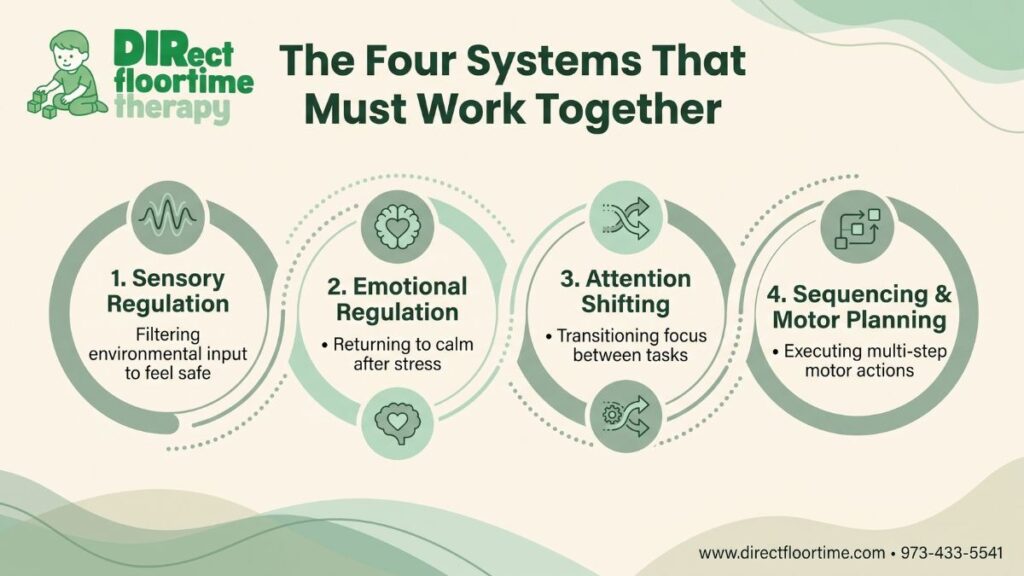
The Four Systems That Must Work Together
For a child to receive an instruction, understand it, and execute it, four neurological systems must be cooperating at the same time. In autistic children, one or more of these systems is frequently dysregulated, which creates the gap parents see and do not understand.
1. Sensory Regulation
Before the brain can attend to anything, it must feel safe. If the sensory environment is too loud, too bright, too close, or too unpredictable, the nervous system prioritises survival and filtering over social communication. A child sitting in a kitchen with a humming refrigerator, a TV in the next room, and fabric that scratches against their wrist may be using nearly all available cognitive bandwidth just to tolerate being in their own body.
Families in busy suburban areas of New Jersey, like those near Newark, Parsippany, or Woodbridge, often find that the sheer volume and unpredictability of daily life creates a background layer of sensory challenge their child never fully escapes from.
2. Emotional Regulation
Emotional regulation is the brain’s ability to return to a calm baseline after activation. Autistic children are frequently described by researchers as having a lower window of tolerance, meaning they reach dysregulation faster and take longer to return to baseline.
If your child had a difficult moment at school, was embarrassed, or felt excluded at lunch, they may still be emotionally activated hours later when you give them the afternoon instruction. They heard you. But their nervous system is still in a state that makes executive action extremely difficult.
3. Attention Shifting
Transitioning attention from one focus to another is a distinct executive function skill. Many autistic children have what is described as strong monotropic attention, meaning they go very deep into a single focus and experience genuine neurological difficulty shifting out of it.
When your child is absorbed in a train set or a particular YouTube video, asking them to shift to a different task is not a simple request. It is a significant neurological ask. Without the right support, the nervous system resists that shift, not to be stubborn, but because shifting is genuinely costly for that brain.
4. Sequencing and Motor Planning
“Put your shoes on” sounds like one instruction. Neurologically, it involves locating the shoes, orienting them correctly, managing laces or velcro, balancing on one foot, and sustaining attention through the whole sequence. For a child with motor planning challenges, any of these micro-steps can become the point where the chain breaks.
Why Repeating the Instruction Rarely Works
This is one of the hardest things for parents to accept, because repeating is the most natural response when someone does not comply with a request.
But when a child’s nervous system is dysregulated, repeating the same instruction increases the cognitive and emotional load on a system that is already at capacity. The child now has the original instruction plus the awareness that they have not done it plus the social pressure of a parent who is increasingly frustrated. That is more input on top of an already overwhelmed system.
What parents often observe in response is:
- The child moves further into their current activity, not away from it
- Stimming increases, which is actually the nervous system self-regulating
- Eye contact drops, as the child withdraws from the social demand
- Physical resistance or a meltdown begins to build
- Verbal responses become echolalic or completely stop
None of these responses indicate defiance. They are all signs of a nervous system that has hit its ceiling.
What Works Instead
The DIR/Floortime approach does not begin with the instruction. It begins with connection. Before asking your child to shift what they are doing, you enter their world first. You join them in the activity. You make yourself emotionally present and attuned. You reduce the demand on their system rather than adding to it.
From that foundation of connection, you can begin to gently expand the activity toward what needs to happen next. Instead of “put your shoes on,” a Floortime-informed parent might:
- Sit beside the child and observe what they are doing for thirty seconds without speaking
- Make a playful, low-pressure comment about the activity to signal safety
- Begin incorporating the transition as part of the play: “the train is going to the station, let’s get our shoes ready for the trip”
- Break the task into one micro-step at a time, staying present and regulated yourself
- Name the emotion if resistance appears: “it is hard to stop when you are really enjoying this”
This does not take longer. In practice, the connection-first approach is almost always faster than the repeat-and-escalate cycle, because it does not trigger the dysregulation cascade that makes the child unavailable to you entirely.
What the Research Says
The gap between language understanding and instruction-following in autistic children is well documented in developmental neuroscience.
Research published in journals including the Journal of Autism and Developmental Disorders has consistently found that executive function deficits, not language deficits, are the primary predictor of difficulty following multi-step instructions in autistic children with strong receptive language.
Stanley Greenspan, the psychiatrist who developed the DIR/Floortime model, identified what he called the six developmental milestones that a child must progress through to fully integrate emotion, attention, language, and action. Many autistic children have mastered some of these milestones but have gaps in others, particularly the milestones related to shared attention, purposeful communication, and complex emotional thinking. These gaps explain precisely why a child can understand words but cannot use them to guide behaviour under pressure.
The good news embedded in this research is that these milestones are not fixed. They are developmental. With consistent, relationship-based support, the brain builds the connections that were not built in the typical sequence.

DIR/Floortime: Building the Bridge
The DIR/Floortime model, developed by Dr. Stanley Greenspan and Dr. Serena Wieder, is built on a foundational understanding that emotional and relational development drives all other learning, including the ability to follow instructions under real-world conditions.
In a DIR/Floortime session, the therapist and parent are not trying to train specific behaviours. They are building the underlying capacity that makes those behaviours possible.
Here is what that looks like in practice at a DirectFloortime session in New Jersey:
Following the Child’s Lead
The session begins where the child is, literally and emotionally. The therapist enters the child’s activity and interest, not to redirect, but to be present. This builds the sense of emotional safety that allows the nervous system to settle.
Opening and Closing Circles of Communication
In DIR language, a circle is a back-and-forth exchange: the child initiates something, the adult responds, the child responds to the response. Each complete circle builds the child’s capacity for sustained, purposeful interaction. Over time, the number of circles a child can sustain increases, and with it, their capacity to attend to and act on social communication like instructions.
Expanding the Window of Tolerance
Through repeated experiences of co-regulation, where an attuned adult helps the child return to calm after activation, the child’s nervous system gradually builds a wider window of tolerance. Situations that once triggered shutdown or meltdown begin to feel more manageable. Transitions become less costly. Instructions become easier to receive.
Connecting Emotion to Action
DIR/Floortime specifically works on the connection between emotional experience and purposeful motor action. Greenspan called this the functional emotional development ladder. As a child climbs it, they develop the capacity to use their understanding of language to actually guide their body, which is precisely the bridge that breaks down in the shoe scenario above.
Frequently Asked Questions
My child’s school says he is non-compliant. What do I tell them?
Ask the school to distinguish between non-compliant and neurologically unavailable. Share information about sensory and emotional regulation with the child study team. If you are preparing for an upcoming academic transition, our week-by-week Floortime guide for starting school in New Jersey offers step-by-step strategies to build school-readiness routines before stepping into the classroom. A good IEP should include sensory supports and regulation strategies before any compliance-focused intervention.
My child follows instructions perfectly at home but not at school. Why?
This is extremely common and makes complete sense neurologically. The classroom involves constant noise, artificial lighting, and unpredictable social demands that quickly trigger sensory overload at school. By the time your child has spent hours filtering that input, their system has very little cognitive bandwidth left.What looks like a different child at school is the same child under a higher cognitive and sensory load.
Could this be related to auditory processing?
Yes, for some children. Auditory processing disorder can co-occur with autism and means the brain has difficulty organising and interpreting what the ears hear, even when hearing itself is intact. If you notice your child struggling specifically in noisy environments or when multiple sounds compete, raise this with your child’s speech-language pathologist or developmental paediatrician.
Should we use visual supports or picture schedules?
Absolutely, and DIR/Floortime is entirely compatible with visual supports. For many autistic children, seeing a visual sequence reduces the cognitive load of holding a sequence in working memory. At DirectFloortime, we help families integrate visual tools within a relationship-based framework, so the tools support connection rather than replace it.
My child is twelve and this is still happening. Is it too late?
It is never too late. The brain retains neuroplasticity throughout adolescence and well into adulthood. Families working with DirectFloortime in Montclair, Teaneck, and South Jersey have seen meaningful development in teenagers and young adults who had not previously received relationship-based therapy. The journey looks different at twelve than at four, but the capacity for growth is real.
How long before we see change?
Every child is different, but most families report noticing shifts in their child’s regulation and responsiveness within eight to twelve weeks of consistent DIR/Floortime practice at home and in sessions. The goal is not speed. The goal is building a genuine foundation. Once that foundation exists, everything else becomes easier.
Your Child Is Not Ignoring You
They are trying. Their brain is working as hard as it can within the constraints of how it is built. The gap between understanding and doing is not a character flaw, a discipline failure, or a sign that your child will not progress.
It is a developmental opportunity. And it is one that DIR/Floortime is specifically designed to address.
If your family is in New Jersey and you are ready to understand your child’s nervous system at a deeper level, and to learn how to become the co-regulating presence that makes everything easier for them, DirectFloortime is here.
Visit DirectFloortime to schedule a consultation or learn more about our DIR/Floortime services across New Jersey.