

Key Points
- Tactile defensiveness is a neurological condition where non-painful touch, like water or a hairbrush, is perceived by the brain as a physical threat or “attack.”
- The scalp’s high nerve density makes hairwashing one of the most intense sensory experiences for children with autism, often leading to severe dysregulation.
- DIR/Floortime strategies focus on giving the child agency and control over the bathing process, moving from forced compliance to shared sensory play.
For many families in Montclair, New Jersey, the end of the day is marked not by a peaceful bedtime routine, but by the sound of screaming coming from the bathroom. One local father recently shared that it took three adults to wash his daughter’s hair, one to hold the towel, one to keep her still, and one to pour the water. They felt like they were “surviving” every bath, leaving both the child and the parents emotionally depleted.
While it is common for toddlers to dislike getting water in their eyes, the reaction seen in many autistic children is qualitatively different. It isn’t a “tantrum”; it is a physiological crisis. When a child’s nervous system is wired to perceive the light touch of water or the pressure of a comb as physical pain, the bathroom becomes a place of trauma.
The DIR/Floortime approach looks beyond the “behavior” of screaming and investigates the Individual-difference of the child’s tactile system. By understanding how the skin and brain communicate, NJ parents can stop the “battle” and start building a bridge toward sensory comfort. This article explores the science of the scalp and provides practical, relationship-based strategies for a tear-free bath time.
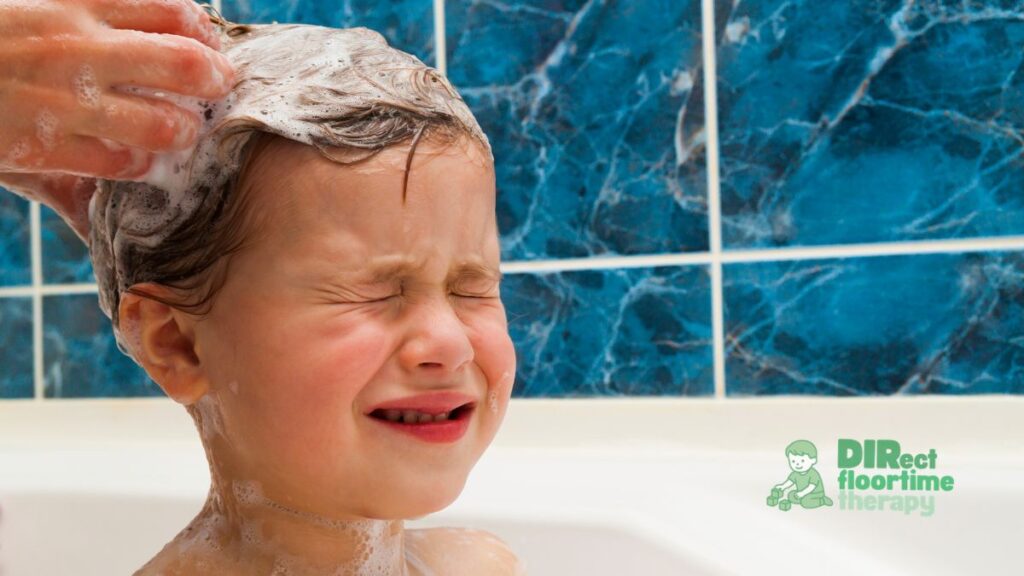
The Science of the Scalp: Why Touch Can Hurt
To understand why a child in Morristown or Cherry Hill reacts so strongly to a washcloth, we must look at the biology of the skin. The human scalp is one of the most sensitive parts of the body, packed with a high density of mechanoreceptors—nerve endings that transmit information about pressure, vibration, and touch to the brain.
Understanding Tactile Defensiveness
Tactile defensiveness is a subset of sensory processing disorder where the brain over-responds to touch. In a typical nervous system, the brain can distinguish between “protective” touch (a wasp landing on your arm) and “discriminative” touch (the feeling of your shirt).
For an autistic child, this “filter” is often broken. As described in the tactile defensiveness framework by Royeen & Lane (1991), the brain misinterprets neutral or even soothing touch as a signal of danger. When water hits the scalp, the brain triggers the “primitive” survival system.
Neural Connectivity and Autism
Research published in Nature Reviews Neuroscience (Marco et al., 2011) suggests that sensory processing differences in autism are linked to “atypical neural connectivity.” This means the pathways that carry tactile information to the brain are essentially “turned up to ten.” For a child with this neurological profile, a gentle spray from a showerhead doesn’t feel like water—it feels like needles.
Tactile Defensiveness vs. Tactile Discrimination
It is crucial for NJ parents and educators to distinguish between these two clinical concepts, as they require different support strategies.
- Tactile Defensiveness (The Emotional Reaction): This is the “fight-or-flight” response. The child feels a shirt tag or water on their head and their heart rate spikes, they sweat, and they may become aggressive or fearful. It is an emotional reaction to a physical sensation.
- Tactile Discrimination (The Physical Mapping): This is the brain’s ability to “map” where it is being touched. Many autistic children have poor tactile discrimination. If they cannot see where the water is coming from (because it is behind their head), the unpredictability of the sensation makes the defensiveness even worse.
In Livingston schools or home programs, we often see that when a child cannot “discriminate” or predict the touch, their “defensiveness” sky-rockets. This is why “sneaking up” on a child with a wet washcloth is the quickest way to break their trust.
Why the Bathroom is a “Perfect Storm” for Dysregulation
The bathroom is a sensory minefield. For a child in Jersey City or Middletown, bath time isn’t just about touch; it’s a combination of several overwhelming factors:
- Acoustics: Bathrooms are often tiled and echoey, magnifying the sound of running water or a bathroom fan (triggering the auditory sensitivities discussed in Blog 1).
- Temperature: The transition from warm air to wet skin, and then back to cold air, is a massive challenge for a child with thermoregulatory sensitivities.
- Visuals: Bright lights reflecting off white tiles and water can be visually overstimulating.
- Proprioception: Being naked and in water can make a child feel “unmoored” or unsure of where their body begins and ends in space.
When you add the “threat” of hairwashing to this list, it’s no wonder so many children “fall apart” before they even step into the tub.
The DIR/Floortime Approach: Moving from Power to Partnership
In a traditional behavioral model, the goal might be “completing the wash.” In DIR/Floortime, our goal is Social-Emotional Development. We want the child to feel safe, to communicate their needs, and to solve problems alongside us.
The Power of Agency
The antidote to fear is control. If a child feels they have the “power” to stop the water or choose the sponge, their nervous system remains much more regulated.
Practical Bathroom Strategies for NJ Parents
- The “Dry Run”: Don’t wait for “bath night” to work on these skills. Spend ten minutes of Floortime in the empty bathtub with toys. Let the child explore the space without the “threat” of water.
- Follow the Lead with Water Play: If your child loves pouring water into cups, lean into that. Use the cups to slowly pour water on their legs or hands—only as far as they are comfortable.
- Firm Pressure vs. Light Touch: Paradoxically, “light” touch (like a gentle spray) is often much more irritating than “deep” pressure. Using a heavy, soaked washcloth and pressing it firmly against the head is often much more calming.
- Visual and Predictable: Use a hand-held mirror so the child can see what you are doing to their hair. Use a “First/Then” visual schedule: “First we wash one arm, then we play with the ducks.”
Parent Coaching: Regulating the Regulator
At Direct Floortime, we often tell parents in Ridgewood and Hoboken: You are the most important piece of equipment in the bathroom.
If you are tensed up, bracing for the scream, your child will “co-regulate” to your stress. They sense your heart rate and your tight grip. To help your child feel safe, you must first find your own “green zone.”
Strategies for Caregiver Regulation
- Lower Your Expectations: If the hair only gets rinsed with water today and no soap, that is a win for the relationship. The relationship is always more important than the shampoo.
- Voice and Tone: Use a low, rhythmic, melodic voice. This taps into the child’s “social engagement system” and can help override the “threat” signal in the brain.
- Shared Problem Solving: If the child screams, stop. Acknowledge it: “That felt scary! The water was too fast. Let’s try it slow.” This builds the Fourth Milestone of DIR: Complex Communication and Shared Problem-Solving.
Integrating Sensory Success into the Daily Routine
The goal of family-based autism support in Lakewood or Teaneck is to make life easier for everyone. You don’t need a formal “therapy session” to do Floortime; you just need intentionality.
Making the Transition Easier
- Predictable Rituals: Use the same “bath song” or the same color towel every time. Predictability breeds safety.
- Sensory “Heavy Work” Before Bath: Engaging in jumping, pushing, or “wall push-ups” before bath time provides proprioceptive input that can “dampen” the tactile system, making it less reactive.
- Post-Bath Recovery: Have a warm, weighted robe or a “burrito wrap” in a towel ready immediately after the bath to provide a sense of security.
Building Trust Through the “Small Circles”
Every time you stop pouring water because your child asked you to, you are completing a circle of communication. You are teaching them that their voice has power and that you are a safe partner. This trust is the foundation for all future learning.
Research on parent-implemented Floortime shows that when parents focus on the relationship during daily routines, children show greater gains in social communication than when they are simply “drilled” on skills.
By shifting the bathroom from a “battleground” to a “playroom,” you aren’t just getting hair clean—you are helping your child’s nervous system learn that the world is a safe place to explore.
FAQs
How often should I wash my child’s hair if they are terrified? As little as possible while you are building trust. Focus on “mini-wins” with just a wet cloth until the child is no longer in a state of “fight-or-flight.”
My child loves water but hates the bathtub. Why? It could be the “confinement” of the tub or the “echo” of the room. Try a “sponge bath” in the kitchen or a shallow plastic pool outside to see if the environment is the trigger.
Are there specific products that help with tactile defensiveness? Yes. “Shampoo shields” that keep water out of the face, “seamless” washcloths, and scent-free soaps are often very helpful for children in NJ.
Can a weighted blanket help after the bath? Absolutely. Many children find the “unprotected” feeling of being wet and cold very dysregulating. A weighted blanket provides the “deep pressure” needed to reset the nervous system.
Is this something I should mention in an IEP? If your child’s sensory defensiveness is affecting their ability to participate in school activities (like swimming or messy play), it should definitely be included in their sensory profile for the school.
From Bath Struggles to Sensory Confidence
The journey from “screaming in the tub” to “splashing in the water” doesn’t happen overnight. It is a process of small, intentional steps built on the foundation of DIR/Floortime.
At Direct Floortime, we are here to support NJ families in every room of the house. We believe that every “meltdown” is a message, and every “bath” is an opportunity for connection. Whether you are in Voorhees or Maplewood, we provide the coaching you need to navigate these sensory challenges with confidence.
Contact Direct Floortime today to learn more about our parent coaching and how we can help your child feel comfortable in their own skin.