
Why My Child Screams During Hairwashing: Scalp Sensitivity, Water Temperature, and Tactile Defensiveness in the Bathroom

Learn how to transform the “bathroom battle” into a moment of trust and sensory success by understanding the clinical roots of tactile defensiveness in autistic children.
Why Changing Shoes Before Leaving the HouseTakes 45 Minutes: Transitions, Rigidity, and Autism inNJ Homes
Aggression in autism is almost never random and almost never about the apparent trigger: When a child with autism hits, bites, or scratches, they are communicating something that their current language system cannot express any other way. The target, the timing, the intensity, and the specific form of the aggression all carry information that a trained clinician can read. The first job is not to stop the behavior. It is to understand what it is saying.
When Your Child Hits, Bites, or Scratches: Understanding Aggression in Autism as Communication, Not Behavior
Aggression in autism is almost never random and almost never about the apparent trigger: When a child with autism hits, bites, or scratches, they are communicating something that their current language system cannot express any other way. The target, the timing, the intensity, and the specific form of the aggression all carry information that a trained clinician can read. The first job is not to stop the behavior. It is to understand what it is saying.
Why My Child Will Only Eat 6 Foods: Autism, Food Selectivity, and the Sensory Science Behind the Beige Diet in NJ

The first shift was for Maya, age seven, autistic, and eating exactly: plain pasta with no sauce, twelve Ritz crackers in a specific pattern, three brand-specific chicken nuggets (purchased only at a specific ShopRite), and apple juice in a specific cup.
3 AM in New Jersey: Why Children with Autism Cannot Sleep and the Sensory and Regulatory Reasons Behind It
If you are the parent of an autistic child in New Jersey who hasn’t slept through the night in years, you have likely heard the same well-intentioned but useless advice: “You just need a more consistent bedtime routine.” Or worse: “You need to be stricter about staying in bed.”
The Grocery Store Meltdown: Why Supermarkets Are Neurological Nightmares for Children with Autism and How NJ Families Can Change That
Shame is not the answer to public meltdowns. Parents are not failing, and children are not misbehaving. What is happening is a real neurological response. With the right framework, parents can understand the cause and build better outcomes through support, not control.
Why My Child Will Only Eat 6 Foods: Autism, FoodSelectivity, and the Sensory Science Behind the BeigeDiet in NJ

When a child with autism refuses to eat anything outside a small rotation of familiar foods, they are not being stubborn, manipulative, or poorly parented. Their nervous system is responding to real sensory discomfort, sometimes even distress triggered by taste, texture, smell, temperature, or appearance. Avoiding those foods is not defiance. It’s protection.
Why Your Child Lines Up Toys, Spins Wheels, and Sorts by Color: How DIR/Floortime Turns These Rituals Into Doorways
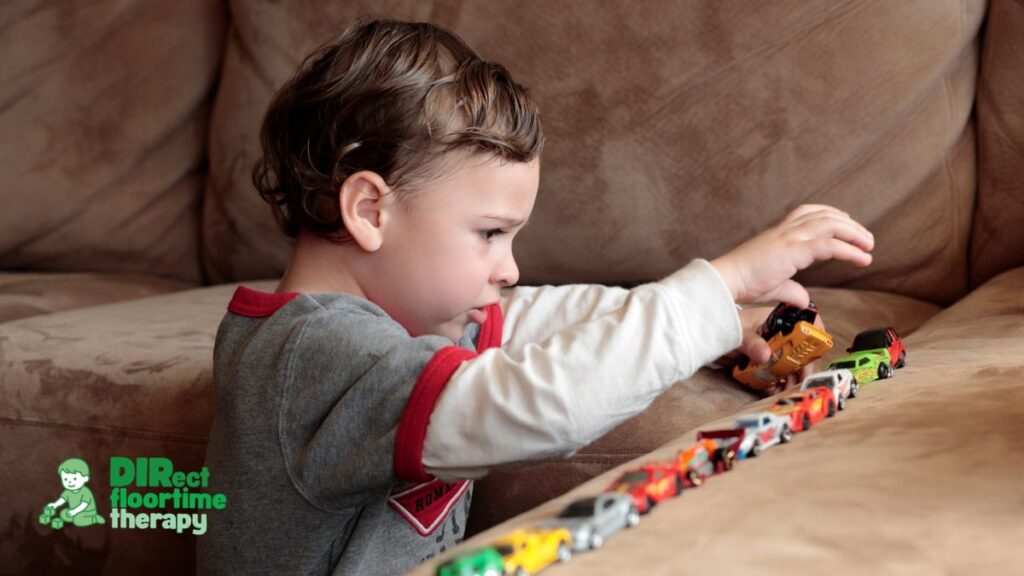
In the DIR/Floortime model, these rituals are not viewed as obstacles to development; they are the current leading edge of it. A child’s lining behavior or color-sorting system is the place where their nervous system is currently most organized and engaged. By entering that world rather than redirecting away from it, we open the door to everything beyond.
My Child Won’t Look at Me: What Eye Contact Really Means in Autism and Why Forcing It Makes Things Worse

Paulette’s mother-in-law was visiting from Paterson when it happened. They were in the kitchen of the family’s home in Bergen County, and her four-year-old son Marcus was at the table with his trains. He had been arranging them for twenty minutes with the concentration of a jeweler. The grandmother leaned over, took Marcus’s chin gently in her hand, and turned his face toward hers.
When Your Child Repeats Lines from TV Instead of Talking to You

The gap between what a child can recite and what they can say is a clinical signal, not a character flaw. A child who quotes entire Bluey episodes but cannot answer “Are you hungry?” is showing a therapist exactly where their language system is organized and exactly where to begin.